

Chinese President Xi meets former Taiwan leader Ma Ying-jeou on pro-unification visit
Advertisement
Read this article for free:
or
Already have an account? Log in here »
To continue reading, please subscribe:

Digital Subscription
One year of digital access for only $205*
- Enjoy unlimited reading on winnipegfreepress.com
- Read the E-Edition, our digital replica newspaper
- Access News Break, our award-winning app
- Play interactive puzzles
*First annual payment billed as $205.00 + GST for one year. This annual subscription will automatically renew at $233.00 + GST every 52 weeks (10% off the regular annual price of $259.35). Offer available to new and qualified returning subscribers only. Cancel any time.
To continue reading, please subscribe:
Add Free Press access to your Brandon Sun subscription for only an additional
$1 for the first 4 weeks*
- Enjoy unlimited reading on winnipegfreepress.com
- Read the E-Edition, our digital replica newspaper
- Access News Break, our award-winning app
- Play interactive puzzles
*Your next Brandon Sun subscription payment will increase by $1.00 and you will be charged $17.95 plus GST for four weeks. After four weeks, your payment will increase to $24.95 plus GST every four weeks.
Read unlimited articles for free today:
or
Already have an account? Log in here »
Hey there, time traveller!
This article was published 10/04/2024 (890 days ago), so information in it may no longer be current.
BEIJING (AP) — Chinese President Xi Jinping met with former Taiwanese President Ma Ying-jeou in Beijing Wednesday in a bid to promote unification between the sides that separated amid civil war in 1949.
Ma stepped down as president in 2016 and was largely excluded from the opposition Nationalist Party’s failed campaign to retake the presidency in January, a concession to the electorate’s strong opposition to political unification with China and politicians seen as willing to compromise Taiwan’s security.
He follows a long line of politicians from the Nationalists, also known as the KMT, who have been invited to China by its authoritarian one-party government and given VIP treatment on visits around the country.
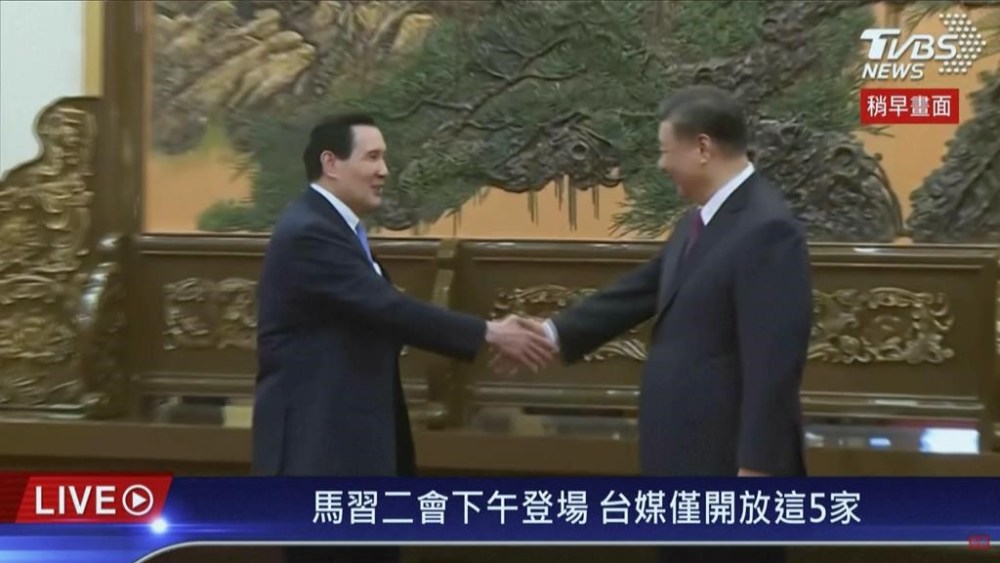
China claims Taiwan as its own territory, to be annexed by force if necessary. Beijing sends navy ships and warplanes around the island on a daily basis in hopes of wearing down Taiwan’s defensives and intimidating the population.
“The people on both sides of the Taiwan Strait are all Chinese. There is no dispute that cannot be resolved, there is no problem that cannot be discussed, and no force can separate us,” Xi told Ma.
“Differences in systems cannot change the fact that both sides of the Taiwan Straits belong to the same country and nation,” he added.
Ma responded that a new war between the sides would be “an unbearable burden for the Chinese nation.”
“The Chinese people on both sides of the Taiwan Strait will definitely have enough wisdom to handle cross-Strait disputes peacefully and avoid conflicts,” Ma said.
Independence leaning president-elect Lai Ching-te of the Democratic Progressive Party won the January election handily and his vice president-elect Bi-khim Hsiao has been visiting nations friendly to Taiwan in Europe and elsewhere ahead of taking office.
Ma’s 11-day trip, ostensibly at the head of a student delegation, underlines continued interactions in education, business and culture despite Beijing’s threat to use military force against the self-governing island democracy to achieve unification.
Toward the end of his second term in 2015, Ma held a historic meeting with Xi in Singapore, which has close contacts with both sides. The meeting — the first between the leaders of China and Taiwan in more than half a century — produced few tangible outcomes, and Ma’s Nationalist Party lost the next presidential election to Tsai Ing-wen of the DPP.
Lai Ching-te, currently vice president, is despised by Beijing for his opposition to unification. The Nationalists recovered a narrow majority in the legislature but their influence on foreign policy and other national issues remains limited.
Taiwan has been boosting military relations with allies such as the U.S. and Japan while maintaining close economic ties with the Chinese mainland.