

A strong earthquake in Japan leaves 9 people with minor injuries. But there was no tsunami danger
Advertisement
Read this article for free:
or
Already have an account? Log in here »
To continue reading, please subscribe:

Digital Subscription
One year of digital access for only $205*
- Enjoy unlimited reading on winnipegfreepress.com
- Read the E-Edition, our digital replica newspaper
- Access News Break, our award-winning app
- Play interactive puzzles
*First annual payment billed as $205.00 + GST for one year. This annual subscription will automatically renew at $233.00 + GST every 52 weeks (10% off the regular annual price of $259.35). Offer available to new and qualified returning subscribers only. Cancel any time.
To continue reading, please subscribe:
Add Free Press access to your Brandon Sun subscription for only an additional
$1 for the first 4 weeks*
- Enjoy unlimited reading on winnipegfreepress.com
- Read the E-Edition, our digital replica newspaper
- Access News Break, our award-winning app
- Play interactive puzzles
*Your next Brandon Sun subscription payment will increase by $1.00 and you will be charged $17.95 plus GST for four weeks. After four weeks, your payment will increase to $24.95 plus GST every four weeks.
Read unlimited articles for free today:
or
Already have an account? Log in here »
Hey there, time traveller!
This article was published 18/04/2024 (897 days ago), so information in it may no longer be current.
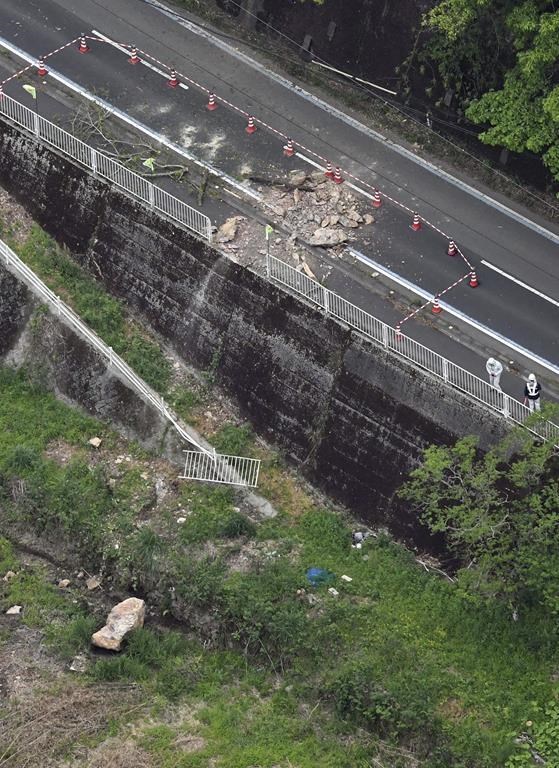
TOKYO (AP) — A strong earthquake that struck southwestern Japan left nine people with minor injuries and caused damage such as burst water pipes and small landslides, authorities said Thursday. But there was no danger of a tsunami.
The magnitude 6.6 temblor late Wednesday was centered just off the western coast of the southwestern main island of Shikoku, in an area called the Bungo Channel, a strait separating Shikoku and the southern main island of Kyushu.
The quake occurred about 50 kilometers (30 miles) below the sea’s surface and posed no danger of a tsunami, the Japanese Meteorological Agency said.
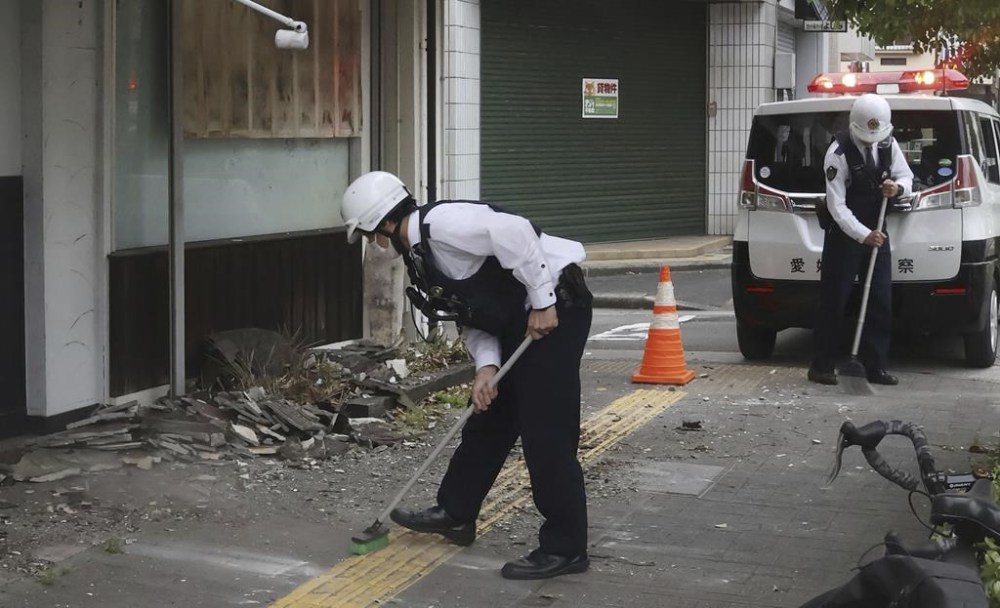
The Fire and Disaster Management Agency said Thursday that six in Ehime prefecture, one in neighboring Kochi and two others in Oita on Kyushu island suffered minor injuries, mostly from falling at home.
Water pipes were ruptured at a number of locations in Sukumo City in Kochi prefecture, and grave stones collapsed at a Buddhist temple in Ainan town in Ehime prefecture, according to local media reports. Falling rooftiles were also reported.
The Nuclear Regulation Authority said that no abnormalities were reported from four reactors operating at three nuclear power plants in Shikoku and Kyushu.
As part of the Pacific “ring of fire,” Japan is one of the world’s most earthquake-prone areas. A magnitude 9.0 earthquake and subsequent tsunami in March 2011 devastated large areas along Japan’s northeastern coast, killing nearly 20,000 people and triggering the Fukushima Daiichi nuclear meltdowns. On Jan. 1, a magnitude 7.6 quake struck the north-central region of Noto and left 241 people dead.
___
This story corrects the spelling of the last name in the byline to Yamaguchi, not Yamaguchia, and to show that the number of injured in Kochi was one, not two.