

Columbia’s president, no stranger to complex challenges, walks tightrope on student protests
Advertisement
Read this article for free:
or
Already have an account? Log in here »
To continue reading, please subscribe:

Digital Subscription
One year of digital access for only $205*
- Enjoy unlimited reading on winnipegfreepress.com
- Read the E-Edition, our digital replica newspaper
- Access News Break, our award-winning app
- Play interactive puzzles
*First annual payment billed as $205.00 + GST for one year. This annual subscription will automatically renew at $233.00 + GST every 52 weeks (10% off the regular annual price of $259.35). Offer available to new and qualified returning subscribers only. Cancel any time.
To continue reading, please subscribe:
Add Free Press access to your Brandon Sun subscription for only an additional
$1 for the first 4 weeks*
- Enjoy unlimited reading on winnipegfreepress.com
- Read the E-Edition, our digital replica newspaper
- Access News Break, our award-winning app
- Play interactive puzzles
*Your next Brandon Sun subscription payment will increase by $1.00 and you will be charged $17.95 plus GST for four weeks. After four weeks, your payment will increase to $24.95 plus GST every four weeks.
Read unlimited articles for free today:
or
Already have an account? Log in here »
Hey there, time traveller!
This article was published 24/04/2024 (873 days ago), so information in it may no longer be current.
Columbia University president Minouche Shafik is no stranger to navigating complex international issues, having worked at some of the world’s most prominent global financial institutions.
At the World Bank and the International Monetary Fund, for example, she tackled both the European debt crisis and the Arab Spring.
It remains to be seen, however, if her experience with world conflicts has sufficiently equipped her to navigate the thorny challenges she faces amid ongoing student protests over the Israel-Hamas war.
“The reason you protest is to call attention to an issue,” said Ted Mitchell, president of the American Council on Education. “And you do that by challenging the normal order of things. It’s not a problem to be solved, but a tension to be managed.”
The task before her — to balance the demands of students, faculty and politicians — is also a reflection of just how complex governing universities has become in this day and age, when college footprints have grown ever larger, observers say. And it echoes the experience of a growing number of university leaders who, like Shafik, come from nonacademic backgrounds.
Thus far, it seems no one is happy with Shafik’s responses to the protests that began last week at Columbia.
Her decision to ask New York City police to intervene, resulting in the arrests of more than 100 protesters, only served to motivate the demonstrators, who quickly regrouped — and to inspire other students at campuses around the country.
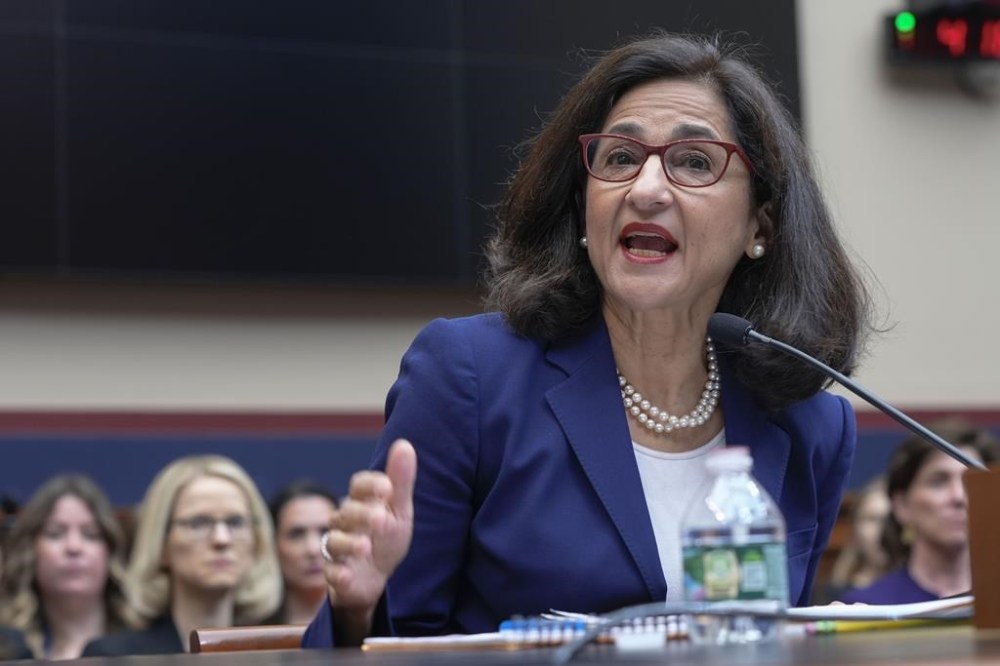
Shafik initially appeared to have weathered the grilling by Republican lawmakers who have expressed growing concern about antisemitism on college campuses. She struck a more conciliatory tone before the House Education and Workforce Committee than the presidents of Harvard and the University of Pennsylvania, who were forced to step down after they were widely criticized for emphasizing free speech protections during their appearances before the same panel.
But Columbia’s chapter of the American Association of University Professors responded angrily to her congressional testimony, accusing her of capitulating to demands from lawmakers who they said made “slanderous assaults” on faculty and students. The AAUP submitted a motion of censure against Shafik. While it does not call for her resignation and is largely symbolic, it reflects the intensity of anger on campus toward her actions.
And now lawmakers are piling on again.
Republicans in New York’s delegation to the U.S. House on Monday wrote a letter urging Shafik to resign, saying she had failed to provide a safe learning environment in recent days as “anarchy has engulfed the campus.” During a visit to Columbia on Wednesday, Republican House Speaker Mike Johnson called for Shafik to resign “if she cannot bring order to this chaos.”
In a written statement to Congress preceding her in-person testimony, Shafik described a childhood in Egypt and then in the Southeast as schools were desegregating, saying those experiences gave her the skills necessary “to engage with and learn from people with a wide array of backgrounds and experience overcoming discrimination firsthand.”
But that may not be enough; Shafik’s position at Columbia also appears to require a fair amount of political finesse.
It’s not only that she must try to balance principles of free speech and academic freedom with creating a safe environment on campus. Like other college presidents these days, she also is charged with balancing the pillars of shared governance between the faculty, the board and the administration, said Katherine Cho, assistant professor of higher education at Loyola University Chicago.
“Oftentimes, all three groups have different ideas of what the college is and how well the president is doing their job … and the president might have a different definition of how they think that they’re successful,” Cho said.
When she arrived at Columbia last year, Shafik was the first woman to take on the role of president and one of several women newly appointed to take the reins at Ivy League institutions.
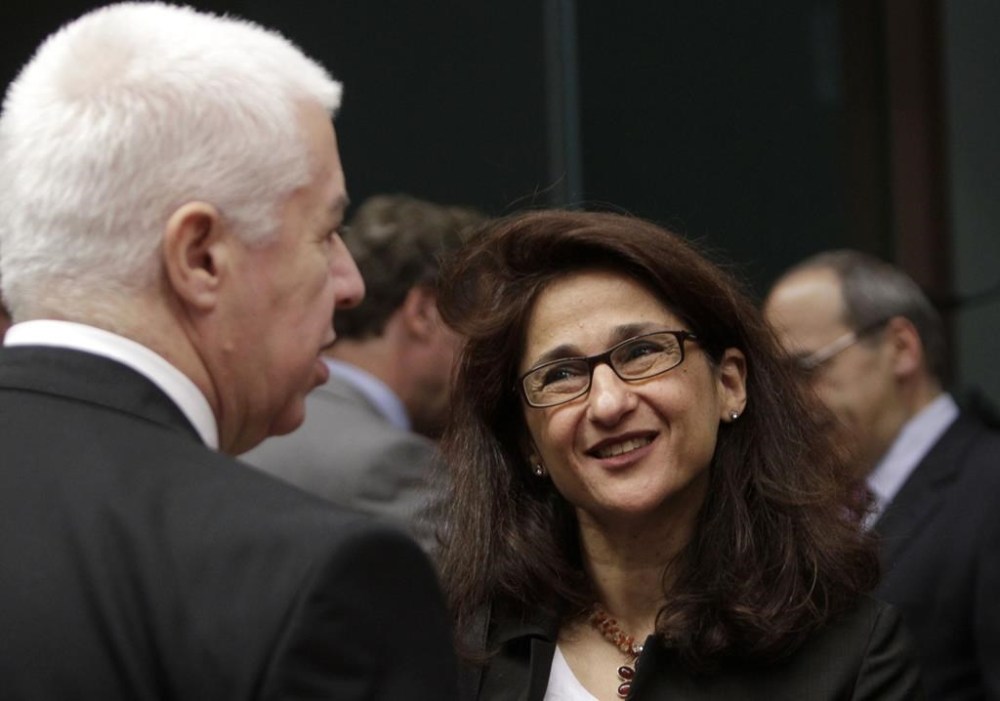
Her experience in finance, rather than academia, puts her in line with more and more university leaders who come from nonfaculty backgrounds.
After obtaining her master’s degree at the London School of Economics, she went on to earn a doctorate at Oxford University. She rose through the ranks at the World Bank, eventually becoming the bank’s youngest-ever vice president.
Shafik also worked at the United Kingdom’s Department for International Development, followed by stints at the International Monetary Fund and the Bank of England, before taking over the leadership of the London School of Economics.
At the time of Shafik’s appointment, Columbia Board of Trustees chair Jonathan Lavine described her as a leader who deeply understood “the academy and the world beyond it.”
“What set Minouche apart as a candidate,” Lavine said in a statement, “is her unshakable confidence in the vital role institutions of higher education can and must play in solving the world’s most complex problems.”
Shafik also framed her international experience as foundational to her leadership of Columbia in her testimony to lawmakers.
“These experiences have shown me that education is the single most powerful tool to make our communities and our world better,” she said in her written statement. “And, amid these challenging times, I believe it is important for the Columbia community to realize the powerful impact of our core educational mission.”
___
The Associated Press’ education coverage receives financial support from multiple private foundations. AP is solely responsible for all content. Find AP’s standards for working with philanthropies, a list of supporters and funded coverage areas at AP.org.
Related Articles
Columbia protesters say they're at an impasse with administrators and will continue anti-war camp
Advertisement Advertise With Us
Advertisement Advertise With Us