

First round of North Macedonia’s presidential polls shows big shift towards center-right opposition
Advertisement
Read this article for free:
or
Already have an account? Log in here »
To continue reading, please subscribe:

Digital Subscription
One year of digital access for only $205*
- Enjoy unlimited reading on winnipegfreepress.com
- Read the E-Edition, our digital replica newspaper
- Access News Break, our award-winning app
- Play interactive puzzles
*First annual payment billed as $205.00 + GST for one year. This annual subscription will automatically renew at $233.00 + GST every 52 weeks (10% off the regular annual price of $259.35). Offer available to new and qualified returning subscribers only. Cancel any time.
To continue reading, please subscribe:
Add Free Press access to your Brandon Sun subscription for only an additional
$1 for the first 4 weeks*
- Enjoy unlimited reading on winnipegfreepress.com
- Read the E-Edition, our digital replica newspaper
- Access News Break, our award-winning app
- Play interactive puzzles
*Your next Brandon Sun subscription payment will increase by $1.00 and you will be charged $17.95 plus GST for four weeks. After four weeks, your payment will increase to $24.95 plus GST every four weeks.
Read unlimited articles for free today:
or
Already have an account? Log in here »
Hey there, time traveller!
This article was published 25/04/2024 (888 days ago), so information in it may no longer be current.
SKOPJE, North Macedonia (AP) — Near-complete results from North Macedonia’s first round of presidential polls confirmed on Thursday a strong shift towards a candidate backed by the country’s center-right opposition.
It was the seventh such election in the small landlocked Balkan country since it gained independence from the former Yugoslavia in 1991.
With 99.85% of Wednesday’s ballots counted, the State Electoral Commission said Gordana Siljanovska Davkova had 40.08% — that’s about double the votes of incumbent President Stevo Pendarovski, who got 19.93%.
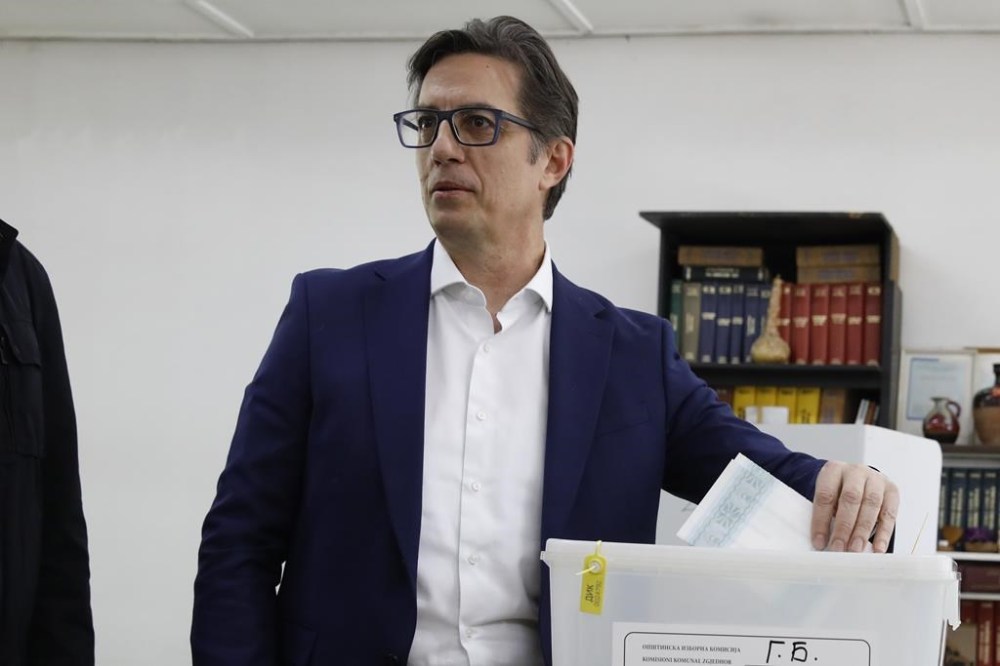
Siljanovska Davkova and Pendarovski, who is backed by the governing social democrats, will face off in a second round on May 8, when the country will also hold parliamentary elections.
The presidential election is largely seen as a barometer for the parliamentary vote. Political analyst Aleksandar Krzhalovski said the result of Wednesday’s voting will largely determine the runoff.
Krzhalovski, who heads the Macedonian Center for International Cooperation, said Thursday that the governing social democrats had made the mistake of focusing almost exclusively on European Union membership in Pendarovski’s campaign.
They neglected “all other important issues, especially the fight against crime and corruption, which are seen by the citizens — and noted in international reports — as a major problem,” he said.
The runoff will also be affected by potential support from other candidates who failed to get through to the second round. Foremost among them is North Macedonia’s Foreign Minister Bujar Osmani, a government-allied candidate from the country’s ethnic Albanian minority, who got 13.36%. Turnout was 49.75%.
Pendarovski, 61, and Siljanovska Davkova, 70, had also competed for a five-year presidential term in 2019, when Pendarovski won the runoff.
Hopes are high in North Macedonia that the next president will oversee the country’s long-anticipated entry into the EU — a prospect that both main parties support.
The small Balkan country has orbited the 27-nation bloc for nearly two decades with little to show for its efforts.
But the two presidential candidates have differed on how to deal with neighboring Bulgaria’s demands that Skopje enshrine in its constitution the recognition of a Bulgarian ethnic minority. EU member Bulgaria has said it will otherwise hinder North Macedonia’s membership bid for the bloc.
North Macedonia has been a candidate to join the EU since 2005, but membership talks only began in 2022 and the process is expected to take years.
International observers monitoring the presidential election said in their report Thursday that voting “took place in a peaceful and democratic atmosphere.”
But they added that “the increasingly negative rhetoric was regrettable and reflected broader political fragmentation and ethnic division” in the small Balkan country of 2.1 million people.