

Scotland’s leader resigns after conflicts over climate change, gender identity weakened government
Advertisement
Read this article for free:
or
Already have an account? Log in here »
To continue reading, please subscribe:

Digital Subscription
One year of digital access for only $205*
- Enjoy unlimited reading on winnipegfreepress.com
- Read the E-Edition, our digital replica newspaper
- Access News Break, our award-winning app
- Play interactive puzzles
*First annual payment billed as $205.00 + GST for one year. This annual subscription will automatically renew at $233.00 + GST every 52 weeks (10% off the regular annual price of $259.35). Offer available to new and qualified returning subscribers only. Cancel any time.
To continue reading, please subscribe:
Add Free Press access to your Brandon Sun subscription for only an additional
$1 for the first 4 weeks*
- Enjoy unlimited reading on winnipegfreepress.com
- Read the E-Edition, our digital replica newspaper
- Access News Break, our award-winning app
- Play interactive puzzles
*Your next Brandon Sun subscription payment will increase by $1.00 and you will be charged $17.95 plus GST for four weeks. After four weeks, your payment will increase to $24.95 plus GST every four weeks.
Read unlimited articles for free today:
or
Already have an account? Log in here »
Hey there, time traveller!
This article was published 29/04/2024 (864 days ago), so information in it may no longer be current.
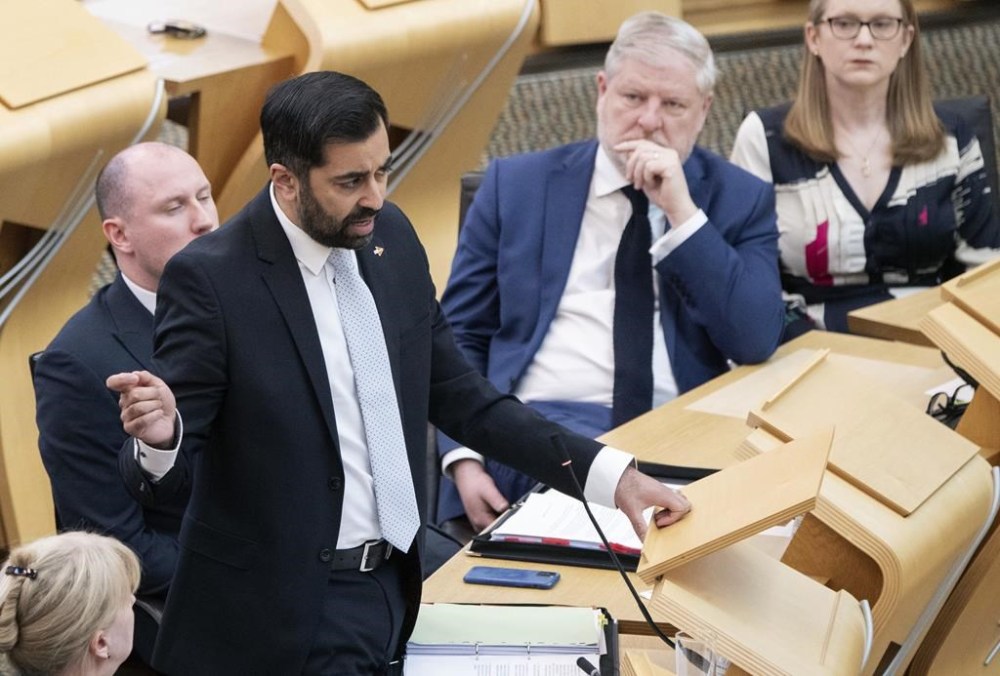
LONDON (AP) — Scotland’s first minister, Humza Yousaf, resigned on Monday, triggering a leadership contest as the governing Scottish National Party seeks to heal internal divisions and strengthen its position ahead of U.K.-wide parliamentary elections expected later this year.
Yousaf, whose pro-independence party has been weakened by a campaign finance scandal and divisions over transgender rights, was brought down by his decision to oust the Green Party from his governing coalition because of differences over climate change goals. He was unable to persuade other parties to back his minority government in Scotland’s regional parliament.
With no prospect of victory in two confidence votes that had been scheduled for later this week, Yousaf quit rather than be forced out. He will remain first minister while the SNP tries to choose a successor who can command a majority in parliament.

“I’ve concluded that repairing our relationship across the political divide can only be done with someone else at the helm,” Yousaf told reporters in Edinburgh, Scotland’s capital.
The debacle adds to the fevered political climate in the United Kingdom, with the country preparing for parliamentary elections at a time when concerns about immigration, health care and government spending have undermined support for the governing Conservative Party.
The Conservatives and the opposition Labour Party had proposed separate no-confidence motions in Yousaf and his government amid efforts to weaken the SNP going into the general election. The SNP has been the dominant party in Scottish politics for almost two decades and currently holds 43 of Scotland’s 59 seats in the U.K. Parliament. Labour is likely to be the biggest beneficiary of the problems in the SNP because both parties share left-leaning policies.
On Thursday, England and Wales will hold local elections that are seen as a barometer of support for Prime Minister Rishi Sunak’s government.
But the SNP’s focus will be on selecting a leader who can repair the party’s image in Scotland and attract support from at least one opposition party in the regional parliament, where it is one seat short of a majority with 63 of the 128 voting seats.
That job appeared to be within reach Monday, as the Greens said they would be willing to work with the SNP now that Yousaf is out of the picture.
“The SNP is still the largest party in Parliament by some distance, and has the right to form a minority government,” the Greens’ co-leader, Patrick Harvey, said. “The Scottish Greens have a long track record of working constructively from opposition and will do so with any first minister who shares our progressive values and who can secure our confidence.”
One of the early favorites to replace Yousaf is former deputy first minister John Swinney, who said he was giving “very careful consideration” to seeking the top job. Another leading candidate is Kate Forbes, who narrowly lost to Yousaf in the last leadership contest. She is seen as unacceptable to the Greens because of her conservative religious views and opposition to gender identity reforms.

Whoever the SNP chooses, the new party leader will face the same tight electoral arithmetic that proved Yousaf’s undoing.
With all of the other parties lined up against him, Yousaf would have had to make a deal with the breakaway Alba Party, which holds just one seat, to secure his job.
Founded in 2021 by former SNP leader and first minister Alex Salmond, Alba sees itself as the true voice of Scottish independence. As the price of its support, Alba demanded that Yousaf put independence at the top of his agenda, move away from divisive “identity politics” and focus on issues such as jobs, education and investment in Scottish industry.
That proved a step too far for Yousaf.
“While a route through this week’s motion of no confidence was absolutely possible, I am not willing to trade my values and principles or do deals with whomever simply for retaining power,” he said.
Yousaf became the leader of the SNP and first minister of Scotland in March 2023 after former leader Nicola Sturgeon stepped down and cited the toll of more than eight years in office.
Support for the SNP in part declined after the party backed legislation to make it easier for people to change their gender and implemented a hate crime law that made transgender identity a protected characteristic, even though the same protections weren’t given to all women.
Then came Yousaf’s decision to scrap Scotland’s goal of reducing carbon emissions by 75% by 2030.
Although he said Scotland would still achieve its goal of net-zero carbon emissions by 2045, the decision sparked tensions with coalition partners. The Green Party initially backed the change, but party leaders said they would poll the broader membership and reverse course if necessary.
Last week, Yousaf abruptly ended a power-sharing agreement with the Greens, embarrassing the party’s two government ministers who had arrived for a Cabinet meeting. Although Yousaf on Monday acknowledged his mistake, it was too late to repair the damage.
“Hurt egos have destroyed countries before now, so it’s not exactly surprising that they are currently leading to the mess we’re in,’’ Murray Pittock, an expert on Scottish nationalism at the University of Glasgow, told The Associated Press. “And you can’t hurt people’s egos any more than by chucking them straight out of ministerial office with no warning, and their entire party with them.”
___
Find more of AP’s Europe coverage at https://apnews.com/hub/europe