

Witness says Alaska plane that crashed had smoke coming from engine after takeoff, NTSB finds
Advertisement
Read this article for free:
or
Already have an account? Log in here »
To continue reading, please subscribe:

Digital Subscription
One year of digital access for only $205*
- Enjoy unlimited reading on winnipegfreepress.com
- Read the E-Edition, our digital replica newspaper
- Access News Break, our award-winning app
- Play interactive puzzles
*First annual payment billed as $205.00 + GST for one year. This annual subscription will automatically renew at $233.00 + GST every 52 weeks (10% off the regular annual price of $259.35). Offer available to new and qualified returning subscribers only. Cancel any time.
To continue reading, please subscribe:
Add Free Press access to your Brandon Sun subscription for only an additional
$1 for the first 4 weeks*
- Enjoy unlimited reading on winnipegfreepress.com
- Read the E-Edition, our digital replica newspaper
- Access News Break, our award-winning app
- Play interactive puzzles
*Your next Brandon Sun subscription payment will increase by $1.00 and you will be charged $17.95 plus GST for four weeks. After four weeks, your payment will increase to $24.95 plus GST every four weeks.
Read unlimited articles for free today:
or
Already have an account? Log in here »
Hey there, time traveller!
This article was published 02/05/2024 (860 days ago), so information in it may no longer be current.
JUNEAU, Alaska (AP) — A witness saw smoke coming from one of the engines of an old military plane that crashed last week shortly after taking off on a flight to deliver fuel to a remote Alaska village, according to a preliminary crash report released Thursday.
The witness said that shortly after the plane took off from a Fairbanks airport on April 23, he noticed that one of its engines wasn’t running and that there was white smoke coming from it, the National Transportation Safety Board report states. When the plane turned south, he saw that the engine was on fire, it says.
Not long after that, the 54D-DC airplane — a military version of the World War II-era Douglas DC-4 — crashed and burned, killing the two pilots.
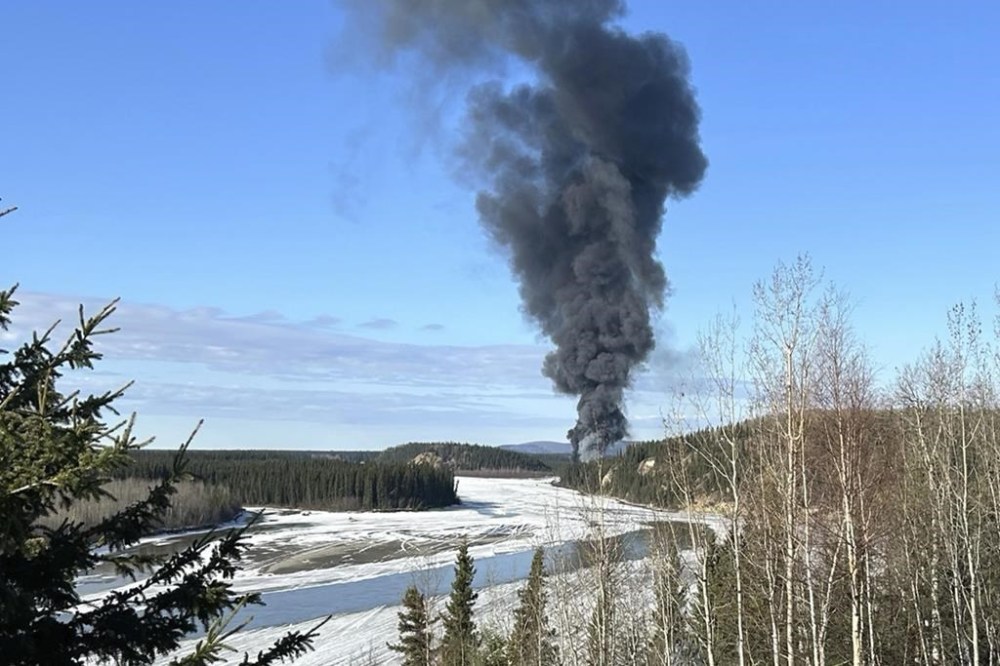
Before the crash, one of the pilots told air traffic control that there was a fire on board and that he was trying to fly the 7 miles (11 kilometers) back to Fairbanks.
Surveillance video showed white smoke behind the engine, followed by flames, the report states. Seconds later, “a bright white explosion is seen just behind the number one engine followed by fragments of airplane wreckage falling to the ground,” it says.
The roughly 80-year-old airplane then began an uncontrolled descending left turn, with the engine separating from the wing.
The plane landed on a slope above the Tanana River and slid down to the bank, leaving a trail of debris. The engine, which came to rest on the frozen river, has been recovered and will undergo a detailed examination, the report says, noting that much of the plane burned after the crash.
The probable cause of the crash will come in a future report.
The plane was carrying 3,400 gallons (12,870 liters) of unleaded fuel and two large propane tanks intended for the village of Kobuk, a small Inupiat community about 300 miles (480 kilometers) northwest of Fairbanks. Earlier reports said the plane was carrying 3,200 gallons (12,113 liters) of heating oil.
Air tankers deliver fuel to many rural Alaska communities, especially those off the road system and that have no way for barges to reach them.
The state medical examiner’s office has not yet positively identified the two people on board, Alaska Department of Public Safety spokesperson Austin McDaniel said in a Thursday email.
The plane was owned by Alaska Air Fuel Inc., which did not offer immediate comment Thursday.
___
Thiessen reported from Anchorage, Alaska.