

Swedish premier hosts German, Nordic leaders to deepen cooperation shadowed by a threat from Russia
Advertisement
Read this article for free:
or
Already have an account? Log in here »
To continue reading, please subscribe:

Digital Subscription
One year of digital access for only $205*
- Enjoy unlimited reading on winnipegfreepress.com
- Read the E-Edition, our digital replica newspaper
- Access News Break, our award-winning app
- Play interactive puzzles
*First annual payment billed as $205.00 + GST for one year. This annual subscription will automatically renew at $233.00 + GST every 52 weeks (10% off the regular annual price of $259.35). Offer available to new and qualified returning subscribers only. Cancel any time.
To continue reading, please subscribe:
Add Free Press access to your Brandon Sun subscription for only an additional
$1 for the first 4 weeks*
- Enjoy unlimited reading on winnipegfreepress.com
- Read the E-Edition, our digital replica newspaper
- Access News Break, our award-winning app
- Play interactive puzzles
*Your next Brandon Sun subscription payment will increase by $1.00 and you will be charged $17.95 plus GST for four weeks. After four weeks, your payment will increase to $24.95 plus GST every four weeks.
Read unlimited articles for free today:
or
Already have an account? Log in here »
Hey there, time traveller!
This article was published 13/05/2024 (842 days ago), so information in it may no longer be current.
COPENHAGEN, Denmark (AP) — Swedish Prime Minister Ulf Kristersson said Monday that Nordic and Baltic cooperation is now “deeper than at any time in modern times,” underpinned by increasing security threats from Russia following its invasion of Ukraine.
Kristersson was hosting a meeting with German Chancellor Olaf Scholtz and the Nordic prime ministers in Stockholm. Also Monday, the three Baltic prime ministers meeting in Lithuania’s capital, Vilnius, said that Moscow’s intimidation is not going to dissuade them from supporting Ukraine.
”For decades, we have lived very peacefully and without very big threats to Europe. Personally, I think these times are over,” Danish Prime Minister Mette Frederiksen said, according to Danish broadcaster DR. “With all that we see from the Russian side, we are at the beginning of a new era. It would be wrong if we, as a government, said that you don’t have to deal with this in your everyday life.”
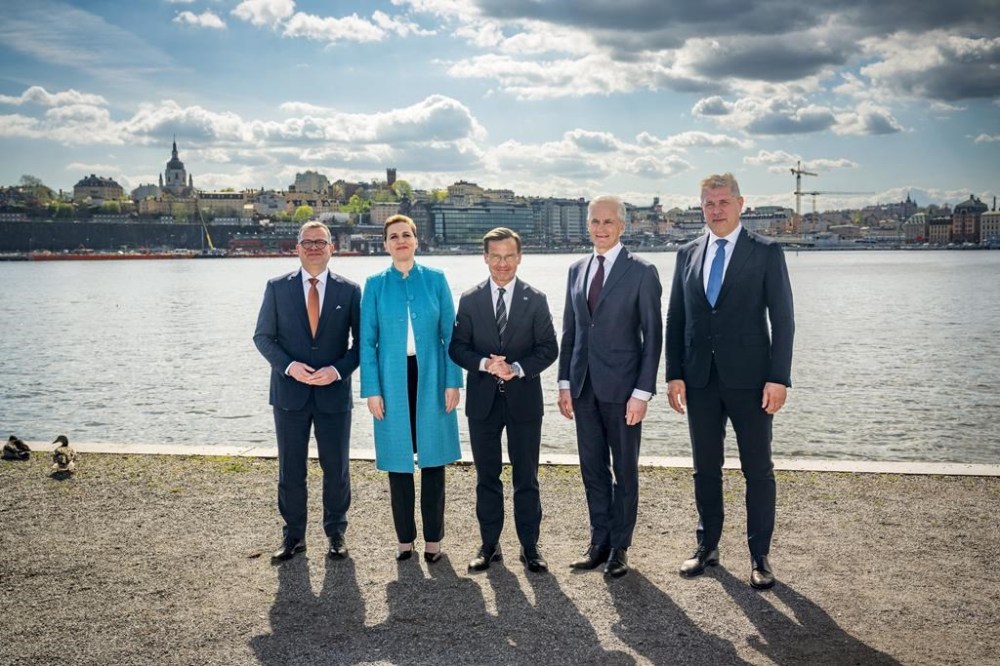
Kristersson said that security policy and NATO’s upcoming summit in July in Washington will top the agenda in talks with Scholz and the prime ministers from Denmark, Norway, Finland and Iceland.
“We have long appreciated our neighbors, but at the same time underestimated the importance of concrete, operational cooperation,” Kristersson wrote in an op-ed in Swedish business paper Dagens Industri. “If you want to cooperate well, you have to meet, get to know each other and seek broader common alliances — in both NATO and the EU.”
Sweden joined the military alliance in March while Finland joined in April 2023. NATO’s expansion was a major blow to Russian President Vladimir Putin with a historic realignment of Europe’s post-Cold War security landscape triggered by Moscow’s invasion of Ukraine.
The Baltic Sea is now almost surrounded by NATO countries, strengthening the alliance in the strategically important region. It includes maritime access to the Russian city of St. Petersburg and the Kaliningrad enclave.
The Swedish government leader said that in the past weeks he had held a series of meetings with his regional counterparts and “discussed issues that are important to both them and Sweden: defense, forestry, the climate, migration, crime and the security threats from Russia.”
In Vilnius, Lithuanian Prime Minister Ingrida Šimonytė received Estonia’s Prime Minister Kaja Kallas and Latvian Prime Minister Evika Siliņa for a meeting of the Baltic Council of Ministers.
Estonia’s Kallas said that “Russia has also intensified the shadow war against all of European countries. It wants to really scare and intimidate the free world to scare us away from helping Ukraine.”
“We shouldn’t be scared,” she added.
The three Baltic countries have been ardent supporters of Ukraine.
“Russia must lose the war for the sake of Ukraine, European security and global order,” Latvia’s Siliņa said. “We have to remember that we are living in a wartime in Europe. This is a war that disturbs societies in Europe. And this war is growing here just in our neighborhood.”