

Future of Texas’ migrant-blocking buoys may hinge on whether the Rio Grande is ‘navigable’
Advertisement
Read this article for free:
or
Already have an account? Log in here »
To continue reading, please subscribe:

Digital Subscription
One year of digital access for only $205*
- Enjoy unlimited reading on winnipegfreepress.com
- Read the E-Edition, our digital replica newspaper
- Access News Break, our award-winning app
- Play interactive puzzles
*First annual payment billed as $205.00 + GST for one year. This annual subscription will automatically renew at $233.00 + GST every 52 weeks (10% off the regular annual price of $259.35). Offer available to new and qualified returning subscribers only. Cancel any time.
To continue reading, please subscribe:
Add Free Press access to your Brandon Sun subscription for only an additional
$1 for the first 4 weeks*
- Enjoy unlimited reading on winnipegfreepress.com
- Read the E-Edition, our digital replica newspaper
- Access News Break, our award-winning app
- Play interactive puzzles
*Your next Brandon Sun subscription payment will increase by $1.00 and you will be charged $17.95 plus GST for four weeks. After four weeks, your payment will increase to $24.95 plus GST every four weeks.
Read unlimited articles for free today:
or
Already have an account? Log in here »
Hey there, time traveller!
This article was published 15/05/2024 (828 days ago), so information in it may no longer be current.
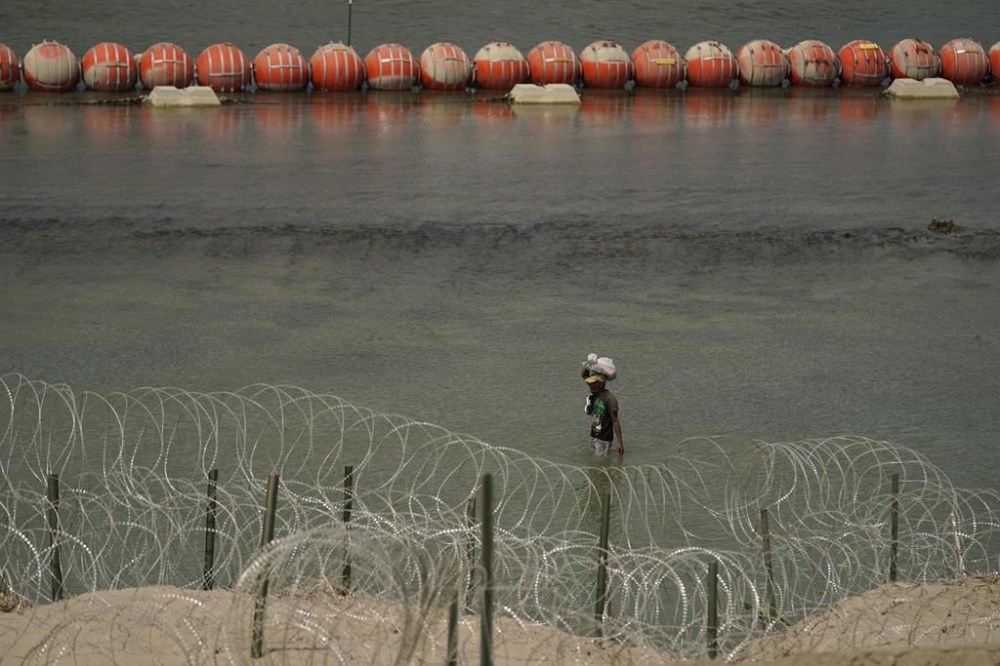
NEW ORLEANS (AP) — The future of a barrier of giant buoys that Texas Gov. Greg Abbot placed in the Rio Grande last year to deter migrant traffic may turn on whether a rocky, shallow stretch of the border river can be considered “navigable” and whether immigration sometimes constitutes a hostile invasion.
The full 17-member 5th U.S. Circuit Court of Appeals heard arguments on the issues in New Orleans on Wednesday, the latest courtroom debate in multiple legal disputes over border control between Democratic President Joe Biden and the Republican governor. The judges did not indicate when they would rule.
Part of the hearing touched on Texas’ claim that the barrier is authorized constitutionally as a means of defending against an invasion.
“Are you saying that federal law overcomes the constitutional right of the state?” Judge Edith Jones asked Justice Department attorney Michael Gray. She later added: “Under what circumstances can the United States thwart that attempt at self-defense?”
In response to questions from Jones and Judge James Ho, Gray argued that a governor cannot get around federal law simply by claiming an invasion. “Their argument is, once they say invasion ‘We can do anything we want for as long as we want.’ We don’t think that’s right,” Gray said.
But much of the hearing dealt with whether the administration was correct that the Rio Grande is subject to federal regulation as a navigable waterway.
Texas says the stretch of river is rocky and shallow — describing it as “ankle deep” in one filing.
“For most of its length and much of its storied history, the Rio Grande has been little more than a creek with an excellent publicist,” Lanora Pettit, with Texas Attorney General’s Office said.
The Biden administration has pointed to past ferry traffic in the area, the use of the area by vessels with the U.S. Coast Guard and the International Boundary and Water Commission and the possibility of future projects to make the stretch better suited for commercial traffic.
The state installed the orange, wrecking ball-sized buoys last July. The barrier stretches about 1000 feet (304 meters) along the international border with Mexico between the Texas border city of Eagle Pass and Piedras Negras, Coahuila.
In December, a divided panel of the 5th U.S. Circuit Court of Appeals had sided with a federal district judge in Texas who said the buoys must be moved. But the panel’s 2-1 ruling after was vacated in January when a majority of the conservative-dominated court’s 17 active judges voted to rehear the case. An 18th judge who is on part-time senior status and was on the three-member panel also participated with the full court Wednesday.
The Biden administration also is fighting for the right to cut razor-wire fencing at the border and for access to a city park at the border that the state fenced off.
And a decision is pending from a 5th Circuit panel on whether to allow Texas to enforce a law that allows any Texas law enforcement officer to arrest people suspected of entering the country illegally.