

USS Ronald Reagan leaves its Japan home port after nearly 9 years
Advertisement
Read this article for free:
or
Already have an account? Log in here »
To continue reading, please subscribe:

Digital Subscription
One year of digital access for only $205*
- Enjoy unlimited reading on winnipegfreepress.com
- Read the E-Edition, our digital replica newspaper
- Access News Break, our award-winning app
- Play interactive puzzles
*First annual payment billed as $205.00 + GST for one year. This annual subscription will automatically renew at $233.00 + GST every 52 weeks (10% off the regular annual price of $259.35). Offer available to new and qualified returning subscribers only. Cancel any time.
To continue reading, please subscribe:
Add Free Press access to your Brandon Sun subscription for only an additional
$1 for the first 4 weeks*
- Enjoy unlimited reading on winnipegfreepress.com
- Read the E-Edition, our digital replica newspaper
- Access News Break, our award-winning app
- Play interactive puzzles
*Your next Brandon Sun subscription payment will increase by $1.00 and you will be charged $17.95 plus GST for four weeks. After four weeks, your payment will increase to $24.95 plus GST every four weeks.
Read unlimited articles for free today:
or
Already have an account? Log in here »
Hey there, time traveller!
This article was published 16/05/2024 (877 days ago), so information in it may no longer be current.
YOKOSUKA, Japan (AP) — A U.S. Navy strike group’s flagship aircraft carrier left its Japanese home port on Thursday, wrapping up nearly nine years of deployment in the Indo-Pacific, where it served a key role in the U.S. effort to bolster defense ties with Japan and other partners in the region.
The departure of USS Ronald Reagan — one of America’s largest warships and a nuclear-powered Nimitz-class aircraft carrier — comes at a time of growing tension in the face of increasingly assertive China in the Indo-Pacific.
It will be replaced later this year by USS George Washington, another Nimitz-class carrier, now on assignment near South America. Japan has been accelerating the buildup of its military capability and significantly increased joint naval operations with the United States.
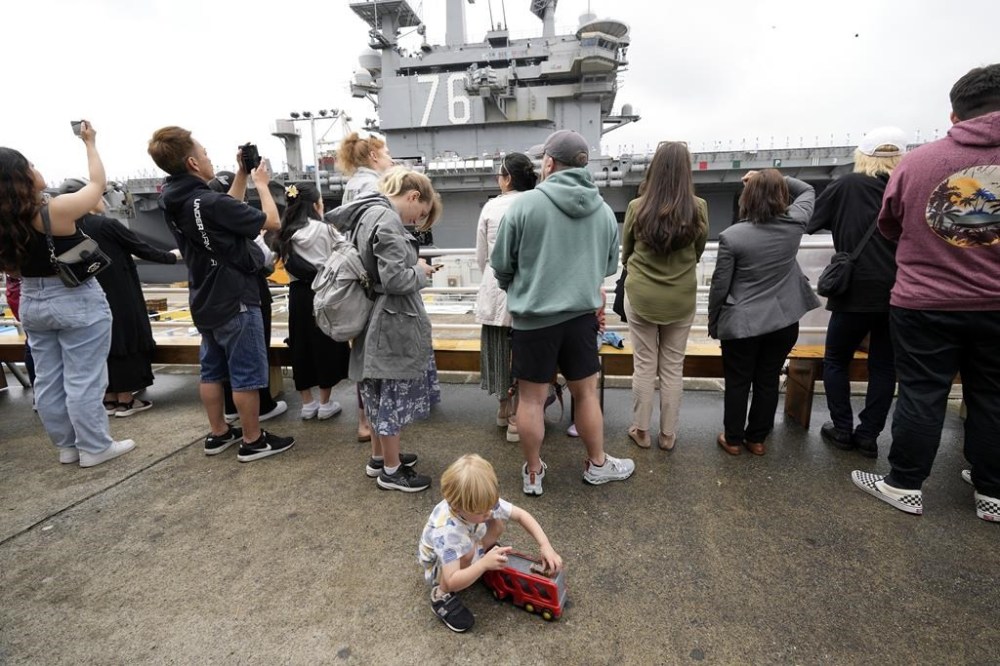
Family members and friends of the crew were on hand to wave the carrier off from Yokosuka Naval Base after its final patrolling mission earlier in the day.
Hundreds of sailors stood along the rails while others on the flight deck stood forming the Japanese saying “dewa mata,” or “see you.” The carrier was accompanied by two guided-missile destroyers, USS Robert Smalls and USS Howard. It is scheduled to transit in Bremerton, Washington, later this year, before heading to a next home port assignment.
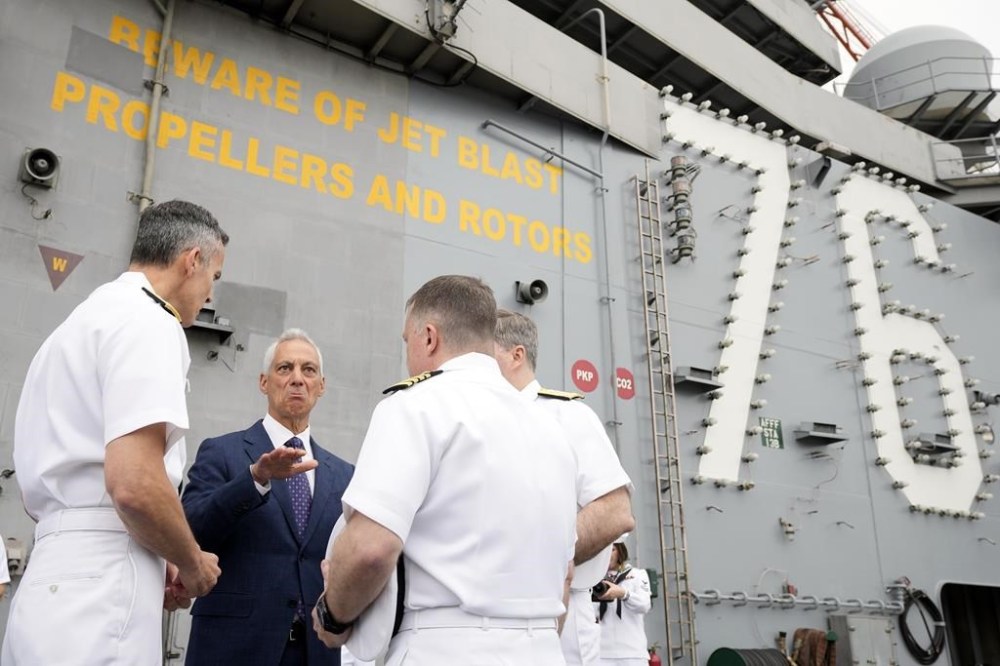
Speaking at the ceremony, U.S. Ambassador to Japan Rahm Emanuel ensured a “seamless transition.”
“The USS Ronald Reagan and her crew have ensured that millions of people across the Indo-Pacific have been able to live their lives free of coercion, aggression and suppression,” Emanuel later told reporters.
USS Ronald Reagan first arrived in Yokosuka in 2015. Earlier, during its deployment near the Korean Peninsula, the carrier contributed in Operation Tomodachi, following the 2011 earthquake, tsunami and nuclear disaster in northeastern Japan.
USS Ronald Reagan was the only American aircraft carrier deployed as a flagship of the Carrier Strike Group 5 under the U.S. Navy’s 7th Fleet, to a home port outside the U.S.
During its tenure, it participated in dozens of multilateral exercises and visited more than a dozen foreign ports, including its historic port call to Da Nang, Vietnam, last year.
While tensions have escalated in the South China Sea between China and the Philippines and a number of other countries over maritime and territorial disputes, Japan is concerned about its dispute with China over uninhabited islands in the East China Sea.
Japanese and Chinese coast guard ships repeatedly face off in the waters there.
Former Defense Minister Tomomi Inada, who recently joined an environmental survey trip near the disputed Senkaku islands, which Beijing calls the Diaoyu, said Thursday that cooperation with the U.S. and other like-minded countries is key to defending the international order.
“We have a sense of urgency that we must not let the East China Sea become another South China Sea,” she said.
Landing on the islands is not permitted, so Inada’s group flew drones for land and vegetation survey of the area. China protested the trip.
Inada said experts should be able to land on Japan’s territory for research, calling for a parliamentary debate.
___
Yamaguchi reported from Tokyo.
___
Follow AP’s Asia-Pacific coverage at https://apnews.com/hub/asia-pacific