

Taiwan’s new president inherits a strong foreign policy position but political gridlock at home
Advertisement
Read this article for free:
or
Already have an account? Log in here »
To continue reading, please subscribe:

Digital Subscription
One year of digital access for only $205*
- Enjoy unlimited reading on winnipegfreepress.com
- Read the E-Edition, our digital replica newspaper
- Access News Break, our award-winning app
- Play interactive puzzles
*First annual payment billed as $205.00 + GST for one year. This annual subscription will automatically renew at $233.00 + GST every 52 weeks (10% off the regular annual price of $259.35). Offer available to new and qualified returning subscribers only. Cancel any time.
To continue reading, please subscribe:
Add Free Press access to your Brandon Sun subscription for only an additional
$1 for the first 4 weeks*
- Enjoy unlimited reading on winnipegfreepress.com
- Read the E-Edition, our digital replica newspaper
- Access News Break, our award-winning app
- Play interactive puzzles
*Your next Brandon Sun subscription payment will increase by $1.00 and you will be charged $17.95 plus GST for four weeks. After four weeks, your payment will increase to $24.95 plus GST every four weeks.
Read unlimited articles for free today:
or
Already have an account? Log in here »
Hey there, time traveller!
This article was published 18/05/2024 (859 days ago), so information in it may no longer be current.
TAIPEI, Taiwan (AP) — In a campaign ad for Taiwan’s President-elect Lai Ching-te, incumbent President Tsai Ing-wen was shown driving with Lai in the passenger seat, exchanging reflections on their years governing together. Tsai later turned over the driving to Lai, who was joined by running mate Bi-khim Hsiao.
The message was clear: Lai would steer the island in the direction set by Tsai, who after eight years in power was barred from running again.
Lai, 64, will take office Monday. Continuing Tsai’s legacy means aiming to strike a balance between cultivating Taiwan’s unofficial alliance with the United States and maintaining peace with China, which claims Taiwan as its own territory, to be retaken by force if necessary.
Lai is also expected to build on some of Tsai’s domestic reforms, despite political gridlock. Lai and Tsai’s Democratic Progressive Party has lost the majority in the legislature, making it hard for Lai to push through legislation, including the approval of crucial national defense budgets.
Tsai, 67, has been Taiwan’s first female president and one of Asia’s few female leaders who didn’t hail from a political dynasty. Her legacy will be tied to defending the island’s sovereignty from China while refashioning it as a credible partner for the U.S. and other democracies. She will also be remembered for overseeing the legalization of same sex-marriage, steering Taiwan through the COVID years and kickstarting the island’s military modernization.
She leaves office with high approval ratings. A recent poll by broadcaster TVBS showed 42% of respondents were satisfied with her eight-year performance. Her predecessor, Ma Ying-jeou, left office with approval ratings of around 23%.
Tsai’s popularity partly reflects a shift in Taiwan’s identity. A vast majority of residents now identify as Taiwanese as opposed to Chinese and want to be governed separately from Beijing. Taiwan and China have had different governments since a civil war in 1949 saw the Nationalists flee to the island while China’s Communist Party took control of the mainland.
Tsai veered from the more China-friendly policies of the previous ruling party, the Kuomintang. By the end of Ma’s tenure, the frequent exchanges with Beijing were making many Taiwanese nervous, said Shelley Rigger, a Taiwan expert at Davidson College.
Beijing called Tsai a separatist after she refused to acknowledge the 1992 Consensus, an agreement which says Taiwan is part of “One China.” While pulling away from Beijing, however, Tsai left a door open for communication.
“President Tsai has always said that Taiwan, under her leadership, is happy, willing and eager to have dialogue with Beijing, just not on terms unilaterally imposed by Beijing,” said Wen-Ti Sung, a fellow with Washington-based think tank Atlantic Council.
China has not only declined to speak to Tsai but also ramped up military and economic pressure on the island, sending warships and military jets near it daily.
Beijing prevents countries it has diplomatic relations with from having formal ties with Taipei. During Tsai’s tenure, it intensified a campaign to lure away the island’s few diplomatic partners. During Tsai’s years in office, China poached almost half of Taiwan’s diplomatic allies, bringing the remaining number to 12.
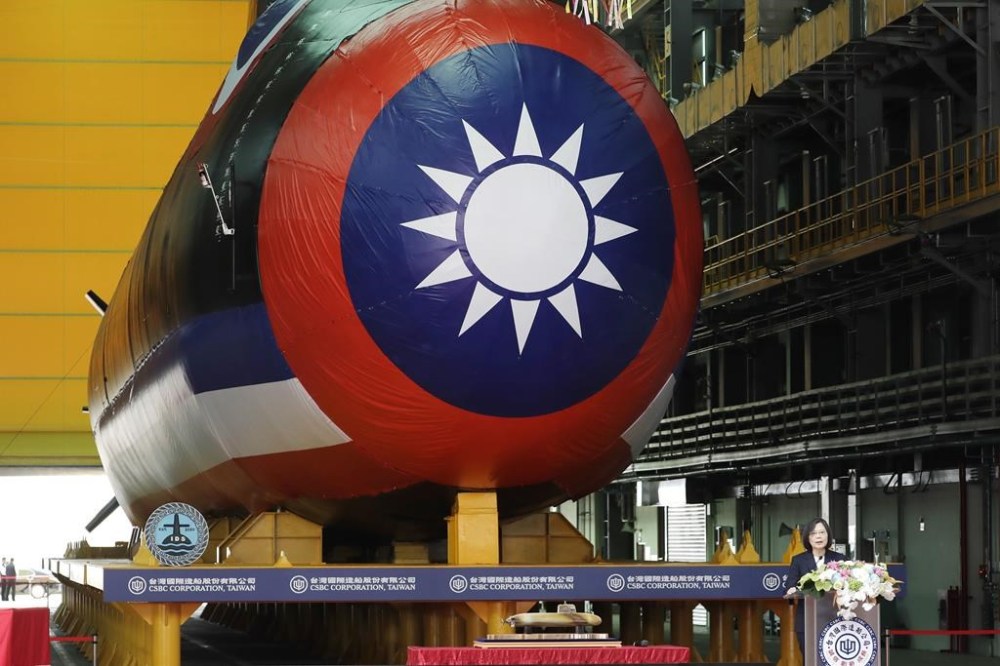
Tsai pushed back by diversifying trade relationships and increasing military spending including submarine development. She also elevated Taiwan’s standing on the international stage, said outgoing Foreign Minister Joseph Wu.
“Her leadership style is very moderate, but at the same time very firm in dealing with any kind of international pressure,” he said.
“She strengthened awareness of Taiwan around the world and its ties with the international community,” said Bonnie Glaser, the director of the Indo-Pacific program at the German Marshall Fund of the United States.
‘TSAI 2.0’

Lai, who served as vice president during Tsai’s second term, came across as more of a firebrand earlier in his career. In 2017, he described himself as a “pragmatic worker for Taiwan’s independence,” drawing Beijing’s rebuke. He has since softened his stance and now supports maintaining the status quo across the Taiwan Strait and the possibility of talks with Beijing.
“Lai has spent the last two-plus years trying to convince the world that he is Tsai Ing-wen 2.0,” said Lev Nachman, an assistant professor at National Chengchi University.
Lai will build on Tsai’s efforts to strengthen ties with the U.S., which doesn’t formally recognize Taiwan as a country but is bound by its own laws to provide the island with the means to defend itself.
By some measures, Lai’s greatest uncertainty on the foreign policy front might come from Washington. A new Donald Trump administration could throw off whatever balance Tsai has achieved in Taipei’s relations with Washington and Beijing, Nachman said.
WHAT’S NEXT AT HOME
During Tsai’s tenure, Taiwan became the first society in Asia to legalize same-sex marriage, though critics say she skirted political responsibility by leaving the decision up to the Supreme Court and a series of referendums.
She oversaw a controversial pension and labor reform and extended the military conscription length to one year. She also kickstarted a military modernization drive, including a program for building indigenous submarines at more than $16 billion each.
Tsai’s leadership during the COVID pandemic split public opinion, with most admiring Taiwan’s initial ability to keep the virus largely outside its borders but criticizing the lack of investment in rapid testing as the pandemic progressed.
Tsai’s mixed success on the domestic policy front contributed to historically poor results for the DPP in local elections, said Sung with the Atlantic Council. The party’s poor performance in the 2022 elections led to Tsai resigning as party chairwoman. And while Lai won the presidential election, DPP lost its majority in the legislature.
“Much of President Tsai’s government’s success comes from the foreign policy and related international outreach fronts, and in terms of making inroads on the much more grassroots party machinery level, for example, those still have room for improvement,” Sung said.