

Taiwan scrambles jets and puts missile, naval and land units on alert over China’s military drills
Advertisement
Read this article for free:
or
Already have an account? Log in here »
To continue reading, please subscribe:

Digital Subscription
One year of digital access for only $205*
- Enjoy unlimited reading on winnipegfreepress.com
- Read the E-Edition, our digital replica newspaper
- Access News Break, our award-winning app
- Play interactive puzzles
*First annual payment billed as $205.00 + GST for one year. This annual subscription will automatically renew at $233.00 + GST every 52 weeks (10% off the regular annual price of $259.35). Offer available to new and qualified returning subscribers only. Cancel any time.
To continue reading, please subscribe:
Add Free Press access to your Brandon Sun subscription for only an additional
$1 for the first 4 weeks*
- Enjoy unlimited reading on winnipegfreepress.com
- Read the E-Edition, our digital replica newspaper
- Access News Break, our award-winning app
- Play interactive puzzles
*Your next Brandon Sun subscription payment will increase by $1.00 and you will be charged $17.95 plus GST for four weeks. After four weeks, your payment will increase to $24.95 plus GST every four weeks.
Read unlimited articles for free today:
or
Already have an account? Log in here »
Hey there, time traveller!
This article was published 22/05/2024 (868 days ago), so information in it may no longer be current.
TAIPEI, Taiwan (AP) — Taiwan scrambled jets and put missile, naval and land units on alert Thursday over Chinese military exercises being conducted around the self-governing island democracy where a new president took office this week.
China’s military said its two-day exercises around Taiwan were punishment for separatist forces seeking independence. Beijing claims the island is part of China’s national territory and the People’s Liberation Army sends navy ships and warplanes into the Taiwan Strait and other areas around the island almost daily to wear down Taiwan’s defenses and seek to intimidate its people, who firmly back their de facto independence.
China’s “irrational provocation has jeopardized regional peace and stability,” the island’s Defense Ministry said. It said Taiwan will seek no conflicts but “will not shy away from one.”
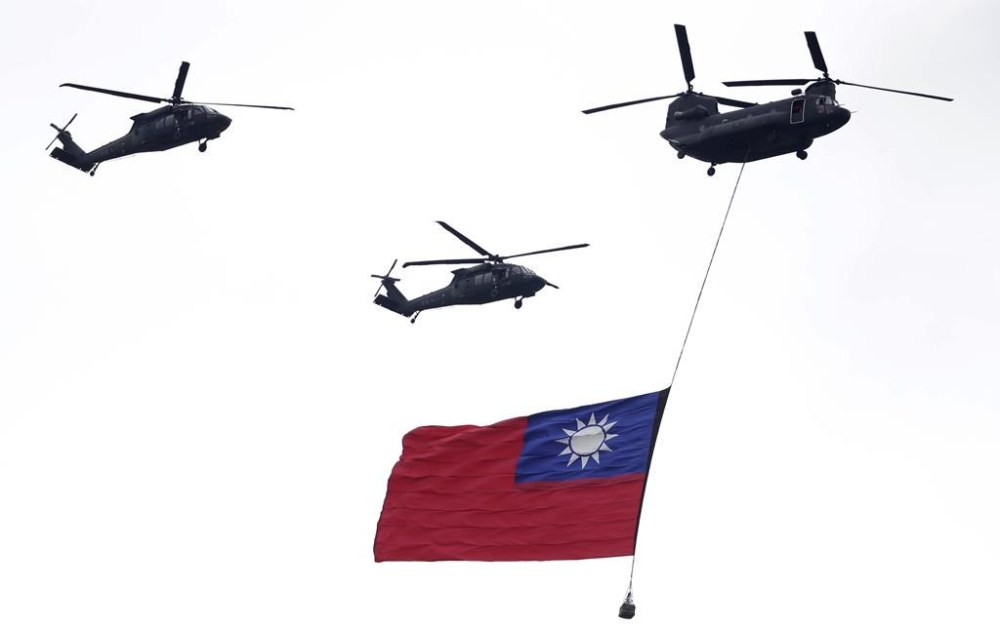
“This pretext for conducting military exercises not only does not contribute to peace and stability across the Taiwan Strait, but also shows its hegemonic nature at heart,” the ministry’s statement said.
In his inauguration address on Monday, Taiwan’s President Lai Ching-te called for Beijing to stop its military intimidation and pledged to “neither yield nor provoke” the mainland Communist Party leadership.
“Facing external challenges and threats, we will continue to maintain the values of freedom and democracy,” Lai told sailors and top security officials Thursday as he visited a marine base in Taoyuan, just south of the capital Taipei.
While not directly referring to China’s moves, he said international society was concerned about Taiwan’s security, a likely reflection of its key role in supply chains for the most advanced computer chips as well as a democratic bulwark against Chinese moves to assert its control over the Asia-Pacific.
Lai has said he seeks dialogue with Beijing while maintaining Taiwan’s current status and avoiding conflicts that could draw in the island’s chief ally the U.S. and other regional partners such as Japan and Australia.
The Nationalist Party, which is generally seen as pro-China, also condemned Beijing’s actions.
The Nationalists, also known as the KMT, called on “the opposite side of the (Taiwan Strait) to exercise restraint, cease unnecessary maneuvers, avoid a conflict in the Taiwan Strait and maintain … the results of peace and development between the sides.”
Thursday’s tensions came amid protests outside Taiwan’s legislature against moves by the Nationalists and allies to use their slim majority to force through legislation that could affect military budgets and key judicial and other appointments.
The People’s Liberation Army’s Eastern Theater Command said the land, navy and air exercises around Taiwan are meant to test the navy and air capabilities of the PLA units, as well as their joint strike abilities to hit targets and win control of the battlefield, the command said on its official Weibo account.
“This is also a powerful punishment for the separatist forces seeking ‘independence’ and a serious warning to external forces for interference and provocation,” the statement said.
The PLA also released a map of the intended exercise area, which surrounds Taiwan’s main island at five different points, as well as places like Matsu and Kinmen, outlying islands that are closer to the Chinese mainland than Taiwan.
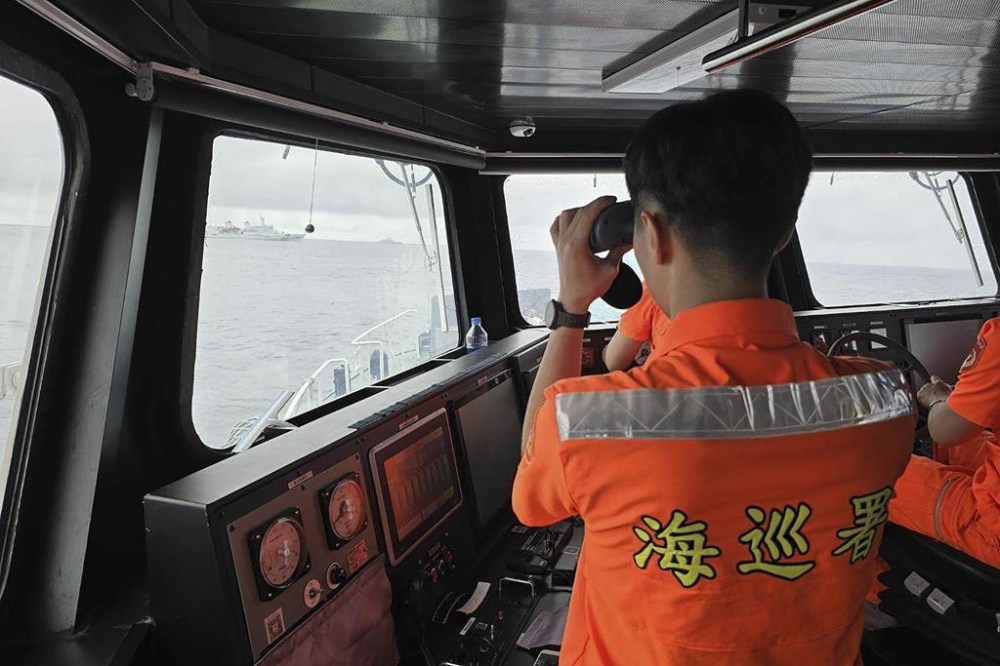
China’s coast guard also said in a statement that it organized a fleet to carry out law enforcement drills near two islands close to the Taiwanese-controlled island groups of Kinmen and Matsu just off the Chinese coast.
While China has called the exercises punishment for Taiwan’s election result, the Democratic Progressive Party has now run the island’s government for more than a decade, although the Nationalist Party took a one-seat majority in parliament.
Speaking in Australia, Marine Corps Lt. Gen. Stephen Sklenka, the deputy commander of the U.S. Indo-Pacific Command, called on Asia-Pacific nations to condemn the Chinese military exercises.
“There’s no surprise whenever there’s an action that highlights Taiwan in the international sphere the Chinese feel compelled to make some kind of form of statement,” Sklenka told the National Press Club of Australia in the capital Canberra, in a reference to Monday’s presidential inauguration.
“Just because we expect that behavior doesn’t mean that we shouldn’t condemn it, and we need to condemn it publicly. And it needs to come from us, but it also needs to come, I believe, from nations in the region. It’s one thing when the United States condemns the Chinese, but it has a far more powerful effect, I believe, when it comes from nations within this region,” Sklenka added.
Japan’s top envoy weighed in while visiting the U.S., saying Japan and Taiwan share values and principles, including freedom, democracy, basic rights and rule of law.
“(Taiwan) is our extremely important partner that we have close economic relations and exchanges of people, and is our precious friend,” Foreign Minister Yoko Kamikawa told reporters in Washington, where she held talks with Secretary of State Antony Blinken.
She said the two ministers discussed Taiwan and the importance of the Taiwan Strait, one of the world’s most important waterways for shipping, remaining peaceful.
___
Associated Press reporters Rod McGuirk in Melbourne, Australia, and Mari Yamaguchi in Tokyo contributed to this report.
___
Follow AP’s Asia-Pacific coverage at https://apnews.com/hub/asia-pacific