

European Union criticizes Russia for removing Estonian buoys, demand an explanation from Moscow
Advertisement
Read this article for free:
or
Already have an account? Log in here »
To continue reading, please subscribe:

Digital Subscription
One year of digital access for only $205*
- Enjoy unlimited reading on winnipegfreepress.com
- Read the E-Edition, our digital replica newspaper
- Access News Break, our award-winning app
- Play interactive puzzles
*First annual payment billed as $205.00 + GST for one year. This annual subscription will automatically renew at $233.00 + GST every 52 weeks (10% off the regular annual price of $259.35). Offer available to new and qualified returning subscribers only. Cancel any time.
To continue reading, please subscribe:
Add Free Press access to your Brandon Sun subscription for only an additional
$1 for the first 4 weeks*
- Enjoy unlimited reading on winnipegfreepress.com
- Read the E-Edition, our digital replica newspaper
- Access News Break, our award-winning app
- Play interactive puzzles
*Your next Brandon Sun subscription payment will increase by $1.00 and you will be charged $17.95 plus GST for four weeks. After four weeks, your payment will increase to $24.95 plus GST every four weeks.
Read unlimited articles for free today:
or
Already have an account? Log in here »
Hey there, time traveller!
This article was published 24/05/2024 (863 days ago), so information in it may no longer be current.
BRUSSELS (AP) — European Union foreign policy chief Josep Borrell on Friday called the removal of Estonian buoys by Russian border guards on a river separating the Baltic country from Russia “unacceptable,” and demanded an explanation from Moscow and the immediate return of the orange floats.
Early Thursday, Estonian border guards noticed that their Russian counterparts had removed 25 of the 50 buoys that Estonia had installed on the Narva River to prevent boats from accidentally crossing the border.
Borrell said the incident “is part of a broader pattern of provocative behavior and hybrid actions by Russia.”
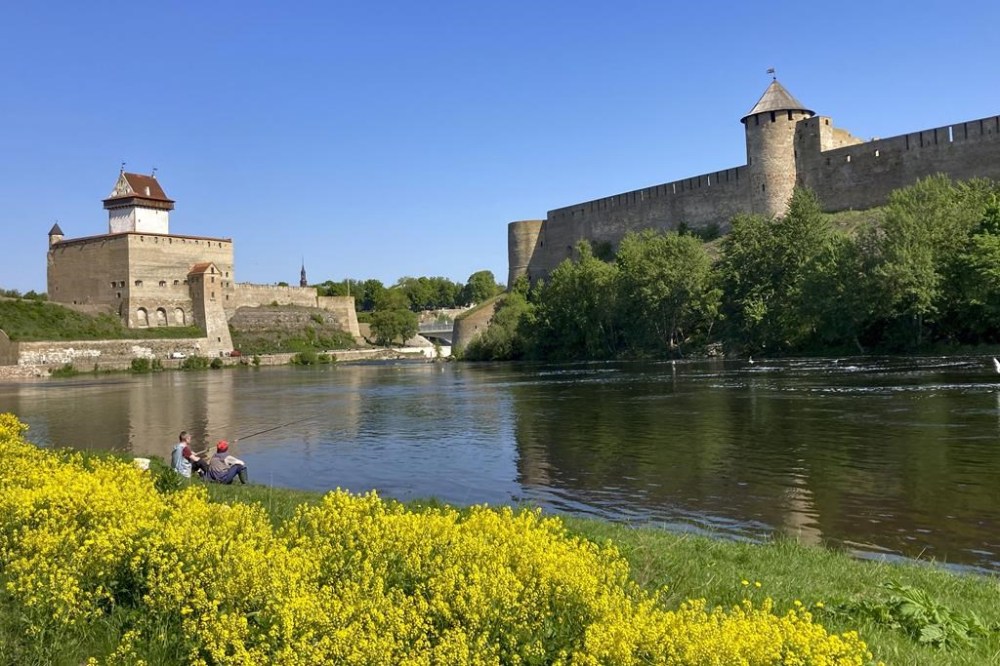
Estonia also dubbed it “unacceptable,” but said its response “remains calm and clear-eyed.”
“We treat this as a provocative border incident,” the Foreign Ministry in Tallinn said Thursday.
For decades, Estonia and Russia have installed buoys on the Narva River for the summer, with the towns of Narva on the Estonian side and Ivangorod on the Russian bank, largely in mutual agreement.
Every year, the marking of the shipping routes is rechecked because “the riverbed changes over time,” said Eerik Purgel, the local Estonian Border Guard head. Last year, Russia said it did not agree with the locations of the Estonian buoys.
This year, “we decided to release the floating marks into the water for the summer season according to a 2022 agreement, because they are necessary to avoid navigational errors, so that our fishermen and other hobbyists do not accidentally wander into Russian waters,” he said.
The first 50 buoys were installed on May 13. However, 25 of them were removed by their Russian counterparts early in the morning 10 days later, he added.
The Estonian Ministry of Foreign Affairs on Friday summoned Russia’s deputy head of mission, the Baltic News Service agency said. BNS quoted Foreign Minister Margus Tsahkna as saying that they “clearly expressed to the Russian charge d’affaires that such actions are provocative and unacceptable.”
Estonia’s Foreign Ministry said the action “fits well within the broader pattern of Russia’s provocative behavior,” and drew parallels to the border mapping incidents in the Baltic Sea earlier this week. According to media reports, Moscow could revise the borders of its territorial waters in the region.
The draft proposal was published on an official Russian government website for draft legislation but disappeared hours after it was posted on Wednesday. It wasn’t immediately clear why.
Russian media said the Defense Ministry in Moscow had suggested updating the coordinates used to measure the strip of territorial waters off its mainland coast and that of its islands in the Baltic Sea. The existing coordinates were approved in 1985, the ministry says, adding that they were “based on small-scale nautical navigation maps” and don’t correspond to the “modern geographical situation.”
Kremlin spokesman Dmitry Peskov later said there was “nothing political” in the Defense Ministry’s proposal, and Russian news agencies said Moscow did not intend to revise the border or the width of its territorial waters.
Since Russia’s full-scale invasion of Ukraine in early 2022, Finland and Sweden have joined NATO, meaning that the Baltic Sea — Russia’s maritime point of access to the city of St. Petersburg and its Kaliningrad enclave — is now almost surrounded by members of the military alliance.