

Mexican government says the arm of a 19th century mummy came off after mishandling by museum staff
Advertisement
Read this article for free:
or
Already have an account? Log in here »
To continue reading, please subscribe:
Monthly Digital Subscription
$0 for the first 4 weeks*
- Enjoy unlimited reading on winnipegfreepress.com
- Read the E-Edition, our digital replica newspaper
- Access News Break, our award-winning app
- Play interactive puzzles
*No charge for 4 weeks then price increases to the regular rate of $19.00 plus GST every four weeks. Offer available to new and qualified returning subscribers only. Cancel any time.
Monthly Digital Subscription
$4.75/week*
- Enjoy unlimited reading on winnipegfreepress.com
- Read the E-Edition, our digital replica newspaper
- Access News Break, our award-winning app
- Play interactive puzzles
*Billed as $19 plus GST every four weeks. Cancel any time.
To continue reading, please subscribe:
Add Free Press access to your Brandon Sun subscription for only an additional
$1 for the first 4 weeks*
*Your next subscription payment will increase by $1.00 and you will be charged $16.99 plus GST for four weeks. After four weeks, your payment will increase to $23.99 plus GST every four weeks.
Read unlimited articles for free today:
or
Already have an account? Log in here »
Hey there, time traveller!
This article was published 27/05/2024 (561 days ago), so information in it may no longer be current.
MEXICO CITY (AP) — Mexico’s federal archaeology agency on Monday accused the conservative-governed city of Guanajuato of mistreating one of the country’s famous mummified 19th century bodies.
The National Institute of Anthropology and History, INAH, said that during recent renovations at the museum where the mummified bodies are on permanent display, the arm of one of the mummies, well, came off.
One might think the complaint is all about the dignified treatment of corpses buried around the early 1800s and dug up starting in the 1860s, because their families could no longer pay burial fees.
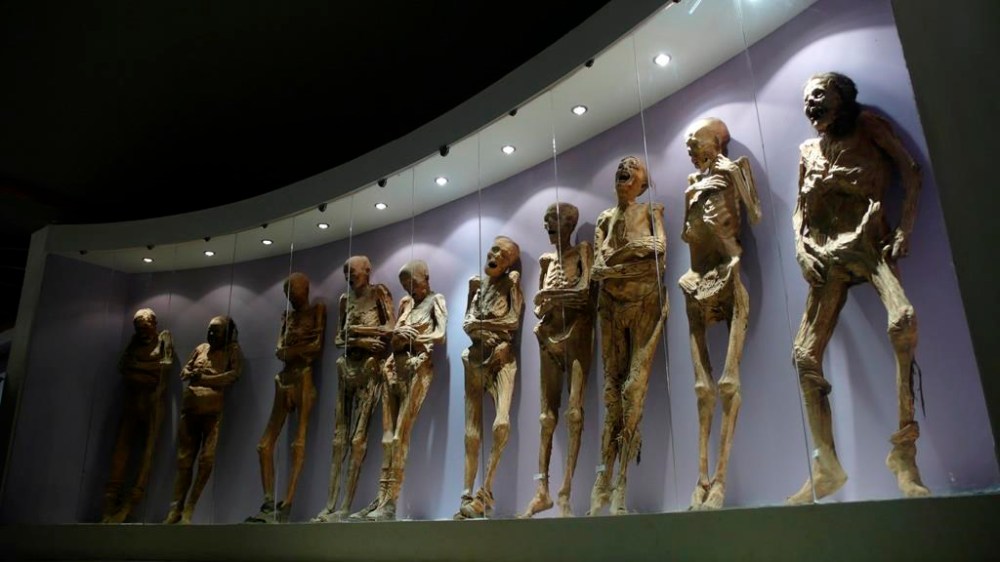
But in fact, the mummies have been on a somewhat grisly display in glass cases in a museum in Guanajuato, the capital of the state of the same name, and toted around to tourism fairs for decades. Some were exhibited in the United States in 2009.
What appears to be at the root of the latest dispute is a turf battle between the INAH, which believes it has jurisdiction over the mummies because it says they are “national patrimony,” and Guanajuato, which considers them a tourist attraction. The state and city are governed by the conservative National Action Party, which the Morena party – which holds power at the federal level – considers its arch enemy.
On Monday, the institute said it would demand an accounting of what permits and procedures were followed during the museum renovations.
“These events confirm that the way the museum’s collection was moved is not the correct one, and that far from applying proper corrective and conservation strategies, the actions carried out resulted in damages, not only to this body,” the institute wrote in a statement.
It did not say what, if any, other bits of mummies had fallen off.
“It appears that this situation is related to a lack of knowledge about proper protocols and the lack of training of the personnel in charge of carrying out these tasks,” it continued.
The Guanajuato city government did not immediately respond to requests for comment.
The preserved corpses were unintentionally mummified when they were buried in crypts in a dry, mineral-rich soil environment in the mining state of Guanajuato. Some still have hair, leathery skin and their original clothing.
The institute appeared to be miffed because personnel in Guanajuato, not the institute’s own staff, is in charge of the approximately 100 mummies. In part because they were mostly dug up before the institute was founded in 1939, they remain under local control, something that has rankled federal officials in the past.
In 2023, experts from the institute complained that a traveling display of mummies could pose a health risk to the public, because one of the mummies appeared to have fungal growths.
It is not the first time that the extremity of a long-dead person becomes a national political issue.
In 1989, the Mexican government weathered a wave of criticism after it removed the arm of revolutionary Gen. Álvaro Obregón – severed in battle in 1915 – after being displayed in a jar of formaldehyde in a marble monument for a half-century. Visitors said it had become ‘unsightly,’ and so the arm was incinerated and buried.
In 1838, Antonio López de Santa Anna, who served as president of Mexico 11 times, lost his leg in battle, and had it buried with honors. By 1844, an angry crowd that accused him of treason dragged the leg through the streets of Mexico City and apparently destroyed it.
___
Follow AP’s coverage of Latin America and the Caribbean at https://apnews.com/hub/latin-america