

Papua New Guinea landslide survivors slow to move to safer ground after hundreds buried
Advertisement
Read this article for free:
or
Already have an account? Log in here »
To continue reading, please subscribe:

Digital Subscription
One year of digital access for only $205*
- Enjoy unlimited reading on winnipegfreepress.com
- Read the E-Edition, our digital replica newspaper
- Access News Break, our award-winning app
- Play interactive puzzles
*First annual payment billed as $205.00 + GST for one year. This annual subscription will automatically renew at $233.00 + GST every 52 weeks (10% off the regular annual price of $259.35). Offer available to new and qualified returning subscribers only. Cancel any time.
To continue reading, please subscribe:
Add Free Press access to your Brandon Sun subscription for only an additional
$1 for the first 4 weeks*
- Enjoy unlimited reading on winnipegfreepress.com
- Read the E-Edition, our digital replica newspaper
- Access News Break, our award-winning app
- Play interactive puzzles
*Your next Brandon Sun subscription payment will increase by $1.00 and you will be charged $17.95 plus GST for four weeks. After four weeks, your payment will increase to $24.95 plus GST every four weeks.
Read unlimited articles for free today:
or
Already have an account? Log in here »
Hey there, time traveller!
This article was published 30/05/2024 (865 days ago), so information in it may no longer be current.
MELBOURNE, Australia (AP) — Traumatized survivors of the massive landslide estimated to have buried hundreds in Papua New Guinea have been slow to move to safer ground as the South Pacific island nation’s authorities prepare to use heavy machinery to clear debris and risk triggering another landslide, officials said Thursday.
Government and army geotechnical experts on Thursday were examining the stability of the massive swath of rubble that crushed Yambali village when a mountainside collapsed last week, Enga provincial administrator Sandis Tsaka said. Australian and New Zealand experts were expected to arrive on Friday.
Two excavators and a bulldozer were ready to start digging on one side of the mass of debris more than 150 meters (500 feet) wide while another excavator and a bulldozer were also ready on the other side, Tsaka said. Villagers have been digging with spades, farming tools and their bare hands since the disaster in search of survivors or bodies.
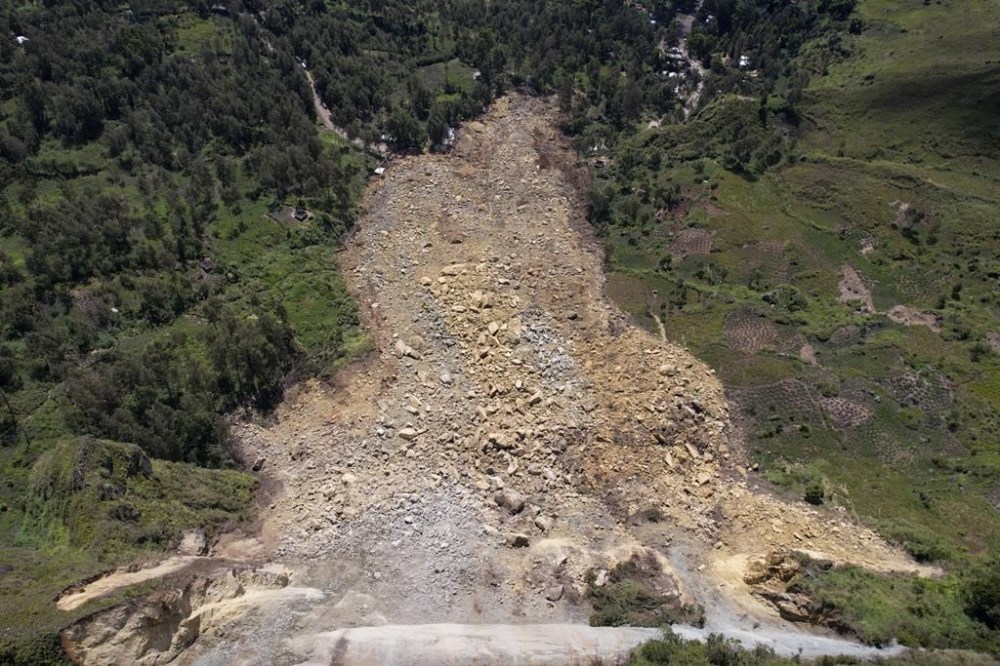
“It’s still very active. We’re getting rocks and debris still moving so it’s been unsafe for our first responders and our emergency team,” Tsaka told The Associated Press.
The United Nations estimated 670 villagers died in the disaster that immediately displaced 1,650 survivors. Papua New Guinea’s government has told the United Nations it thinks more than 2,000 people were buried. Only six bodies have been retrieved.
A hospital in the provincial capital Wabag on Thursday reported 17 patients had been injured by the disaster, that struck at 3 a.m. while the village slept.
Authorities say that up to 8,000 people might need to be evacuated as the mass of boulders, earth and splintered trees that crushed Yambali becomes increasingly unstable and threatens to tumble further downhill. There is also a growing disease risk for those downhill from water streams buried beneath rubble and decomposing corpses that continue to seep from the debris.
Tsaka said only 700 people had agreed to evacuate on Wednesday.
“They’re emotionally scarred and it’s their home and they’re reluctant to move, but we’re encouraging them to move,” Tsaka said. “The villages at risk have been put on alert to move as and when required.”
There were also cultural sensitivities surrounding displaced people intruding upon someone else’s land in a volatile province that is almost always dealing with tribal warfare, officials said.
“That’s a challenge, but with a tragedy the communities and the surrounding villages have come in to help and they’re taking care of the villagers who have been impacted,” Tsaka said.
Chris Jensen, country director for the children-focused charity World Vision, said moving vulnerable villagers onto neighbors’ land was likely a short-term option.
“There’s a concern that if you move people onto land that’s not their land — it’s other people’s land — maybe in the short-term it could be OK, but in the long run, it’s the sort of thing that could trigger challenges. It’s a very sensitive issue,” Jensen said.
But many from Yambali’s surrounds are keen to relocate to somewhere safer, including Frida Yeahkal.
“The stones from the mountain still keep falling. The land, food gardens and houses have been destroyed, and we appeal to the government to help us relocate to a safe place, where we can settle,” Yeahkal told U.N. Development Program officials when they visited the village on Wednesday.
“There is little food and water. We are hungry and asking for your help. We are not even sleeping at night. We are afraid that more of the mountain will slide down and it will kill us all,” she said.
Authorities acknowledge there were many more people in the village than the almost 4,000 that official records suggest. But no one knows how many were present when the mountainside collapsed.
Tsaka said two of the six bodies recovered so far were visitors, which he said suggested many outsiders could be buried among locals.
The nearby Porgera Gold Mine has offered additional earth-moving equipment to the emergency response.
The mine’s manager Karo Lelai confirmed the offer had been made, but could not say what equipment would be provided or when it would arrive.