

Chinese defense minister accuses US of causing friction with its support for Taiwan and Philippines
Advertisement
Read this article for free:
or
Already have an account? Log in here »
To continue reading, please subscribe:

Digital Subscription
One year of digital access for only $205*
- Enjoy unlimited reading on winnipegfreepress.com
- Read the E-Edition, our digital replica newspaper
- Access News Break, our award-winning app
- Play interactive puzzles
*First annual payment billed as $205.00 + GST for one year. This annual subscription will automatically renew at $233.00 + GST every 52 weeks (10% off the regular annual price of $259.35). Offer available to new and qualified returning subscribers only. Cancel any time.
To continue reading, please subscribe:
Add Free Press access to your Brandon Sun subscription for only an additional
$1 for the first 4 weeks*
- Enjoy unlimited reading on winnipegfreepress.com
- Read the E-Edition, our digital replica newspaper
- Access News Break, our award-winning app
- Play interactive puzzles
*Your next Brandon Sun subscription payment will increase by $1.00 and you will be charged $17.95 plus GST for four weeks. After four weeks, your payment will increase to $24.95 plus GST every four weeks.
Read unlimited articles for free today:
or
Already have an account? Log in here »
Hey there, time traveller!
This article was published 01/06/2024 (844 days ago), so information in it may no longer be current.
SINGAPORE (AP) — China’s defense minister on Sunday acknowledged the importance of newly renewed military-to-military communications with the United States as tensions escalate in the Asia-Pacific, while at the same time accusing Washington of causing the friction with its support for Taiwan and the Philippines.
“We will not allow anyone to bring geopolitical conflicts or any war, whether hot or cold, into our region,” Chinese Defense Minister Dong Jun told the Shangri-La defense forum in Singapore through a translator.
“We will not allow any country or any force to create conflict and chaos in our region,” he added.
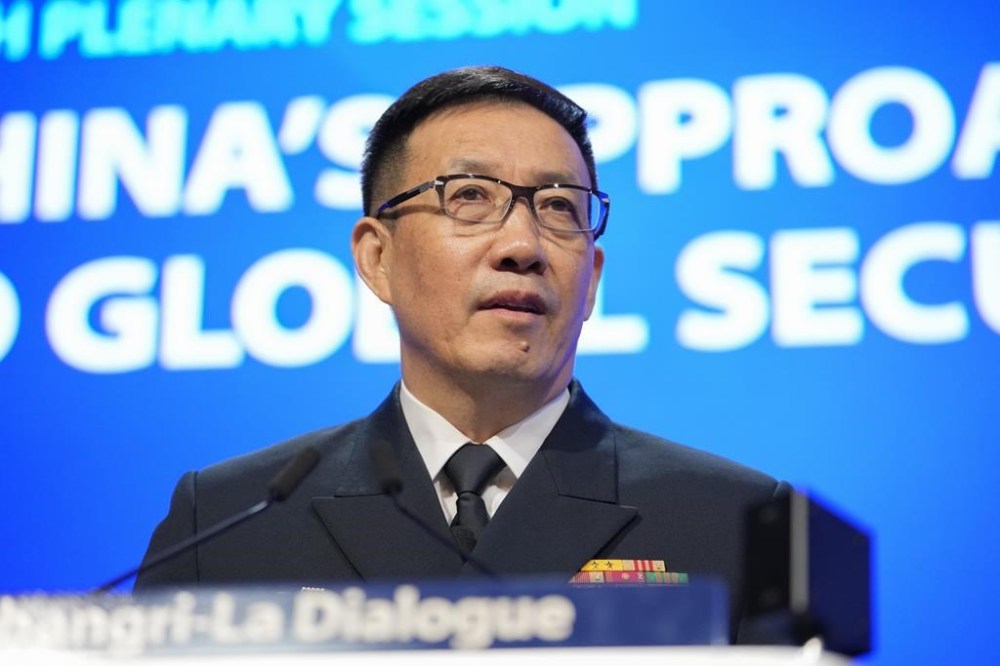
China has been increasingly assertive in pressing its claim to virtually the entire South China Sea, a key global shipping route, which has led to a growing number of conflicts, most notably with the Philippines, whose ships have been rammed by Chinese vessels and hit with water cannons.
Dong insisted that China’s “strategic culture is anchored in universal love and non-aggression,” before threatening the Philippines, which has grown rapidly pro-American since the election of Ferdinand Marcos Jr. in 2022.
Since territorial hostilities with China surged last year in the South China Sea, Marcos Jr.’s administration has taken steps to forge new security alliances with a number of Asian and Western countries and allowed a larger U.S. military presence in more Philippine bases under a 2014 defense pact.
Dong accused the Philippines of deliberately provoking China, “emboldened by outside powers.”
“China has recognized great restraint in the face of such infringements and provocations,” he said. “But there is a limit to our restraint.”
U.S. Defense Secretary Lloyd Austin on Saturday said that American support for the Philippines was “ironclad” and praised Marcos’ Friday speech at the forum as a powerful statement “about how the Philippines is standing up for its sovereign rights under international law.”
Austin also stressed the significance of renewing military-to-military communications between China and the U.S. to avoid “misperceptions” and prevent “miscalculations.”
“There are a number of things that can happen at sea or in the air, we recognize that,” he said. “But our goal is to make sure that we don’t allow things to spiral out of control unnecessarily.”
Dong is a former naval commander who was appointed in late December after his predecessor, Li Shangfu, was abruptly removed from office.
Dong met with Austin on Friday on the sidelines of the Singapore forum, which were the first in-person talks between top Chinese and American defense officials since contacts between the two countries’ militaries broke down in 2022 after then-U.S. House Speaker Nancy Pelosi visited Taiwan, infuriating Beijing.
China regards Taiwan as a renegade province that must come under its control, by force if necessary.
The U.S., like most countries, does not have formal diplomatic ties with Taiwan but is bound by its own laws to provide the island with the means to defend itself. Washington is Taiwan’s biggest provider of military hardware and congressional delegations regularly visit Taiwan’s leaders.
Dong said China remains “open to exchanges and cooperation with the U.S. military,” but added “this requires efforts from both sides.”
He accused the U.S. of emboldening Taiwan’s new government, which refuses to accept Beijing’s insistence that the island is part of China, of “pursuing separation in an incremental way.”
“We will take resolute actions to curb Taiwan independence and make sure such a plot never succeeds,” he said. “Anyone who dares to separate Taiwan from China will only end up in self-destruction.”
___
AP reporter Ken Moritsugu contributed to this story from Hong Kong.