

Many leaders are more interested in power than helping end conflict, UN humanitarian chief says
Advertisement
Read this article for free:
or
Already have an account? Log in here »
To continue reading, please subscribe:

Digital Subscription
One year of digital access for only $205*
- Enjoy unlimited reading on winnipegfreepress.com
- Read the E-Edition, our digital replica newspaper
- Access News Break, our award-winning app
- Play interactive puzzles
*First annual payment billed as $205.00 + GST for one year. This annual subscription will automatically renew at $233.00 + GST every 52 weeks (10% off the regular annual price of $259.35). Offer available to new and qualified returning subscribers only. Cancel any time.
To continue reading, please subscribe:
Add Free Press access to your Brandon Sun subscription for only an additional
$1 for the first 4 weeks*
- Enjoy unlimited reading on winnipegfreepress.com
- Read the E-Edition, our digital replica newspaper
- Access News Break, our award-winning app
- Play interactive puzzles
*Your next Brandon Sun subscription payment will increase by $1.00 and you will be charged $17.95 plus GST for four weeks. After four weeks, your payment will increase to $24.95 plus GST every four weeks.
Read unlimited articles for free today:
or
Already have an account? Log in here »
Hey there, time traveller!
This article was published 05/06/2024 (834 days ago), so information in it may no longer be current.
UNITED NATIONS (AP) — Leaders in many conflict areas are more interested in power and political rivalries than in listening to the needs of their people, improving their lives and ending the fighting, the United Nations humanitarian chief told The Associated Press.
In an interview Wednesday, Martin Griffiths said humanitarian workers in conflict-torn countries see the consequences of this failure every day when they often put their lives on the line to help millions of people who are hungry, displaced and caught in violence. That has been brought into sharp relief in Gaza, where over 200 relief workers have been killed.
The eight-month-old Israel-Hamas war in Gaza does remind the world of the willingness of some key nations to engage to try to end conflict, said Griffiths, who is preparing to step down this month after three years as undersecretary-general for humanitarian affairs and emergency relief coordinator.
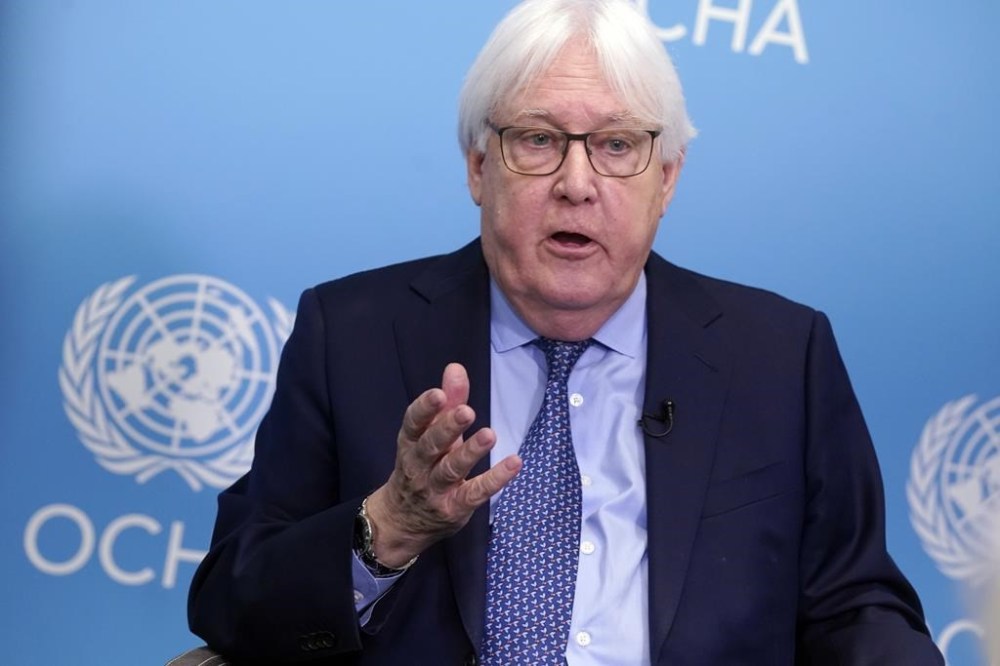
“There’s no lack of political diplomacy on Gaza,” he said. “It’s just not working well enough. But the efforts that have been made by a whole range of governments to support the Palestinian people tells us it can be done.”
The United Nations has criticized Israeli forces for hindering aid deliveries and has called for all border crossings to be open and the security of aid workers and convoys that have been overtaken by starving Palestinians. Israel has repeatedly blamed the U.N. for not getting enough aid into Gaza.
Griffiths called Israel’s criticism “quite a reach,” stressing its obligations as an occupying power to protect and provide civilians with life essentials. “Hamas has an obligation not to have started the October 7 events, which have led to this particular iteration of the terrible Palestinian tragedy.”
Griffiths also said it’s academic whether Israel is carrying out a full-blown military operation in the southern Gaza city of Rafah or not — because it has uprooted a million Palestinians “and it’s full-blown enough to have stopped almost all aid going into southern and central Gaza.”
He said he and Secretary-General Antonio Guterres will attend a conference Tuesday in Amman, Jordan, co-hosted by the U.N., Jordan and Egypt aimed at speeding emergency humanitarian aid to Gaza.
The outgoing humanitarian chief also noted that climate is now rivaling wars as a driver of humanitarian needs, “so it’s a world with two scourges.” He cited more threats of famine today than in many previous years — from the Horn of Africa to conflict zones like Sudan and Gaza — as well as major climate events, including floods in Libya and Pakistan.
Despite increased humanitarian needs and the United Nations paring down its annual budget to help 188 million of the 300 million people in need worldwide, he said the U.N. has only received 17% of funds at mid-year. That’s the lowest in years. The U.N. dropped its budget from about $56 billion last year to $49 billion.
Griffiths said donors — largely countries but also some foundations, companies and others — have cut funding because of expenses like the increasing cost of living and rising energy prices. But he also said a lot more needs to be done to increase aid, from tapping new donors and engaging with the private sector to ending wars and dealing with hundreds of millions of people displaced worldwide.
As examples of the failure of dialogue, he pointed to February 2022 when “Russia simply decided to invade Ukraine to reassert what it saw as its goals — it wasn’t a negotiation, it was an invasion.”
And in Sudan, he said two generals working together in a transitional process toward civilian rule decided one day in mid-April 2023 “to take their country to war and to destroy the livelihoods of so many of their people.” They didn’t negotiate, he said, “they simply decided that the gun was more effective than dialogue.”
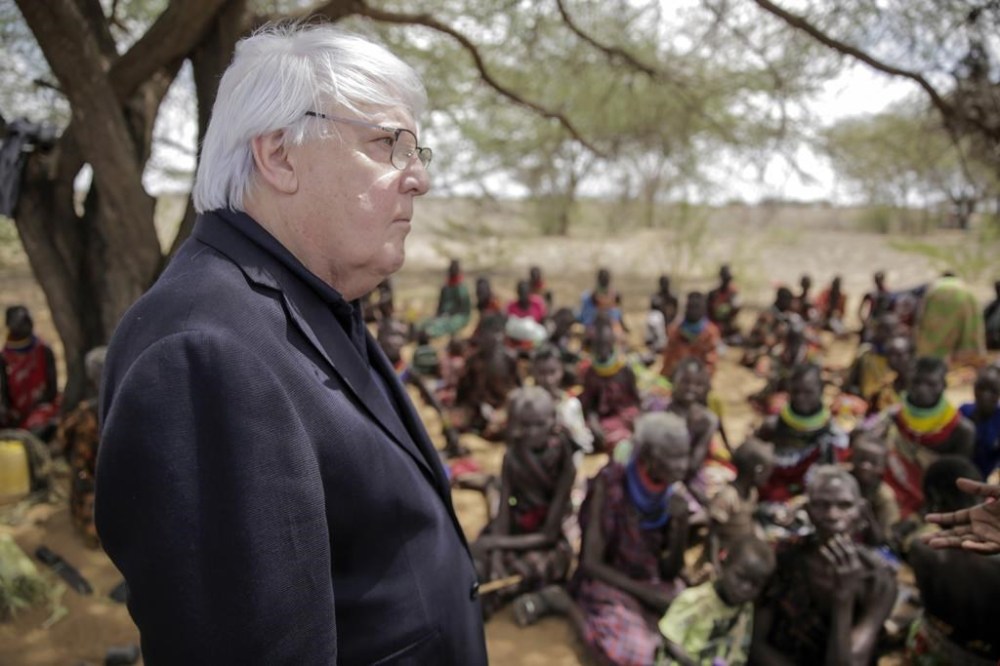
“We have lost our passion for peace and the absence in this divided geopolitical world for political diplomacy to be the central part of how we end wars, which is something I deeply regret,” Griffiths said.
David Miliband, president of the International Rescue Committee, a leading humanitarian organization, praised Griffiths for being a partner in “tackling some of the world’s most pressing challenges,” including wars.
“Martin has worked tirelessly to put the voices of civilians inside Ukraine, Gaza and Sudan at the negotiation table and on the international stage,” Miliband told AP.
He urged the world to fund the humanitarian gap and provide the “diplomatic muscle to stem conflict and human suffering.”
At a time when U.N. mediation and peacekeeping efforts “are often adrift,” Griffiths has tried to alleviate crises the U.N. can’t resolve, said Richard Gowan, the International Crisis Group’s U.N. director. At times, he has gone beyond humanitarian aid, including a wartime deal brokered by the U.N. and Turkey that allowed Ukraine to ship grain for a year after Russia’s invasion, helping alleviate a global food crisis.
“But the reality is that as the U.N.’s humanitarian workload mounts, funding for its efforts is not keeping pace,” he said. “Trying to manage multiple conflicts through aid deliveries, rather than find political solutions for them, is not sustainable indefinitely.”
As for Griffiths’ future, he said he would be spending more time with his family in Geneva but won’t stop working. He is establishing the Office of Martin Griffiths, “or OMG,” he said, laughing, and “what I’ll be doing is working outside the U.N. but on these very similar issues.”