

US submarine pulls into Guantanamo Bay a day after Russian warships arrive in Cuba
Advertisement
Read this article for free:
or
Already have an account? Log in here »
To continue reading, please subscribe:
Monthly Digital Subscription
$0 for the first 4 weeks*
- Enjoy unlimited reading on winnipegfreepress.com
- Read the E-Edition, our digital replica newspaper
- Access News Break, our award-winning app
- Play interactive puzzles
*No charge for 4 weeks then price increases to the regular rate of $19.00 plus GST every four weeks. Offer available to new and qualified returning subscribers only. Cancel any time.
Monthly Digital Subscription
$4.75/week*
- Enjoy unlimited reading on winnipegfreepress.com
- Read the E-Edition, our digital replica newspaper
- Access News Break, our award-winning app
- Play interactive puzzles
*Billed as $19 plus GST every four weeks. Cancel any time.
To continue reading, please subscribe:
Add Free Press access to your Brandon Sun subscription for only an additional
$1 for the first 4 weeks*
*Your next subscription payment will increase by $1.00 and you will be charged $16.99 plus GST for four weeks. After four weeks, your payment will increase to $23.99 plus GST every four weeks.
Read unlimited articles for free today:
or
Already have an account? Log in here »
Hey there, time traveller!
This article was published 13/06/2024 (546 days ago), so information in it may no longer be current.
WASHINGTON (AP) — A U.S. Navy submarine has arrived in Guantanamo Bay, Cuba, in a show of force as a fleet of Russian warships gather for planned military exercises in the Caribbean.
U.S. Southern Command said the USS Helena, a nuclear-powered fast attack submarine, pulled into the waters near the U.S. base in Cuba on Thursday, just a day after a Russian frigate, a nuclear-powered submarine, an oil tanker and a rescue tug crossed into Havana Bay after drills in the Atlantic Ocean.
The stop is part of a “routine port visit” as the submarine travels through Southern Command’s region, it said in a social media post.
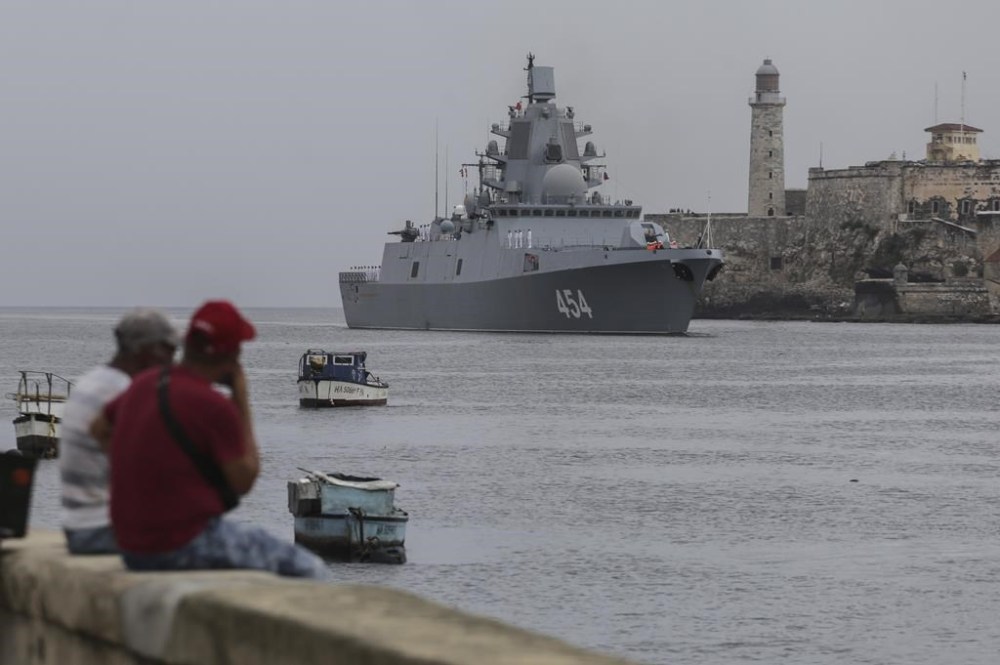
Other U.S. ships also have been tracking and monitoring the Russian drills, which Pentagon officials say do not represent a threat to the United States.
“This is not a surprise. We’ve seen them do these type of port calls before,” Pentagon spokeswoman Sabrina Singh said Wednesday when asked about the Russian drills. “We of course take it seriously, but these exercises don’t pose a threat to the United States.”
The exercises, however, come less than two weeks after President Joe Biden authorized Ukraine to use U.S.-provided weapons to strike inside Russia to protect Kharkiv, Ukraine’s second-largest city. Russian President Vladimir Putin then suggested his military could respond with “asymmetrical steps” elsewhere in the world.
Singh said it wouldn’t be a surprise to see more Russian activity around the United States in such global exercises. The drills are in international waters, and U.S. officials expect the Russian ships to remain in the region through the summer and possibly also stop in Venezuela.
Russia is a longtime ally of Venezuela and Cuba, and its warships and aircraft have periodically made forays into the Caribbean.
Russian ships have occasionally docked in Havana since 2008, when a group of Russian vessels entered Cuban waters in what state media described as the first such visit in almost two decades. In 2015, a reconnaissance and communications ship arrived unannounced in Havana a day before the start of discussions between U.S. and Cuban officials on the reopening of diplomatic relations.