

Indigenous women in Ecuador take on soccer by inventing a sport: handball in traditional skirts
Advertisement
Read this article for free:
or
Already have an account? Log in here »
To continue reading, please subscribe:
Monthly Digital Subscription
$0 for the first 4 weeks*
- Enjoy unlimited reading on winnipegfreepress.com
- Read the E-Edition, our digital replica newspaper
- Access News Break, our award-winning app
- Play interactive puzzles
*No charge for 4 weeks then price increases to the regular rate of $19.95 plus GST every four weeks. Offer available to new and qualified returning subscribers only. Cancel any time.
Monthly Digital Subscription
$4.99/week*
- Enjoy unlimited reading on winnipegfreepress.com
- Read the E-Edition, our digital replica newspaper
- Access News Break, our award-winning app
- Play interactive puzzles
*Billed as $19.95 plus GST every four weeks. Cancel any time.
To continue reading, please subscribe:
Add Free Press access to your Brandon Sun subscription for only an additional
$1 for the first 4 weeks*
*Your next subscription payment will increase by $1.00 and you will be charged $16.99 plus GST for four weeks. After four weeks, your payment will increase to $23.99 plus GST every four weeks.
Read unlimited articles for free today:
or
Already have an account? Log in here »
Hey there, time traveller!
This article was published 20/06/2024 (569 days ago), so information in it may no longer be current.
TURUCU, Ecuador (AP) — In the Indigenous community of Turucu, near the active Cotacachi volcano in northern Ecuador, soccer had always been a man’s thing.
The only gleaming green field belongs to them, especially on weekends. But things changed a year ago when a group of women decided to create a new version of the sport: handball with anaco, an ancient skirt worn by Indigenous women. It is a game only for women.
The match, consisting of two 25-minute halves, begins when the ball is thrown into the air. Screams and laughter erupt almost immediately, even more so when one of the players takes possession of the ball and begins to run to the opposite side of the field to score in a small arc.
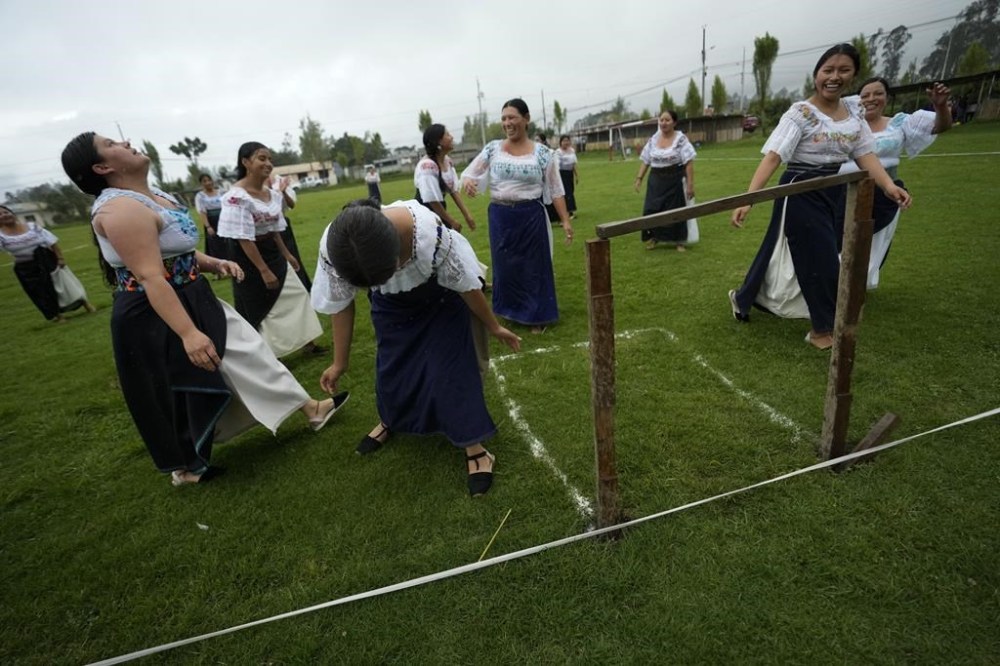
The women run behind whomever is carrying the ball, some of them are trying to defend the attack, and others asking for a pass that allows them to continue advancing. If someone stumbles and falls, the laughter almost makes it impossible to continue the game. This variant of soccer is the simplest and most playful version of what a real game is, the perfect synonym for fun.
Handball with anaco was created by a group of entrepreneurial women from Turucu, located 67 kilometers (41.63 miles) north of the capital, a picturesque indigenous Quichua community surrounded by small agricultural plots and humble houses, near Cotacachi, one of the great attractions of northern Ecuador.
The rules are few and very simple: the uniform is the same traditional Indigenous clothing, blue or black anaco, and impeccable white blouses embroidered with brightly colored flowers, emulating those that grow freely in the nearby fields, the playing field is almost half of the regulations of a regular soccer pitch.
You cannot push rivals or take them by the arms and you cannot kick the ball, which will always be moved with both hands. If there is a strong foul, it is sanctioned with a penalty kick that is taken 10 meters away from the goal, which is 90 centimeters wide and 80 high, propelling the ball with the hands. Anyone can be a forward or a defender. There are no goalkeepers.
“Since we were kids they have told us that soccer is a man’s thing,” Zoila Quinchiguango, one of the members of the Women Entrepreneurs team, told The Associated Press.
By going out to play with the anaco, she added, “we wanted to show that women are not only made for staying in the house raising children or taking care of the animals because we can also have fun on the field.”
The women are far from the only ones who enjoy handball with anaco. Their families watch the games and shout instructions that no one seems to hear.
Around this area of Ecuador, no one knows that the Copa América is going to be played in the United States, they hardly know or have heard about the young Ecuadorian soccer sensation Kendry Páez, a 17-year-old player who was named the most outstanding player in LigaPro.
Some of the older women now say that they have heard about Pelé or Diego Armando Maradona, but they all love handball with anaco.
“This sport is about uniting us as women, uniting the older generations and the younger ones, who only want to go out to the big cities, where we are discriminated against. It is something that we enjoy among women, purely for fun,” said the 33-year-old Sissa de la Cruz.
The oldest one is 58-year-old Dolores Guandinango, who plays often but prefers to stay back and defend near the goal. A year ago her husband was hit by a bus and she is struggling to pay her bills.
“When I play soccer with anaco I forget about the sorrows, even if it’s just for a little while and I laugh with my teammates, it’s only for a little while that the sorrows go away, while we’re on the field,” she added.
___
Follow AP’s coverage of Latin America and the Caribbean at https://apnews.com/hub/latin-america