

Japan’s top court orders government to compensate disabled people who were forcibly sterilized
Advertisement
Read this article for free:
or
Already have an account? Log in here »
To continue reading, please subscribe:

Digital Subscription
One year of digital access for only $205*
- Enjoy unlimited reading on winnipegfreepress.com
- Read the E-Edition, our digital replica newspaper
- Access News Break, our award-winning app
- Play interactive puzzles
*First annual payment billed as $205.00 + GST for one year. This annual subscription will automatically renew at $233.00 + GST every 52 weeks (10% off the regular annual price of $259.35). Offer available to new and qualified returning subscribers only. Cancel any time.
To continue reading, please subscribe:
Add Free Press access to your Brandon Sun subscription for only an additional
$1 for the first 4 weeks*
- Enjoy unlimited reading on winnipegfreepress.com
- Read the E-Edition, our digital replica newspaper
- Access News Break, our award-winning app
- Play interactive puzzles
*Your next Brandon Sun subscription payment will increase by $1.00 and you will be charged $17.95 plus GST for four weeks. After four weeks, your payment will increase to $24.95 plus GST every four weeks.
Read unlimited articles for free today:
or
Already have an account? Log in here »
Hey there, time traveller!
This article was published 03/07/2024 (788 days ago), so information in it may no longer be current.
TOKYO (AP) — In a landmark decision, Japan’s Supreme Court ordered the government Wednesday to pay suitable compensation to about a dozen victims who were forcibly sterilized under a now-defunct Eugenics Protection Law that was designed to eliminate offspring of people with disabilities.
An estimated 25,000 people were sterilized between the 1950s and 1970s without consent to “prevent the birth of poor-quality descendants” under the law, described by plaintiffs’ lawyers as “the biggest human rights violation in the post-war era” in Japan.
The court said the 1948 eugenics law was unconstitutional and rejected the government’s claim that the 20-year statute of limitations should prevent it from paying restitution.
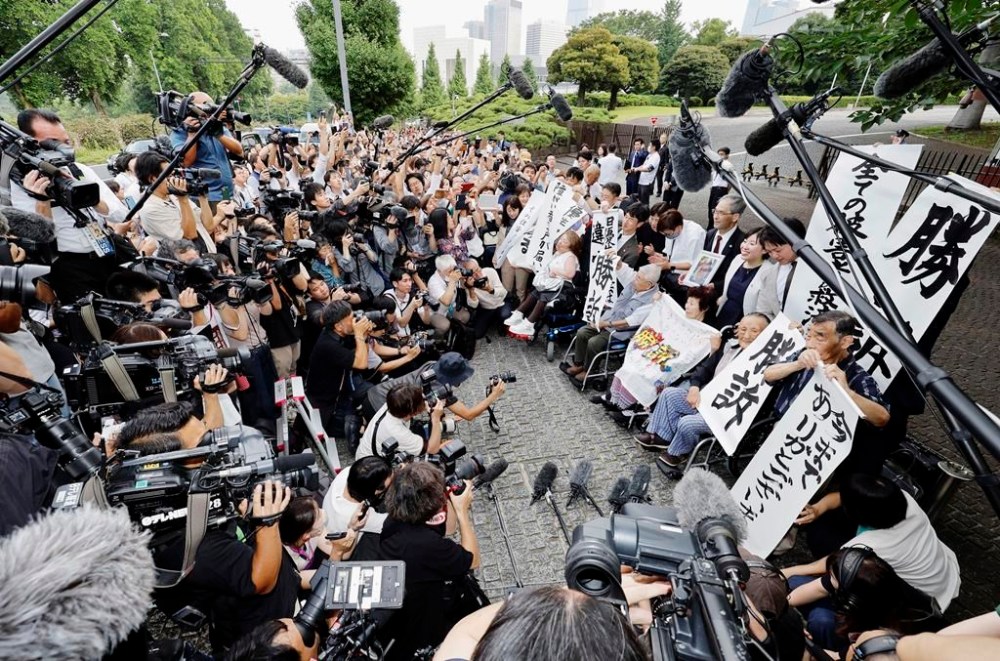
Wednesday’s decision involved 11 of the 39 plaintiffs who fought at five lower courts across Japan to get their case heard by the country’s top court. Cases involving the other litigants are still pending.
The plaintiffs, a number of them in wheelchairs, held up signs saying “thank you” and “victory” outside the court after the ruling. “I couldn’t be happier and I could have never done this alone,” said an 81-year-old plaintiff in Tokyo who uses the pseudonym Saburo Kita.
Kita said he was sterilized in 1957 at age of 14 when he lived in an orphanage. He told his wife his long-buried secret just before she died several years ago, adding that he regretted their inability to have children because of him.
Judge Saburo Tokura ruled that sterilization surgeries were performed “with no rational reasons” and in clear discrimination against the plaintiffs because of their disability, according to court documents released by their lawyers. The court also said the procedure severely violated their dignity, adding that the continuous discrimination and severe violation of human rights for 48 years at the hands of the government was a very serious matter.
In 2019, in response to several lower court rulings holding it accountable, the government offered one-time redress money of 3.2 million yen ($19,800) to each plaintiff. However, the Supreme Court declared Wednesday the compensation was insufficient.
Prime Minister Fumio Kishida expressed “sincere regret and heartfelt apology” to the victims and said he hoped to meet the plaintiffs to apologize in person. Kishida said the government will consider a new compensation scheme.
“The eugenics protection law has created a society that considers people with disabilities as ‘inferior people.’ We call on the society to further promote effort toward eliminating prejudice and discrimination in response to the ruling,” said plaintiffs’ lawyers Koji Niizato and Takehiko Nishimura said in a statement.
About 10,000 leprosy patients were also among those who were sterilized while being confined in isolated institutions. In 1996, the leprosy prevention law was abolished, allowing them to be part of society. The government has offered them compensation and an apology for its forced isolation policy.
In addition to the forced sterilizations at the time, more than 8,000 others were sterilized with consent, though likely under pressure, while nearly 60,000 women had abortions because of hereditary illnesses.
In October, the Supreme Court also ruled that a law requiring transgender people to undergo sterilization in order to change their gender on official documents was unconstitutional, a landmark verdict welcomed by human rights advocates as a sign of growing acceptance of LGBTQ+ rights.