

US envoy to Japan expresses regret over alleged sex crimes by military personnel in Okinawa
Advertisement
Read this article for free:
or
Already have an account? Log in here »
To continue reading, please subscribe:
Monthly Digital Subscription
$0 for the first 4 weeks*
- Enjoy unlimited reading on winnipegfreepress.com
- Read the E-Edition, our digital replica newspaper
- Access News Break, our award-winning app
- Play interactive puzzles
*No charge for 4 weeks then price increases to the regular rate of $19.95 plus GST every four weeks. Offer available to new and qualified returning subscribers only. Cancel any time.
Monthly Digital Subscription
$4.99/week*
- Enjoy unlimited reading on winnipegfreepress.com
- Read the E-Edition, our digital replica newspaper
- Access News Break, our award-winning app
- Play interactive puzzles
*Billed as $19.95 plus GST every four weeks. Cancel any time.
To continue reading, please subscribe:
Add Free Press access to your Brandon Sun subscription for only an additional
$1 for the first 4 weeks*
*Your next subscription payment will increase by $1.00 and you will be charged $16.99 plus GST for four weeks. After four weeks, your payment will increase to $23.99 plus GST every four weeks.
Read unlimited articles for free today:
or
Already have an account? Log in here »
Hey there, time traveller!
This article was published 06/07/2024 (549 days ago), so information in it may no longer be current.
TOKYO (AP) — U.S. Ambassador to Japan Rahm Emanuel expressed regret on Saturday for the handling of two cases of sexual assaults allegedly committed by American military personnel on Okinawa, which have again stoked resentment of the heavy U.S. troop presence on the strategic island in Japan’s far southwest.
The issue broke out late last month, triggering an uproar over reports that two American service members had been charged with sexual assaults months earlier.
Both cases were first reported in local media in late June. In one arrest made in March, a member of the U.S. Air Force was charged with the kidnapping and sexual assault of a teenager, and while in May a U.S. Marine was arrested on charges of attempted rape resulting in injury. Further details about the alleged victims were not released.
Okinawa police said they did not announce the cases out of privacy considerations related to the victims. The Foreign Ministry, per police decision, also did not notify Okinawa prefectural officials.
The cases are a reminder to many Okinawans of the 1995 rape of a 12-year-old girl by three U.S. service members, which sparked massive protests against the U.S. presence. It led to a 1996 agreement between Tokyo and Washington to close a key U.S. air base, although the plan has been repeatedly delayed due to protests at the site designated for its replacement on another part of the island.
Emanuel said he deeply regretted what happened to the individuals, their families and their community, but fell short of apologizing. “Obviously, you got to let the criminal justice process play out. But that doesn’t mean you don’t express on a human level your sense of regret.”
“We have to do better,” he said, adding that the U.S. military’s high standards and protocols for education and training of its troops was “just not working.”
Emanuel said the U.S. may be able to propose measures to improve training and transparency with the public at U.S.-Japan foreign and defense ministers’ security talks expected later this month in Tokyo.
On Friday, Chief Cabinet Secretary Yoshimasa Hayashi said the Japanese authorities would do their utmost to provide more prompt disclosures of alleged crime related to U.S. military personnel on Okinawa while protecting victims’ privacy.
The cases could be a setback for the defense relationship at a time when Okinawa is seen increasingly important in the face of rising tensions with China.
Some 50,000 U.S. troops are deployed in Japan under a bilateral security pact, about half of them on Okinawa, where residents have long complained about heavy U.S. troop presence and related accidents, crime and noise.
Emanuel commented on the issue while visiting Fukushima, on Japan’s northeast coast.
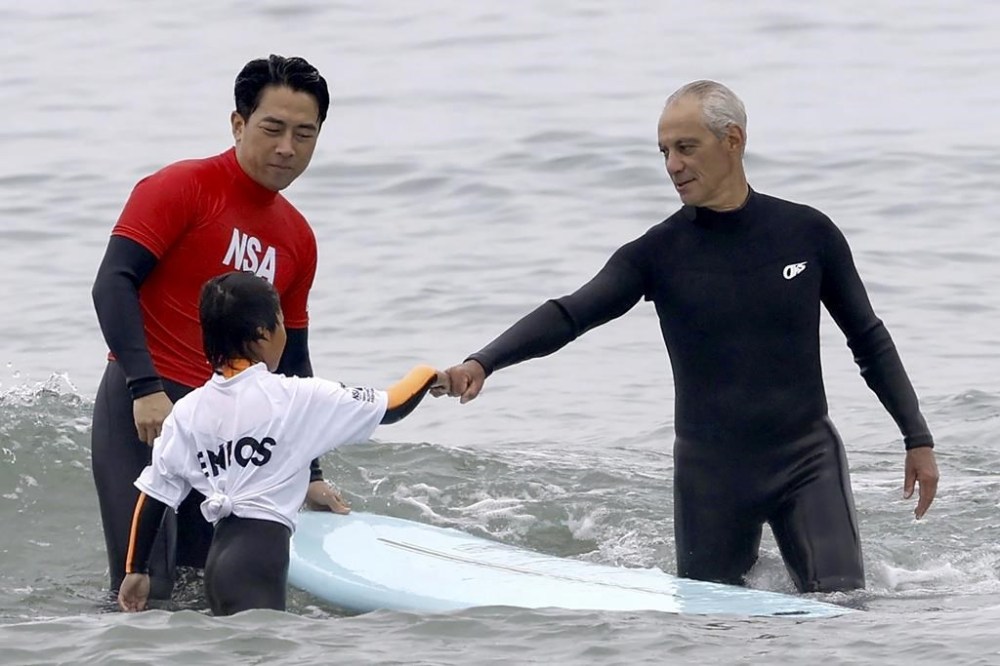
Earlier Saturday, the ambassador visited the nearby town of Minamisoma to join junior surfers and sample locally-caught flounder for lunch, aiming to highlight the safety of the area’s seawater and seafood amid ongoing discharges of treated and diluted radioactive water from the tsuamni-ruined Fukusima Daiichi nuclear power plant.
China has banned Japanese seafood over the discharges, a move Emanuel criticized as unjustified.