

Voting group asks S. Carolina court to order redraw of US House districts that lean too Republican
Advertisement
Read this article for free:
or
Already have an account? Log in here »
To continue reading, please subscribe:

Digital Subscription
One year of digital access for only $205*
- Enjoy unlimited reading on winnipegfreepress.com
- Read the E-Edition, our digital replica newspaper
- Access News Break, our award-winning app
- Play interactive puzzles
*First annual payment billed as $205.00 + GST for one year. This annual subscription will automatically renew at $233.00 + GST every 52 weeks (10% off the regular annual price of $259.35). Offer available to new and qualified returning subscribers only. Cancel any time.
To continue reading, please subscribe:
Add Free Press access to your Brandon Sun subscription for only an additional
$1 for the first 4 weeks*
- Enjoy unlimited reading on winnipegfreepress.com
- Read the E-Edition, our digital replica newspaper
- Access News Break, our award-winning app
- Play interactive puzzles
*Your next Brandon Sun subscription payment will increase by $1.00 and you will be charged $17.95 plus GST for four weeks. After four weeks, your payment will increase to $24.95 plus GST every four weeks.
Read unlimited articles for free today:
or
Already have an account? Log in here »
Hey there, time traveller!
This article was published 29/07/2024 (792 days ago), so information in it may no longer be current.
COLUMBIA, S.C. (AP) — A group that works to protect and expand voting rights is asking South Carolina’s highest court to order lawmakers to redraw the state’s U.S. House districts because they lean too far Republican.
South Carolina’s congressional map was upheld two months ago in a 6-3 U.S. Supreme Court decision that said the state General Assembly did not use race to draw districts based on the 2020 Census.
Those new maps cemented Republicans 6-1 U.S. House advantage after Democrats surprisingly flipped a seat two years earlier.
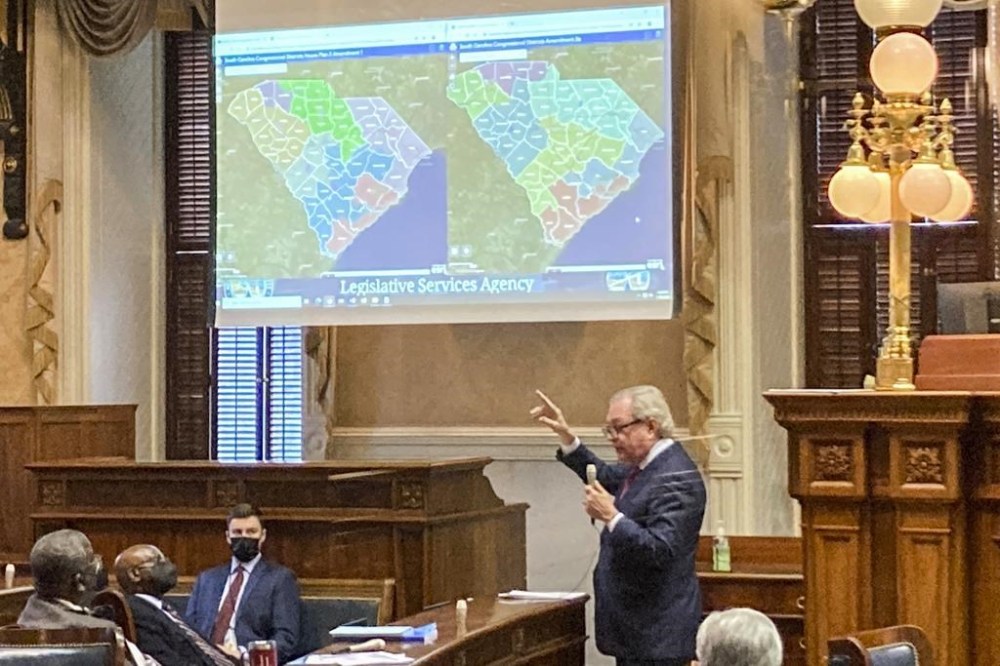
The lawsuit by the League of Women Voters is using testimony and evidence from that case to argue that the U.S. House districts violate the South Carolina constitution’s requirement for free and open elections and that all people are protected equally under the law.
Gerrymandering districts so one party can get much more political power than it should based on voting patterns is cheating, said Allen Chaney, legal director for the South Carolina chapter of the American Civil Liberties Union which is handling the lawsuit.
“South Carolina voters deserve to vote with their neighbors, and to have their votes carry the same weight. This case is about restoring representative democracy in South Carolina, and I’m hopeful that the South Carolina Supreme Court will do just that,” Chaney said Monday in a statement announcing the lawsuit.
The suit was filed against the leadership in both the Republican-dominated state Senate and state House which approved the new maps in January 2022.
“This new lawsuit is another attempt by special interests to accomplish through the courts what they cannot achieve at the ballot box — disregarding representative government. I firmly believe these claims will be found to as baseless as other challenges to these lines have been,” Republican House Speaker Murrell Smith said in a statement.
The suit said South Carolina lawmakers split counties, cities and communities to assure that Republican voters were put into the Charleston to Beaufort area 1st District, which was flipped by a Democrat in 2018 before Republican Nancy Mace flipped it back in 2020.
Democrat leaning voters were then moved into the 6th District, drawn to have a majority of minority voters. The district includes both downtown Charleston and Columbia, which are more than 100 miles (160 kilometers) apart and have little in common.
The ACLU’s suit said in a state where former Republican President Donald Trump won 55% of the vote in 2020, none of the seven congressional districts are even that competitive with Democrats excessively crammed into the 6th District.
Five districts had the two major parties face off in 2022 under the new maps. Republicans won four of the seats by anywhere from 56% to 65% of the vote. Democratic U.S. Rep. Jim Clyburn won his district with 62%.
“There are no competitive districts in the current congressional map (i.e., districts where Democrats make up between 45 percent and 55 percent of seats). This is despite the fact that … simulations show that following traditional redistricting principles would have led mapmakers to draw a map with two competitive congressional districts,” the ACLU wrote in its lawsuit.
The civil rights organization is asking the state Supreme Court to take up the lawsuit directly instead of having hearings and trials in a lower court.
Kentucky, Pennsylvania and New Mexico have similar language in their state constitutions and courts there have ruled drawing congressional districts to secure power for one political party violates the right to equal protection and free and fair elections, the ACLU said in a statement.