

Japan’s defense minister begins visits to Cambodia and Vietnam, both under Beijing’s shadow
Advertisement
Read this article for free:
or
Already have an account? Log in here »
To continue reading, please subscribe:

Digital Subscription
One year of digital access for only $205*
- Enjoy unlimited reading on winnipegfreepress.com
- Read the E-Edition, our digital replica newspaper
- Access News Break, our award-winning app
- Play interactive puzzles
*First annual payment billed as $205.00 + GST for one year. This annual subscription will automatically renew at $233.00 + GST every 52 weeks (10% off the regular annual price of $259.35). Offer available to new and qualified returning subscribers only. Cancel any time.
To continue reading, please subscribe:
Add Free Press access to your Brandon Sun subscription for only an additional
$1 for the first 4 weeks*
- Enjoy unlimited reading on winnipegfreepress.com
- Read the E-Edition, our digital replica newspaper
- Access News Break, our award-winning app
- Play interactive puzzles
*Your next Brandon Sun subscription payment will increase by $1.00 and you will be charged $17.95 plus GST for four weeks. After four weeks, your payment will increase to $24.95 plus GST every four weeks.
Read unlimited articles for free today:
or
Already have an account? Log in here »
Hey there, time traveller!
This article was published 05/08/2024 (786 days ago), so information in it may no longer be current.
PHNOM PENH, Cambodia (AP) — Japan’s defense minister held talks with senior officials in Cambodia, a top ally of China, on Monday as he began a Southeast Asian trip that will also take him to Vietnam, whose relations with Beijing are complicated by maritime disputes.
Japan has historically maintained warm relations with Cambodia, but its influence is minor compared to that of China, Tokyo’s biggest geopolitical rival in Asia, with growing influence throughout Southeast Asia. Tokyo is disturbed by China’s aggressive maritime activity, as are several Southeast Asian nations, and seeks to counter Beijing’s diplomatic and economic outreach.
Defense Minister Minoru Kihara held talks with his Cambodian counterpart, Tea Seiha, as well as with Prime Minister Hun Manet and former Prime Minister Hun Sen, who is now president of the Senate, Defense Ministry spokesperson Gen. Chhum Sochet said on his Facebook page.
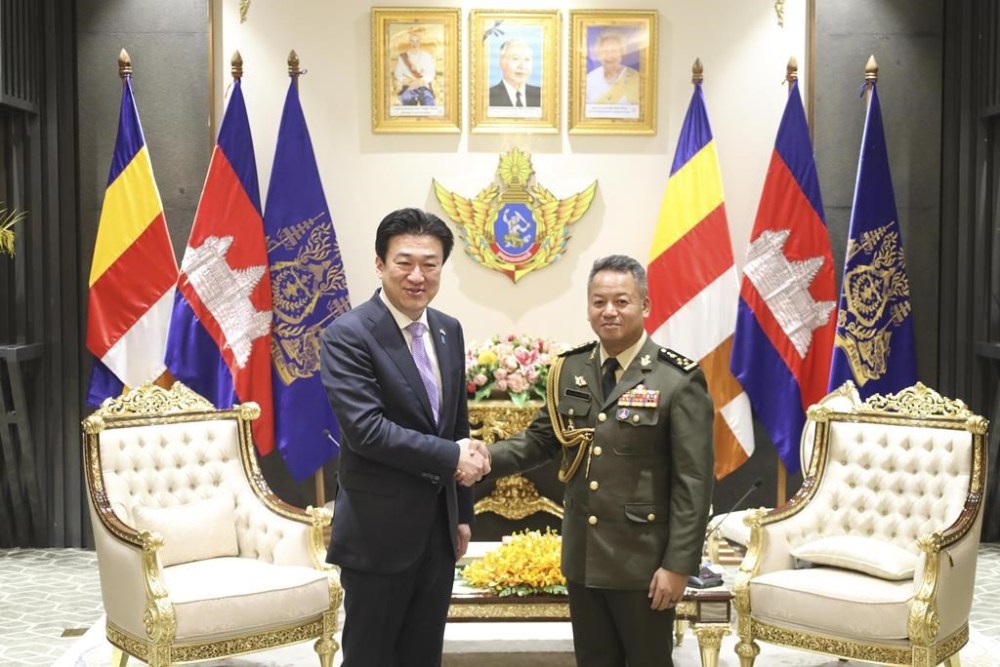
He said the two defense ministers vowed to promote cooperation. especially in human resources and exchanges of personnel visits, as spelled out in a 2013 memorandum of understanding.
A separate Defense Ministry statement said the two sides agreed to hold a joint military training course covering disaster rescue operations and to exchange military attachés.
Kihara told reporters before his trip that Japan has been stepping up defense ties with Cambodia and Vietnam in recent years and that he hopes to deepen cooperation.
“Southeast Asian countries are in strategically important areas that are part of Japan’s crucial sea lanes,” Kihara said.
He said Japan has elevated its relations with both Cambodia and Vietnam to the level of comprehensive and strategic partnership.
Kihara said he hoped to share his “understanding of the strategic environment” in the region and reinforce defense and security cooperation with Cambodia and Vietnam.
Kihara’s visit coincided with Cambodia’s breaking ground on Monday on a controversial China-backed canal linking the capital, Phnom Penh, with the sea, despite environmental concerns and the risk of straining ties with neighboring Vietnam.
The $1.7 billion, 180-kilometer (110-mile) Funan Techo canal is to connect Phnom Penh with Kep province on Cambodia’s southern coast, giving it access to the Gulf of Thailand. Cambodia hopes the 100-meter (328-foot) -wide, 5.4-meter (17-foot) -deep canal will lower the cost of shipping goods to the country’s sole deepwater port, Sihanoukville, and reduce reliance on Vietnamese ports.
China has gained outsize political and economic influence in Cambodia through aid and investment in major infrastructure projects.
Cambodia is a key regional diplomatic partner for Beijing, helping dampen criticism within the 10-member Association of Southeast Asian Nations, several of whose members are engaged in territorial disputes with China in the South China Sea.
In June 2022, China helped Cambodia break ground on a naval port expansion project that has raised concerns from the U.S. and others that it could give Beijing a strategically important military outpost on the Gulf of Thailand. Cambodian officials deny China will have any special basing privileges and say their country maintains a neutral defense posture.