

There’s an apostrophe battle brewing among grammar nerds. Is it Harris’ or Harris’s?
Advertisement
Read this article for free:
or
Already have an account? Log in here »
To continue reading, please subscribe:

Digital Subscription
One year of digital access for only $205*
- Enjoy unlimited reading on winnipegfreepress.com
- Read the E-Edition, our digital replica newspaper
- Access News Break, our award-winning app
- Play interactive puzzles
*First annual payment billed as $205.00 + GST for one year. This annual subscription will automatically renew at $233.00 + GST every 52 weeks (10% off the regular annual price of $259.35). Offer available to new and qualified returning subscribers only. Cancel any time.
To continue reading, please subscribe:
Add Free Press access to your Brandon Sun subscription for only an additional
$1 for the first 4 weeks*
- Enjoy unlimited reading on winnipegfreepress.com
- Read the E-Edition, our digital replica newspaper
- Access News Break, our award-winning app
- Play interactive puzzles
*Your next Brandon Sun subscription payment will increase by $1.00 and you will be charged $17.95 plus GST for four weeks. After four weeks, your payment will increase to $24.95 plus GST every four weeks.
Read unlimited articles for free today:
or
Already have an account? Log in here »
Hey there, time traveller!
This article was published 13/08/2024 (776 days ago), so information in it may no longer be current.
Whatever possessed Vice President Kamala Harris to pick Minnesota Gov. Tim Walz as her running mate, it probably wasn’t a desire to inflame arguments about apostrophes. But it doesn’t take much to get grammar nerds fired up.
“The lower the stakes, the bigger the fight,” said Ron Woloshun, a creative director and digital marketer in California who jumped into the fray on social media less than an hour after Harris selected Walz last week to offer his take on possessive proper nouns.
The Associated Press Stylebook says “use only an apostrophe” for singular proper names ending in S: Dickens’ novels, Hercules’ labors, Jesus’ life. But not everyone agrees.
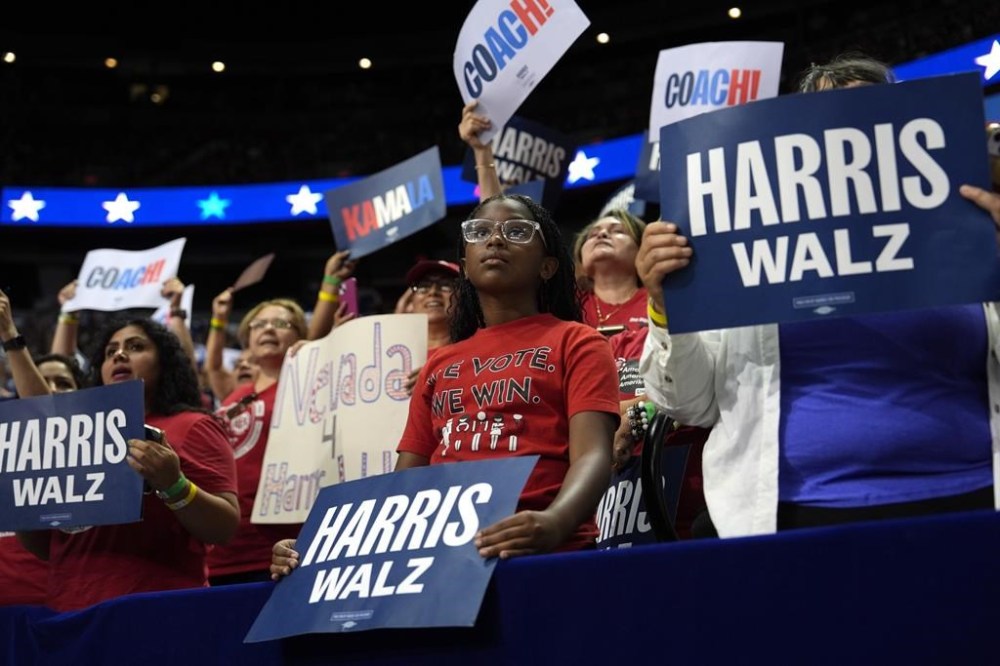
Debate about possessive proper names ending in S started soon after President Joe Biden cleared the way for Harris to run last month. Is it Harris’ or Harris’s? But the selection of Walz with his sounds-like-an-s surname really ramped it up, said Benjamin Dreyer, the retired copy chief at Random House and author of “Dreyer’s English: An Utterly Correct Guide to Clarity and Style”.
Dreyer was inundated with questions within minutes of the announcement, which came while he was at the dentist.
“I was like, ‘All right, everybody just has to chill. I’ll be home in a little while and I can get to my desk,’” he said.
While there is widespread agreement that Walz’s is correct, confusion persists about Harris’ vs. Harris’s. Dreyer’s verdict? Add the ’s.
“To set the ’s is just simpler, and then you can take your valuable brain cells and apply them to more important things,” he said.
Woloshun chimed in with a similar opinion on the social platform X, where apostrophes are being thrown around like hand grenades. “The rule is simple: If you say the S, spell the S,” he argued.
That puts them on the same side as The New York Times, The Washington Post and The Wall Street Journal — and at odds with AP.
While AP style has evolved on many fronts over the years, there are no immediate plans to change the guidance on possessives, said Amanda Barrett, AP’s vice president for news standards and inclusion.
“This is a longstanding policy for the AP. It has served us well, and we’ve not seen any real need to change,” she said. “We do know that the conversation is out there and people make different choices when it comes to grammar, and that’s all fine. Everyone makes a choice that works best for them.”
Timothy Pulju, a senior lecturer in linguistics at Dartmouth College, said that until the 17th or 18th century, the possessive of proper names ending in S — such as Jesus or Moses — often was simply the name itself with no apostrophe or additional S. Eventually, the apostrophe was added (Jesus’ or Moses’) to denote possession, though the pronunciation remained the same.
“That became kind of the standard that I was taught and adhere to, even though in retrospect, I don’t think it’s a great standard,” he said.
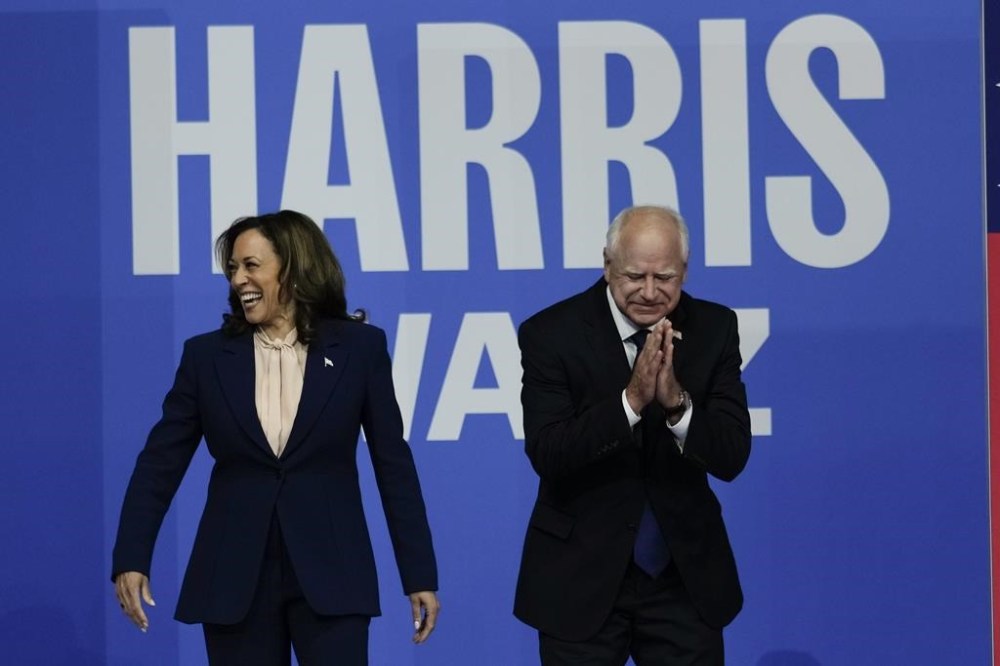
That’s because linguists view writing as a representation of speech, and speech has changed since then. Pulju said he expects the ’s form to become dominant eventually. But for now, he — along with the Merriam-Webster dictionary — says either way is acceptable.
“As long as people are communicating successfully, we say language is doing what it’s supposed to be doing,” he said. “If you can read it whichever way it’s written, then it seems like it’s working for people. They’re not getting confused about whose running mate Tim Walz is.”
If she wins in November, Harris would become the fourth U.S. president with a last name ending in S and the first since Rutherford B. Hayes, who was elected in 1876 — 130 years before the founding of Twitter — and was spared the social media frenzy over apostrophes. Harris is the first nominee with such a tricky last name since 1988, when Democrat Michael Dukakis lost to George H.W. Bush.
Dukakis, now 90, said in a phone interview Monday that he doesn’t recall any similar discussion when he was the nominee. But he agrees with the AP.
“It sounds to me like it would be s, apostrophe, and that’s it,” he said.
The Harris campaign, meanwhile, has yet to take a clear position. A press release issued Monday by her New Hampshire team touted “Harris’s positive vision,” a day after her national press office wrote about “Harris’ seventh trip to Nevada.”
___
This story has been updated to correct that Harris would be the fourth president with a last name ending in S, not third and that Dukakis lost in 1988, not 1984.