

UN rights chief urges voters to beware ‘strongman’ politicians who ‘throw glitter in our eyes’
Advertisement
Read this article for free:
or
Already have an account? Log in here »
To continue reading, please subscribe:

Digital Subscription
One year of digital access for only $205*
- Enjoy unlimited reading on winnipegfreepress.com
- Read the E-Edition, our digital replica newspaper
- Access News Break, our award-winning app
- Play interactive puzzles
*First annual payment billed as $205.00 + GST for one year. This annual subscription will automatically renew at $233.00 + GST every 52 weeks (10% off the regular annual price of $259.35). Offer available to new and qualified returning subscribers only. Cancel any time.
To continue reading, please subscribe:
Add Free Press access to your Brandon Sun subscription for only an additional
$1 for the first 4 weeks*
- Enjoy unlimited reading on winnipegfreepress.com
- Read the E-Edition, our digital replica newspaper
- Access News Break, our award-winning app
- Play interactive puzzles
*Your next Brandon Sun subscription payment will increase by $1.00 and you will be charged $17.95 plus GST for four weeks. After four weeks, your payment will increase to $24.95 plus GST every four weeks.
Read unlimited articles for free today:
or
Already have an account? Log in here »
Hey there, time traveller!
This article was published 09/09/2024 (762 days ago), so information in it may no longer be current.
GENEVA (AP) — The U.N. human rights chief is urging voters to be wary of “strongman” politicians and personalities “that throw glitter in our eyes” as more elections loom in a busy electoral calendar this year.
Volker Türk didn’t mention leaders or countries by name, but alluded to a schedule that includes votes to come in countries like Georgia, Tunisia and the United States.
The rights chief spoke Monday in his traditional opening remarks to sessions of the Human Rights Council, which typically list a wide array of rights concerns globally. The 47-country body — whose membership changes each year — was opening a five-week autumn session.
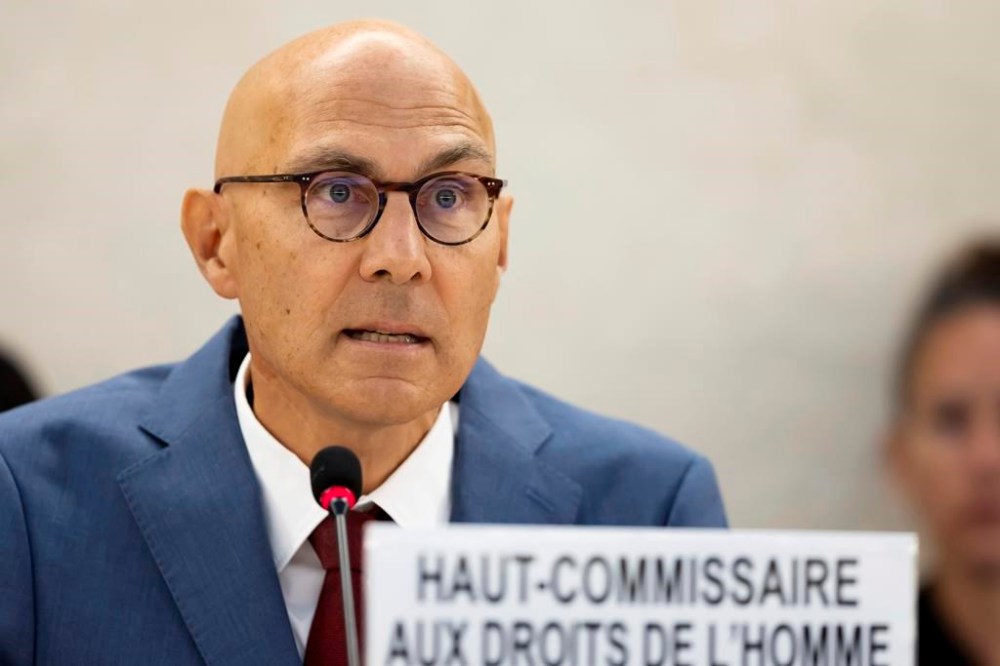
“I urge voters to ask themselves which of the political platforms or candidates will work for the human rights of everyone,” Türk said. “And I urge all voters to be vigilant. Be wary of the shrill voices, the ‘strongman’ types that throw glitter in our eyes, offering illusory solutions that deny reality.”
He denounced some politicians who “scapegoat migrants, refugees and minorities” around electoral periods in places like France, Germany, Hungary, the United Kingdom and the U.S.
High in his mind were the spillover of conflicts on civilians. He warned of “cycles of hatred” that could continue in the Middle East after the “horrific” Oct. 7 attacks in Israel, which took over 1,200 lives, and the subsequent war in Gaza, saying more than 40,000 Palestinians have been killed by Israeli forces.
Ukrainian civilians were “trapped in cycles of terror” due to repeated military strikes by Russian forces in Ukraine, Turk said. He also lamented that Russia has declined to grant access to his team to look into the rights situation in its southwestern Kursk region — which Ukrainian forces recently invaded.
“Troubled by the impact of recent escalations on civilians, including in Kursk, my office has pursued access to all affected areas to be able to monitor the human rights situation. I regret the Russian Federation has so far declined to grant such access to relevant areas,” he said.
The rights chief spoke of a humanitarian crisis amid conflict in Sudan and cited estimates that at least 20,000 people have been killed, saying: “The world cannot let this continue.”
The Austrian-born U.N. veteran contrasted both hopeful and worrying developments. He noted a “positive trend” toward the abolition of the death penalty worldwide, but a rise in executions in Iran and Saudi Arabia.
He hailed a shift toward decriminalization of same-sex relations in many places, but decried “a spate of laws” that aimed to penalize them in countries like Ghana, Indonesia, Iraq and Uganda.
Türk blasted “attempts to muzzle” freedoms of expression and assembly and a free press, pointing to detentions of journalists in Azerbaijan — which hosts a U.N. climate conference in November — arrests of opposition leaders in Tunisia, and “undue restrictions on civic space” in China, among others.
Also Monday, the rights council was taking up discussions on rights situations in Afghanistan, Myanmar and Sri Lanka.