

US troops finish deployment to remote Alaska island amid spike in Russian military activity
Advertisement
Read this article for free:
or
Already have an account? Log in here »
To continue reading, please subscribe:

Digital Subscription
One year of digital access for only $205*
- Enjoy unlimited reading on winnipegfreepress.com
- Read the E-Edition, our digital replica newspaper
- Access News Break, our award-winning app
- Play interactive puzzles
*First annual payment billed as $205.00 + GST for one year. This annual subscription will automatically renew at $233.00 + GST every 52 weeks (10% off the regular annual price of $259.35). Offer available to new and qualified returning subscribers only. Cancel any time.
To continue reading, please subscribe:
Add Free Press access to your Brandon Sun subscription for only an additional
$1 for the first 4 weeks*
- Enjoy unlimited reading on winnipegfreepress.com
- Read the E-Edition, our digital replica newspaper
- Access News Break, our award-winning app
- Play interactive puzzles
*Your next Brandon Sun subscription payment will increase by $1.00 and you will be charged $17.95 plus GST for four weeks. After four weeks, your payment will increase to $24.95 plus GST every four weeks.
Read unlimited articles for free today:
or
Already have an account? Log in here »
Hey there, time traveller!
This article was published 19/09/2024 (702 days ago), so information in it may no longer be current.
ANCHORAGE, Alaska (AP) — About 130 U.S. soldiers are returning to their bases after being deployed last week to a remote Alaska island with mobile rocket launchers amid a spike in Russian military activity off the western reaches of the U.S., a military official said Thursday.
The deployment to Shemya Island involved soldiers from Alaska, Washington and Hawaii with the 11th Airborne Division and the 1st and 3rd Multi Domain Task Forces, Sgt. 1st Class Michael Sword, a spokesperson for the 11th Airborne, said in an email to The Associated Press.
The deployment coincided with eight Russian military planes and four navy vessels, including two submarines, traveling close to Alaska as Russia and China conducted joint military drills. None of the planes breached U.S. airspace.

A Pentagon spokesperson said earlier this week that there was no cause for alarm.
Maj. Gen. Joseph Hilbert, commanding general of the 11th Airborne Division, has told media the deployment to the island 1,200 miles (1,930 kilometers) southwest of Anchorage was done at the right time.
The deployment occurred Sept. 12. The North American Aerospace Defense Command said it detected and tracked Russian military planes operating off Alaska over a four-day span. There were two planes each on Sept. 11, Sept. 13, Sept. 14 and Sept. 15.
The exercise was a measure of the military’s readiness to deploy troops and equipment, Sword said.
“It’s a great opportunity to test ourselves in real-world conditions, and another benefit to being stationed in a place like Alaska,” Sword said.
The Russian military planes operated in the Alaska Air Defense Identification Zone, NORAD said. That is beyond U.S. sovereign air space but an area in which aircraft are expected to identify themselves.
The frequency of Russian airplanes entering the zone varies yearly. NORAD has said the average was six or seven a year, but it has increased recently. There were 26 instances last year and 25 so far this year.
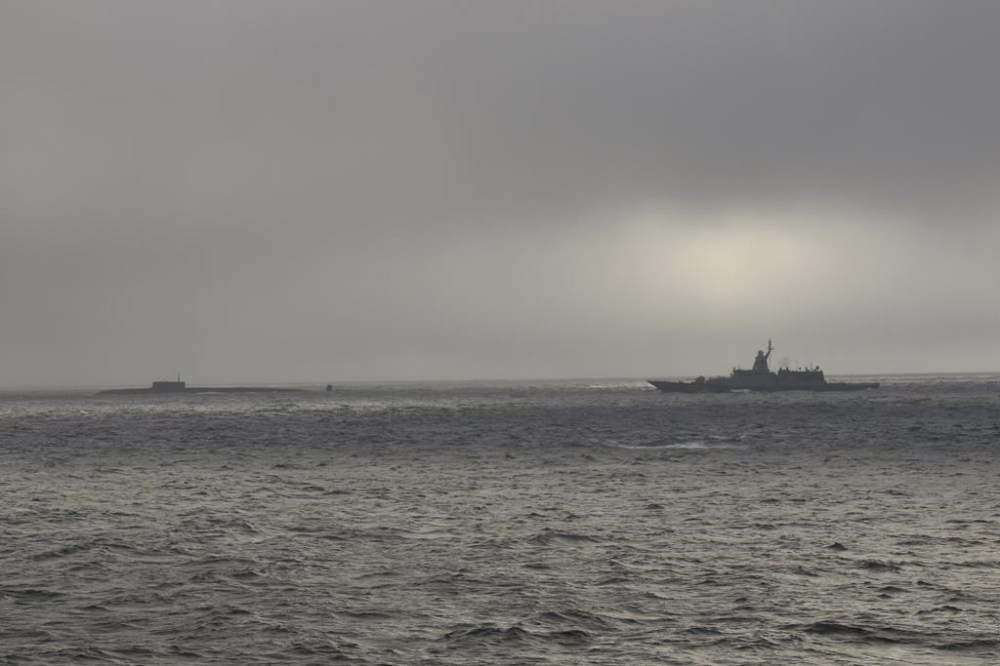
The U.S. Coast Guard’s 418-foot (127-meter) homeland security vessel Stratton was on routine patrol in the Chukchi Sea when it tracked four Russian Federation Navy vessels about 60 miles (100 kilometers) northwest of Point Hope, the agency said Sunday.
Besides the two submarines, the convoy included a frigate and a tugboat. The Coast Guard said the vessels crossed the maritime boundary into U.S. waters to avoid sea ice, which is permitted under international rules and customs.
In 2022 a U.S. Coast Guard ship came across three Chinese and four Russian naval vessels sailing in single formation about 85 miles (140 kilometers) north of Kiska Island in the Bering Sea.