

Head of Myanmar’s military government urges ethnic rebels to join peace talks
Advertisement
Read this article for free:
or
Already have an account? Log in here »
To continue reading, please subscribe:

Digital Subscription
One year of digital access for only $205*
- Enjoy unlimited reading on winnipegfreepress.com
- Read the E-Edition, our digital replica newspaper
- Access News Break, our award-winning app
- Play interactive puzzles
*First annual payment billed as $205.00 + GST for one year. This annual subscription will automatically renew at $233.00 + GST every 52 weeks (10% off the regular annual price of $259.35). Offer available to new and qualified returning subscribers only. Cancel any time.
To continue reading, please subscribe:
Add Free Press access to your Brandon Sun subscription for only an additional
$1 for the first 4 weeks*
- Enjoy unlimited reading on winnipegfreepress.com
- Read the E-Edition, our digital replica newspaper
- Access News Break, our award-winning app
- Play interactive puzzles
*Your next Brandon Sun subscription payment will increase by $1.00 and you will be charged $17.95 plus GST for four weeks. After four weeks, your payment will increase to $24.95 plus GST every four weeks.
Read unlimited articles for free today:
or
Already have an account? Log in here »
Hey there, time traveller!
This article was published 15/10/2024 (725 days ago), so information in it may no longer be current.
BANGKOK (AP) — The head of Myanmar’s military government on Tuesday invited ethnic rebels to hold peace talks to end armed conflict across the country, the second time in less than a month that the ruling generals have publicly promoted negotiations.
Senior Gen. Min Aung Hlaing’s proposal was broadcast on state television on the ninth anniversary of the signing of its nationwide cease-fire agreement. About half of the nation’s 21 established ethnic armed organizations agreed to the pact but some no longer honor it.
Last month, the military announced its most direct invitation for peace talks since it seized power from the elected government of Aung San Suu Kyi in February 2021. It was aimed at the broader pro-democracy forces that have also taken up arms as well as the ethnic groups, but was quickly rejected.
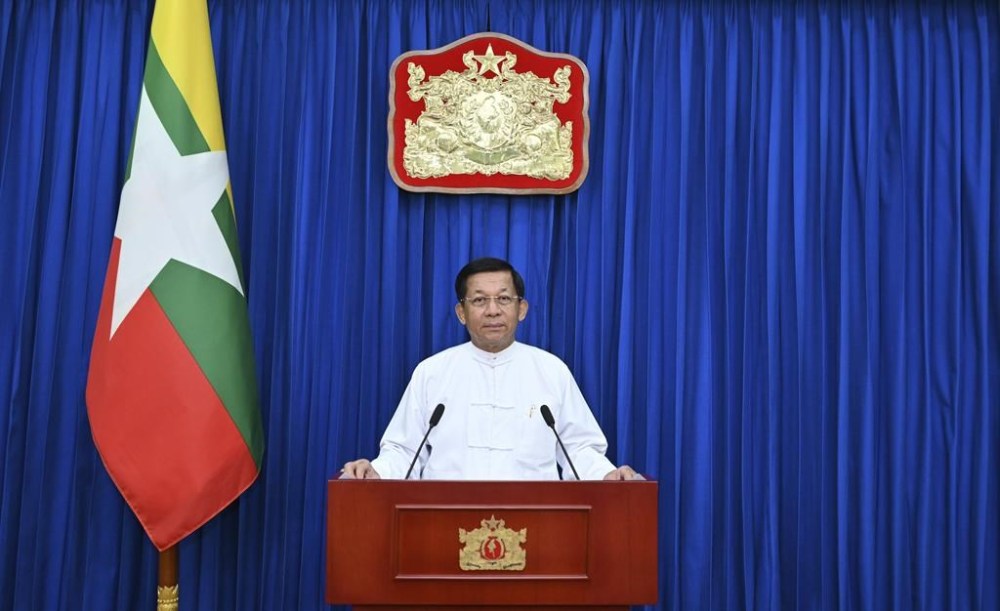
In Tuesday’s brief broadcast, Min Aung Hlaing said the ruling military council will only follow the framework of its existing cease-fire agreement for peace and appealed to the ethnic armed groups to negotiate their issues through dialogue.
“Wishes can’t be demanded through armed violence, but through dialogue at the political table with peaceful means to resolve the conflict,” Min Aung Hlaing said.
Myanmar for several decades has seen a cycle of cease-fires bringing in intermittent periods of relative peace, but none have led to a comprehensive political settlement that would grant the ethnic groups the degree of autonomy they seek in the frontier regions where they are dominant.
The army is currently on the defensive against ethnic militias in much of the country, as well as hundreds of armed guerrilla groups collectively called People’s Defense Forces, formed to fight to restore democracy after the army takeover.
Over the past year, the army has suffered unprecedented battlefield defeats, and the initiative seems to be in the hands of the resistance forces.
In October 2015, eight ethnic armed groups signed the cease-fire agreement, and in February 2018, under Aung San Suu Kyi’s civilian government, two more joined.
The cease-fire was seen by the military as a step toward ending the longstanding ethnic rebellions. Maintaining the cease-fire with as many groups as possible is tactically crucial for the military government so it doesn’t have to fight a strong and united opposition.
Some of the largest and most powerful groups, including the Kachin Independence Army and United Wa State Army, did not endorse the agreement, which they viewed as lacking inclusiveness.
Min Aung Hlaing said that some groups that signed it broke the agreement after the 2021 army takeover, aligning themselves with the shadow National Unity Government, the main opposition group against military rule.
Armed militias representing the Karen, Chin and Pa-O minorities, along with the All Burma Students’ Democratic Front, have spurned peace talks.
“I see that what the military is doing is only creating conditions that will prolong the military dictatorship,” said Aye Lwin, the spokesperson of the students’ front. “There is currently no reason to accept the military-led dialogue.”