

Italy expands its ban on surrogacy to overseas as critics say it targets same-sex couples
Advertisement
Read this article for free:
or
Already have an account? Log in here »
To continue reading, please subscribe:

Digital Subscription
One year of digital access for only $205*
- Enjoy unlimited reading on winnipegfreepress.com
- Read the E-Edition, our digital replica newspaper
- Access News Break, our award-winning app
- Play interactive puzzles
*First annual payment billed as $205.00 + GST for one year. This annual subscription will automatically renew at $233.00 + GST every 52 weeks (10% off the regular annual price of $259.35). Offer available to new and qualified returning subscribers only. Cancel any time.
To continue reading, please subscribe:
Add Free Press access to your Brandon Sun subscription for only an additional
$1 for the first 4 weeks*
- Enjoy unlimited reading on winnipegfreepress.com
- Read the E-Edition, our digital replica newspaper
- Access News Break, our award-winning app
- Play interactive puzzles
*Your next Brandon Sun subscription payment will increase by $1.00 and you will be charged $17.95 plus GST for four weeks. After four weeks, your payment will increase to $24.95 plus GST every four weeks.
Read unlimited articles for free today:
or
Already have an account? Log in here »
Hey there, time traveller!
This article was published 16/10/2024 (715 days ago), so information in it may no longer be current.
ROME (AP) — Italy on Wednesday criminalized citizens who go abroad to have children through surrogacy, a measure slammed by opponents as “medieval” and discriminatory to same-sex couples.
The measure extending a surrogacy ban in place since 2004 was promoted by Premier Giorgia Meloni’s far-right Brothers of Italy party and its conservative coalition partner, the League, asserting that it protects women’s dignity.
The Senate after a seven-hour debate passed the bill 84-58, the final step in the process after the Lower House’s approval last year.
Italians seeking surrogacy in countries such as the United States or Canada, where the practice is legal, can face up to two years in jail and up to 1 million euros ($1.1 million) in fines.
The surrogacy ban applies equally to all couples. But same-sex parent advocates say it hits gay families particularly hard in a country struggling with record-low birthrates and where only heterosexual couples are allowed to adopt.
Same-sex marriages are also banned in Italy, and LGBTQ+ couples have been fighting to obtain parental rights for the partner who is not the biological parent.
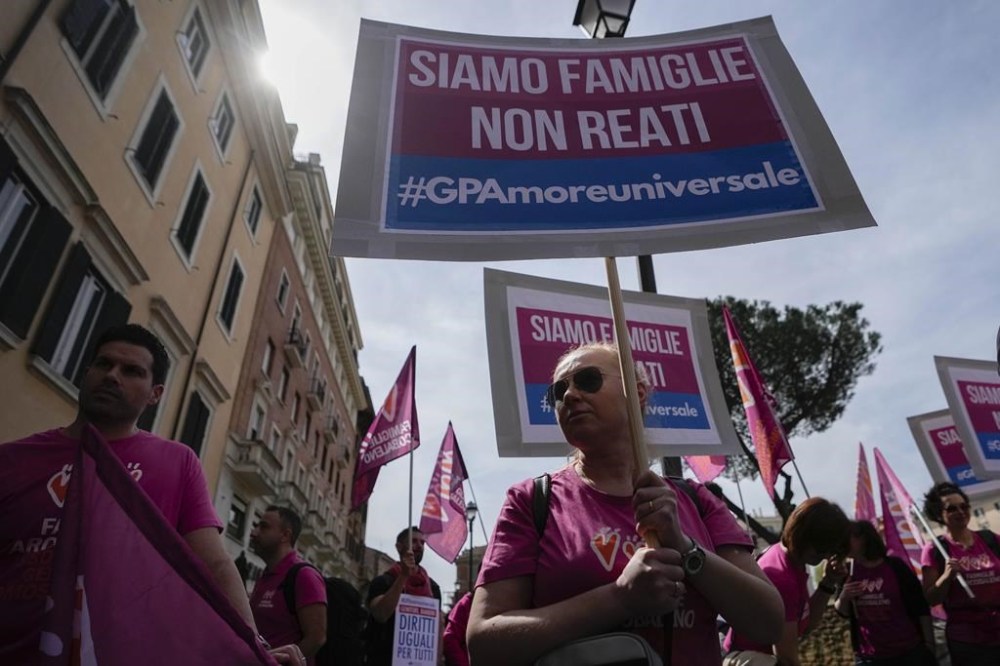
Several lawmakers and LGBTQ+ activists protested in front of the Senate to oppose the law, some holding banners that read: “Parents, not criminals.”
“When protectionism prevails, a social phenomenon is not erased,” opposition lawmaker Riccardo Magi said during the protest. “It is simply relegated to a dark area, which the law doesn’t reach. In that case, it’s easier for exploitation, abuse and rights violations to prevail.”
“We are very saddened because Italy has once again missed an opportunity to demonstrate that it is a country in line with what Europe and the world are,” said Cristiano Giraldi, the father of two 10-year-old children born from a surrogate mother in the U.S.
The Catholic Church has strongly opposed surrogacy in Italy and abroad, with Pope Francis calling for a universal ban and criticizing what he called the “commercialization” of pregnancy.
At the same time, the Vatican’s doctrine office has made clear that same-sex parents who resort to surrogacy can have their children baptized.
While commercial surrogacy contracts are common in the U.S. — including protections for mothers, guarantees of independent legal representation and medical coverage — they are banned in parts of Europe including Spain and Italy.