

A Minnesota woman is accused of turning in a ballot for her dead mother. A routine check caught it
Advertisement
Read this article for free:
or
Already have an account? Log in here »
To continue reading, please subscribe:

Digital Subscription
One year of digital access for only $205*
- Enjoy unlimited reading on winnipegfreepress.com
- Read the E-Edition, our digital replica newspaper
- Access News Break, our award-winning app
- Play interactive puzzles
*First annual payment billed as $205.00 + GST for one year. This annual subscription will automatically renew at $233.00 + GST every 52 weeks (10% off the regular annual price of $259.35). Offer available to new and qualified returning subscribers only. Cancel any time.
To continue reading, please subscribe:
Add Free Press access to your Brandon Sun subscription for only an additional
$1 for the first 4 weeks*
- Enjoy unlimited reading on winnipegfreepress.com
- Read the E-Edition, our digital replica newspaper
- Access News Break, our award-winning app
- Play interactive puzzles
*Your next Brandon Sun subscription payment will increase by $1.00 and you will be charged $17.95 plus GST for four weeks. After four weeks, your payment will increase to $24.95 plus GST every four weeks.
Read unlimited articles for free today:
or
Already have an account? Log in here »
Hey there, time traveller!
This article was published 28/10/2024 (708 days ago), so information in it may no longer be current.
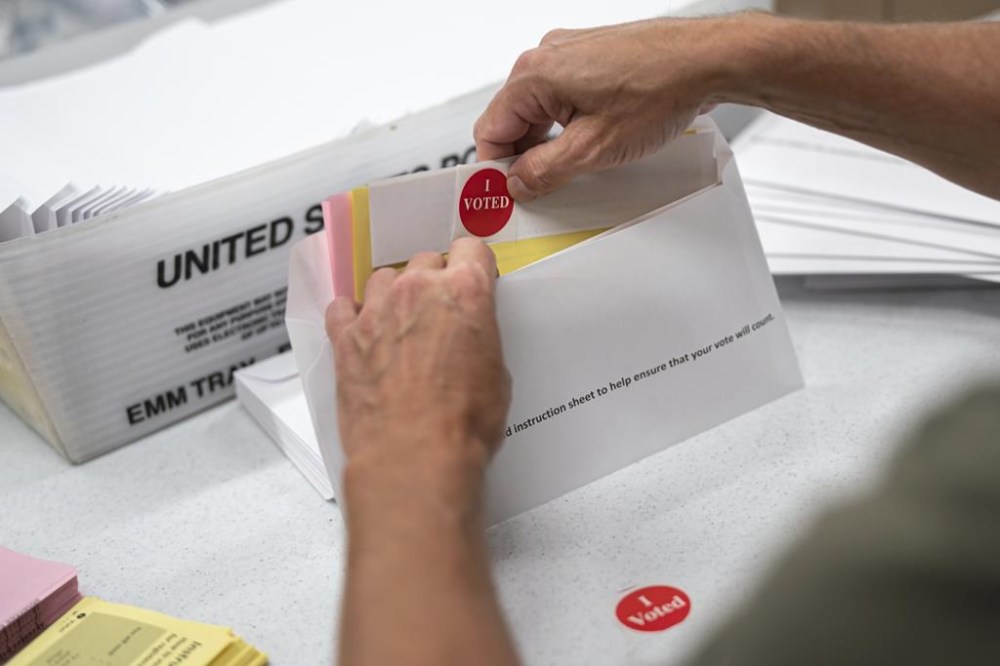
A northern Minnesota woman accused of trying to submit a mail ballot for her recently deceased mother has been charged with three felonies, showing how routine election safeguards thwart rare instances of attempted voter fraud.
Officials in Itasca County, about 200 miles (322 kilometers) north of Minneapolis, said Monday that the improper vote was caught because the state provides a monthly list of people who’ve died to election officials, who then flag those names in the state’s voter registration database. The woman returned ballots for herself and her mother in early October, and the county auditor’s office, which oversees local elections, quickly verified that the mother had died at the end of August, almost three weeks before it began mailing out absentee ballots.
The criminal case was filed last week in state district court in Grand Rapids as former President Donald Trump continued to suggest he will lose the Nov. 5 election only if his political opponents cheat. There was no evidence of significant voter fraud in the 2020 election, which Trump lost, and there is no evidence Trump’s adversaries can or will rig this year’s election.
The woman told a sheriff’s lieutenant in an interview that she filled out her mother’s ballot after her mother’s death, according to a probable cause statement filed with the district court. The statement said the woman was an “ardent” Trump supporter who had wanted to vote for him before she died.
Itasca County Attorney Jake Fauchald said the case shows election officials can catch problems and even rural counties have the resources and willingness to prosecute election fraud. Itasca County has about 45,000 residents.
“It was flagged almost immediately,” Fauchald said. “We do have ways of catching and flagging these fraudulent ballots and we’re going to do something about it so that those ballots don’t get through.”
The woman’s first court appearance is set for Dec. 4. She is charged with one count of illegal voting and two counts of making or signing a false certificate, accused of forging her mother’s signature, both on the mother’s ballot envelope, and as a witness on her own. Each charge carries a maximum penalty of five years in prison and a fine of up to $10,000.
It was not clear whether the woman has an attorney, and 10 telephone listings for her online were out of service. She did not immediately respond Monday to a Facebook message seeking comment.
Fauchald said it’s the county’s first case involving voter fraud during the current election cycle.
An Associated Press investigation of the 2020 election explored every potential case of voter fraud in the six battleground states disputed by Trump and found there were fewer than 475 out of millions of votes cast, not enough to tip the outcome. Democrat Joe Biden won the six states by a combined 311,257 votes.
In Minnesota, Itasca County Auditor Austin Rohling said he hasn’t seen a “nefarious” case of someone casting a ballot for a dead person in his nearly two years in office. He said occasionally, someone fills out a ballot, returns it and then dies before Election Day. In that case, it isn’t counted under Minnesota law.
Sixteen other states prohibit counting ballots cast by someone who subsequently dies before the election, but 10 states specifically allow it. The law is silent in the rest of the country, according to research by the National Conference of State Legislatures.
Rohling said that “strange things happen” in elections “on an extremely minor level,” but very few of those incidents involve intentional fraud.
“The system’s working the way it should,” Rohling said.
____
Hanna reported from Topeka, Kansas.
Related Articles
Fires set in drop boxes destroy hundreds of ballots in Washington and damage 3 in Oregon
Advertisement Advertise With Us
Advertisement Advertise With Us