

Monument erected in Tulsa for victims of 1921 Race Massacre
Advertisement
Read this article for free:
or
Already have an account? Log in here »
To continue reading, please subscribe:

Digital Subscription
One year of digital access for only $205*
- Enjoy unlimited reading on winnipegfreepress.com
- Read the E-Edition, our digital replica newspaper
- Access News Break, our award-winning app
- Play interactive puzzles
*First annual payment billed as $205.00 + GST for one year. This annual subscription will automatically renew at $233.00 + GST every 52 weeks (10% off the regular annual price of $259.35). Offer available to new and qualified returning subscribers only. Cancel any time.
To continue reading, please subscribe:
Add Free Press access to your Brandon Sun subscription for only an additional
$1 for the first 4 weeks*
- Enjoy unlimited reading on winnipegfreepress.com
- Read the E-Edition, our digital replica newspaper
- Access News Break, our award-winning app
- Play interactive puzzles
*Your next Brandon Sun subscription payment will increase by $1.00 and you will be charged $17.95 plus GST for four weeks. After four weeks, your payment will increase to $24.95 plus GST every four weeks.
Read unlimited articles for free today:
or
Already have an account? Log in here »
Hey there, time traveller!
This article was published 12/11/2024 (646 days ago), so information in it may no longer be current.
TULSA, Okla. (AP) — A World War I veteran whose remains were identified earlier this year during a probe into the 1921 Tulsa Race Massacre was among those honored in a memorial service Tuesday at Tulsa’s Oaklawn Cemetery.
C.L. Daniel was the first victim of the massacre to be identified among remains discovered in a mass grave in the city. A gravestone bearing Daniel’s name was erected at the cemetery, along with a monument to other victims.
On May 31 and June 1, 1921, a white mob looted and burned Greenwood, a thriving Black district of Tulsa, in one of the worst single acts of violence against Black people in U.S. history. As many as 300 Black people were killed; more than 1,200 homes, businesses, schools and churches were destroyed; and thousands were forced into internment camps overseen by the National Guard.
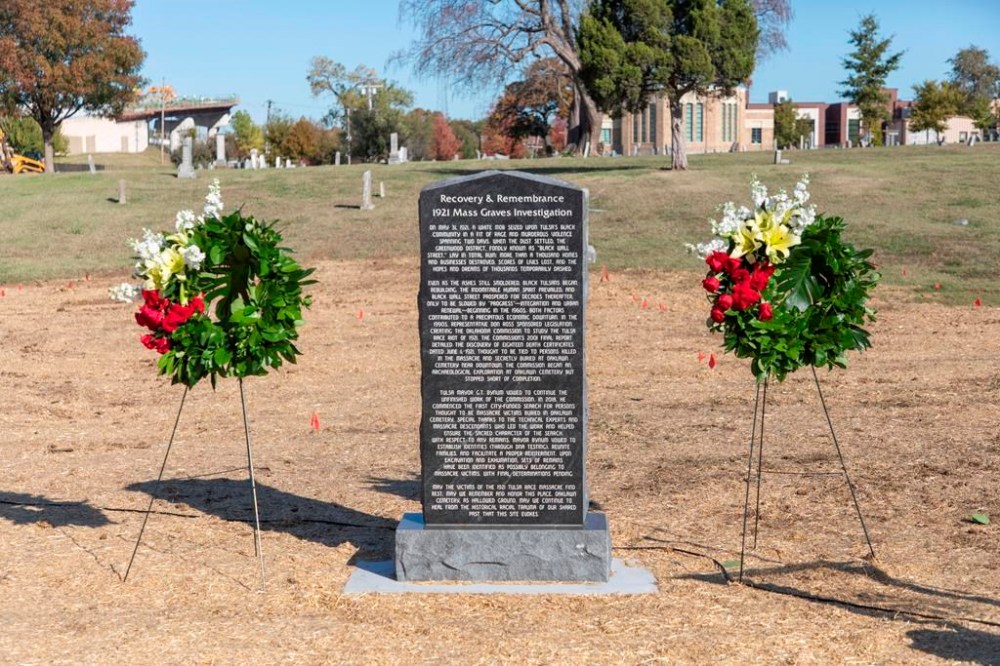
“Today represents more than a memorial for C.L. Daniel and those still resting in unidentified graves,” Daniel’s family said in a statement. “It is a long-awaited acknowledgement of lives impacted by the massacre and a testament to the resilience of the Greenwood community, which has sought recognition and justice for their loved ones over generations.”
City officials said genetic and DNA analyses are continuing for other unidentified individuals whose remains have been discovered in the city’s search for victims.
The U.S. Department of Justice announced in September it was launching a civil rights review into the massacre. The agency plans to issue a public report detailing its findings by the end of the year.