

Turkey’s Erdogan says he remains hopeful about reconciliation with Syria
Advertisement
Read this article for free:
or
Already have an account? Log in here »
To continue reading, please subscribe:

Digital Subscription
One year of digital access for only $205*
- Enjoy unlimited reading on winnipegfreepress.com
- Read the E-Edition, our digital replica newspaper
- Access News Break, our award-winning app
- Play interactive puzzles
*First annual payment billed as $205.00 + GST for one year. This annual subscription will automatically renew at $233.00 + GST every 52 weeks (10% off the regular annual price of $259.35). Offer available to new and qualified returning subscribers only. Cancel any time.
To continue reading, please subscribe:
Add Free Press access to your Brandon Sun subscription for only an additional
$1 for the first 4 weeks*
- Enjoy unlimited reading on winnipegfreepress.com
- Read the E-Edition, our digital replica newspaper
- Access News Break, our award-winning app
- Play interactive puzzles
*Your next Brandon Sun subscription payment will increase by $1.00 and you will be charged $17.95 plus GST for four weeks. After four weeks, your payment will increase to $24.95 plus GST every four weeks.
Read unlimited articles for free today:
or
Already have an account? Log in here »
Hey there, time traveller!
This article was published 13/11/2024 (665 days ago), so information in it may no longer be current.
ANKARA, Turkey (AP) — Turkish President Recep Tayyip Erdogan has said he remains hopeful that a reconciliation with Syrian President Bashar Assad can be achieved to end more than a decade of tensions between their two neighboring countries, state-run media reported on Wednesday.
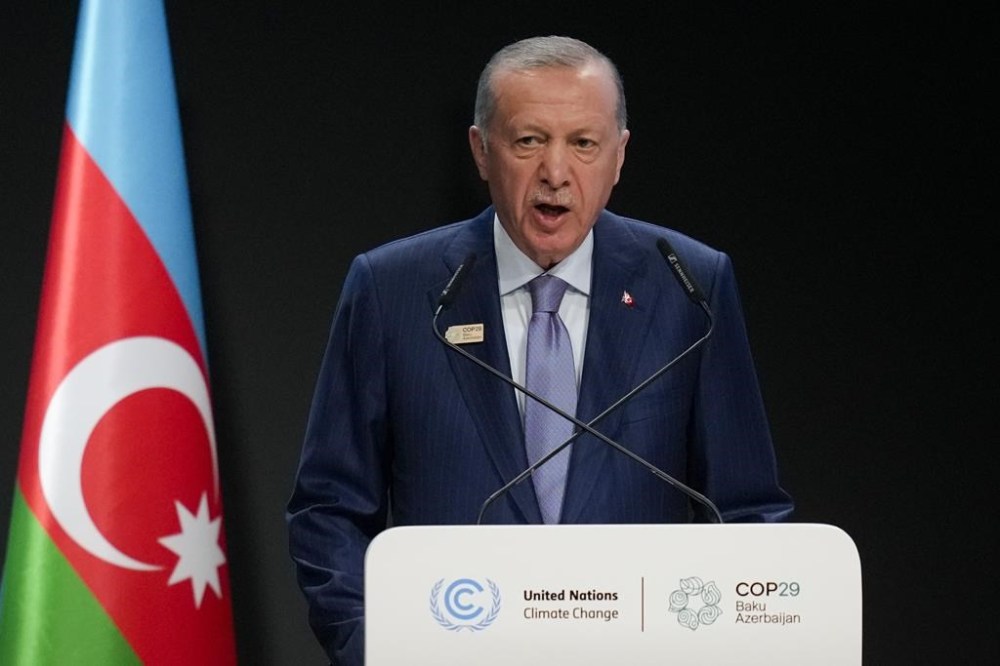
Speaking to journalists on his return from trips to Saudi Arabia and Azerbaijan, Erdogan said he believes a normalization of ties would help stabilize Syria and protect its “territorial integrity.”
“I am still hopeful about Assad,” the state-run Anadolu Agency quoted Erdogan as saying. “I still have hope that we can come together and hopefully put Syria-Turkey relations back on track.”
Relations between Ankara and Damascus broke down with the outbreak of Syria’s civil war, when Turkey backed insurgent groups seeking to overthrow Assad, and Syria accused Turkey of fomenting instability. Turkey later carried out a series of incursions into Syria and still maintains forces in the opposition-held northwest, which Syria has strongly condemned.
More recently, Turkey has been seeking a reconciliation with Syria to address security threats from groups affiliated with Kurdish militants along its southern border and to help ensure the safe return of Syrian refugees. Russia, one of the strongest backers of Assad’s government but which also has close ties with Turkey, has been pushing for a return to diplomatic relations.
The Turkish, Syrian and Russian defense ministers held talks in Moscow in December 2022, the first ministerial level meeting between Turkey and Syria since 2011. Russia also brokered meetings between Syrian and Turkish officials last year, but the efforts have stalled since then.
Assad has said publicly that Turkey would have to withdraw its forces from northern Syria as a condition for any normalization between the two countries.
This week, both Assad and Erdogan took part in a joint Arab-Islamic summit in Riyadh. Erdogan was seen leaving the hall as the Syrian president addressed the summit in what was interpreted as a reflection of the ongoing tensions.
Erdogan however, said he had to leave to attend a bilateral meeting with Saudi Arabia’s crown prince.
“We have extended our hand to the Syrian side regarding normalization. We believe that this normalization will open the door to peace and tranquility in Syria,” Erdogan said on Wednesday.
“We are not the ones threatening Syria’s territorial integrity. Terrorists, primarily the terrorist organization PKK/PYD/YPG, threaten Syria’s territorial integrity,” Erdogan added, in reference to the outlawed Kurdistan Workers’ Party and affiliated Syrian Kurdish groups.
Erdogan also suggested that due to the tensions in the Middle East, reconciliation would be in Syria’s interest.
“The Israeli threat next door is no fairy tale. We must not forget that instability in the region spreads quickly through volatile lands,” he said.
Asked about a possible new Turkish incursion into Syria, Erdogan said “cross-border operations are always on our agenda.”
“If we feel threatened, we are prepared to launch cross-border operations at any time,” Erdogan said.
Turkey has long declared intentions to create a 30- to 40-kilometer (19 to 24-mile) deep buffer zone along its borders with Syria and Iraq to prevent threats from the PKK and other Kurdish groups it considers to be terrorist organizations.