

Putin critics lead a march in Berlin calling for democracy in Russia and an end to war in Ukraine
Advertisement
Read this article for free:
or
Already have an account? Log in here »
To continue reading, please subscribe:

Digital Subscription
One year of digital access for only $205*
- Enjoy unlimited reading on winnipegfreepress.com
- Read the E-Edition, our digital replica newspaper
- Access News Break, our award-winning app
- Play interactive puzzles
*First annual payment billed as $205.00 + GST for one year. This annual subscription will automatically renew at $233.00 + GST every 52 weeks (10% off the regular annual price of $259.35). Offer available to new and qualified returning subscribers only. Cancel any time.
To continue reading, please subscribe:
Add Free Press access to your Brandon Sun subscription for only an additional
$1 for the first 4 weeks*
- Enjoy unlimited reading on winnipegfreepress.com
- Read the E-Edition, our digital replica newspaper
- Access News Break, our award-winning app
- Play interactive puzzles
*Your next Brandon Sun subscription payment will increase by $1.00 and you will be charged $17.95 plus GST for four weeks. After four weeks, your payment will increase to $24.95 plus GST every four weeks.
Read unlimited articles for free today:
or
Already have an account? Log in here »
Hey there, time traveller!
This article was published 17/11/2024 (693 days ago), so information in it may no longer be current.
BERLIN (AP) — Prominent Russian opposition figures led a march of at least 1,000 people in central Berlin Sunday, criticizing Russian President Vladimir Putin and his war in Ukraine and calling for democracy in Russia.
Behind a banner that read “No Putin. No War,” the protesters were led by Yulia Navalnaya, the widow of top Putin critic Alexei Navalny, as well as Ilya Yashin and Vladimir Kara-Murza, who were freed from Russian detention in a high-profile prisoner exchange this summer.
Shouting “Russia without Putin” and other chants in Russian, the demonstrators held up signs with a wide array of messages on a red background, including “Putin = War” and “Putin is a murderer” in German.
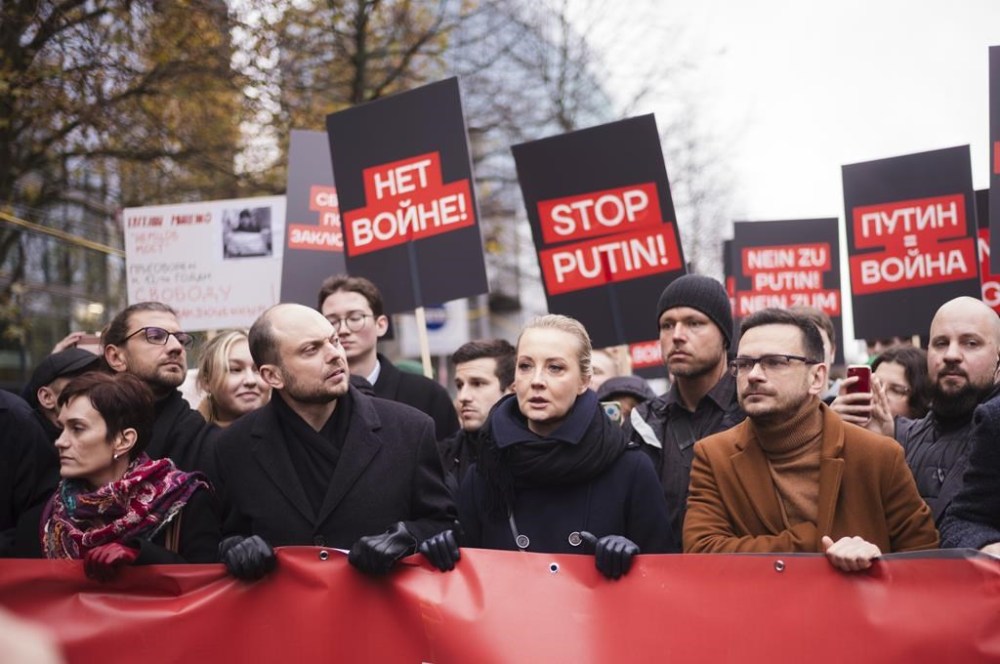
Some marched with the flags of Russia or Ukraine, as well as a white-blue-white flag used by some Russian opposition groups.
Organizers said the march began near Potsdamer Platz and went through the Brandenburg Gate and Checkpoint Charlie and was expected to end outside the Russian Embassy.
“The march demands the immediate withdrawal of Russian troops from Ukraine, the trial of Vladimir Putin as a war criminal, and the release of all political prisoners in Russia,” the protesters said in a statement.
Yashin, in a statement before the demonstration, said demonstrators were “using the freedom we have here in Berlin to show the world: A peaceful, free, and civilized Russia exists.”
Navalnaya, Yashin and Kara-Murza have all billed Sunday’s rally as a show of unity at a time when recent rounds of acrimony have roiled the anti-war camp.
Russia’s exiled anti-war opposition has so far largely failed to speak with one voice and present a clear plan of action.
The landmark East-West prisoner swap in August freed key dissidents and promised to reinvigorate a movement unmoored by the death in prison of Navalny, a charismatic anti-corruption campaigner and arch-Kremlin foe.
Instead, tensions have spiked in recent months, as Navalny’s allies and other prominent dissidents swapped accusations that appeared to dash any hopes of a united anti-Kremlin front.
Many opposition-minded Russians have voiced deep frustration with the infighting, and with what some view as efforts by rivaling groups to discredit and wrest influence from one another.
___
Associated Press writer Joanna Kozlowska in London contributed to this report.