

45 pro-democracy activists get 4 to 10 years in prison in Hong Kong’s biggest national security case
Advertisement
Read this article for free:
or
Already have an account? Log in here »
To continue reading, please subscribe:

Digital Subscription
One year of digital access for only $205*
- Enjoy unlimited reading on winnipegfreepress.com
- Read the E-Edition, our digital replica newspaper
- Access News Break, our award-winning app
- Play interactive puzzles
*First annual payment billed as $205.00 + GST for one year. This annual subscription will automatically renew at $233.00 + GST every 52 weeks (10% off the regular annual price of $259.35). Offer available to new and qualified returning subscribers only. Cancel any time.
To continue reading, please subscribe:
Add Free Press access to your Brandon Sun subscription for only an additional
$1 for the first 4 weeks*
- Enjoy unlimited reading on winnipegfreepress.com
- Read the E-Edition, our digital replica newspaper
- Access News Break, our award-winning app
- Play interactive puzzles
*Your next Brandon Sun subscription payment will increase by $1.00 and you will be charged $17.95 plus GST for four weeks. After four weeks, your payment will increase to $24.95 plus GST every four weeks.
Read unlimited articles for free today:
or
Already have an account? Log in here »
Hey there, time traveller!
This article was published 18/11/2024 (666 days ago), so information in it may no longer be current.
HONG KONG (AP) — Forty-five ex-lawmakers and activists were sentenced to four to 10 years in prison Tuesday in Hong Kong’s biggest national security case under a Beijing-imposed law that crushed a once-thriving pro-democracy movement.
They were prosecuted under the 2020 national security law for their roles in an unofficial primary election. Prosecutors said their aim was to paralyze Hong Kong’s government and force the city’s leader to resign by aiming to win a legislative majority and using it to block government budgets indiscriminately.
The unofficial primary held in July 2020 drew 610,000 voters, and its winners had been expected to advance to the official election. Authorities postponed the official legislative election, however, citing public health risks during the COVID-19 pandemic.
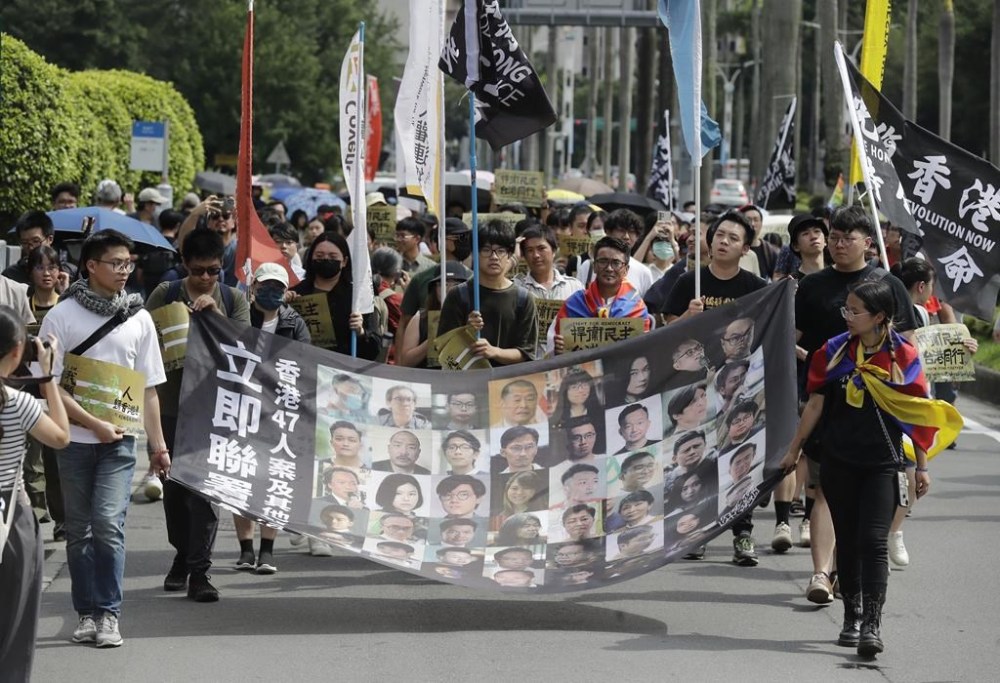
Legal scholar Benny Tai, whom the judges called the mastermind, received the longest sentence of 10 years. The judges said the sentences had been reduced for defendants who said they were unaware the plan was unlawful.
However, the court said the penalties were not reduced for Tai and former lawmaker Alvin Yeung because they are lawyers who were “absolutely adamant in pushing for the implementation of the Scheme.”
In the judgment posted online, the judges wrote that Tai essentially “advocated for a revolution” by publishing a series of articles over several months that traced his thinking, even though in a letter seeking a shorter sentence Tai said the steps were “never intended to be used as blueprint for any political action.”
Two of the 47 original defendants were acquitted earlier this year. The rest either pleaded guilty or were found guilty of conspiracy to commit subversion. The judges said in their verdict that the activists’ plans to effect change through the unofficial primary would have undermined the government’s authority and created a constitutional crisis.
The judges rejected the reasoning from some defendants that the scheme would never have materialized, stating that “all the participants had put in every endeavor to make it a success.”
The judges highlighted that a great deal of time, resources and money were devoted to the organization of the primary election.
“When the Primary Election took place on the 10 and 11 July, no one had remotely mentioned the fact that Primary Election was no more than an academic exercise and that the Scheme was absolutely unattainable,” the judgment read. “In order to succeed, the organizers and participants might have hurdles to overcome, that however was expected in every subversion case where efforts were made to overthrow or paralyze a government.”
Some of the defendants waved at their relatives in the courtroom after they were sentenced.
Gwyneth Ho, a journalist-turned-activist who was jailed for seven years, said onFacebook that “our true crime for Beijing is that we were not content with playing along in manipulated elections.”
“We dared to confront the regime with the question: Will democracy ever be possible within such a structure? The answer was a complete crackdown on all fronts of society,” she wrote.

Chan Po-ying, the wife of defendant Leung Kwok-hung, told reporters she wasn’t shocked when she learned her husband received a jail term of six years and nine months. She said they were trying to use some of the rights granted by the city’s mini-constitution to pressure those who are in power to address the will of the people.
“This is an unjust imprisonment. They shouldn’t be kept in jail for one day,” said Chan, also the chair of the League of Social Democrats, one of the city’s remaining pro-democracy parties.
Emilia Wong, the girlfriend of Ventus Lau, said his jail term was within her expectations. She said the sentencing was a “middle phase” of history and she could not see the end point at this moment, but she pledged to support Lau as best she could.
Philip Bowring, the husband of Claudia Mo, was relieved that the sentences were finally handed down.
Observers said the trial illustrated how authorities suppressed dissent following huge anti-government protests in 2019, alongside media crackdowns and reduced public choice in elections. The drastic changes reflect how Beijing’s promise to retain the former British colony’s civil liberties for 50 years when it returned to China in 1997 is increasingly threadbare, they said.
Beijing and Hong Kong governments insisted the national security law was necessary for the city’s stability.
The sentencing drew criticism from foreign governments and human rights organizations.
The U.S. Consulate in Hong Kong said the U.S. strongly condemned the sentences for the 45 pro-democracy advocates and former lawmakers.
“The defendants were aggressively prosecuted and jailed for peacefully participating in normal political activity protected under Hong Kong’s Basic Law,” the statement said, referring to the city’s mini-constitution.
In Beijing, Chinese Foreign Ministry spokesperson Lin Jian told reporters no one should be allowed to use democracy as a pretext to engage in unlawful activities and escape justice.
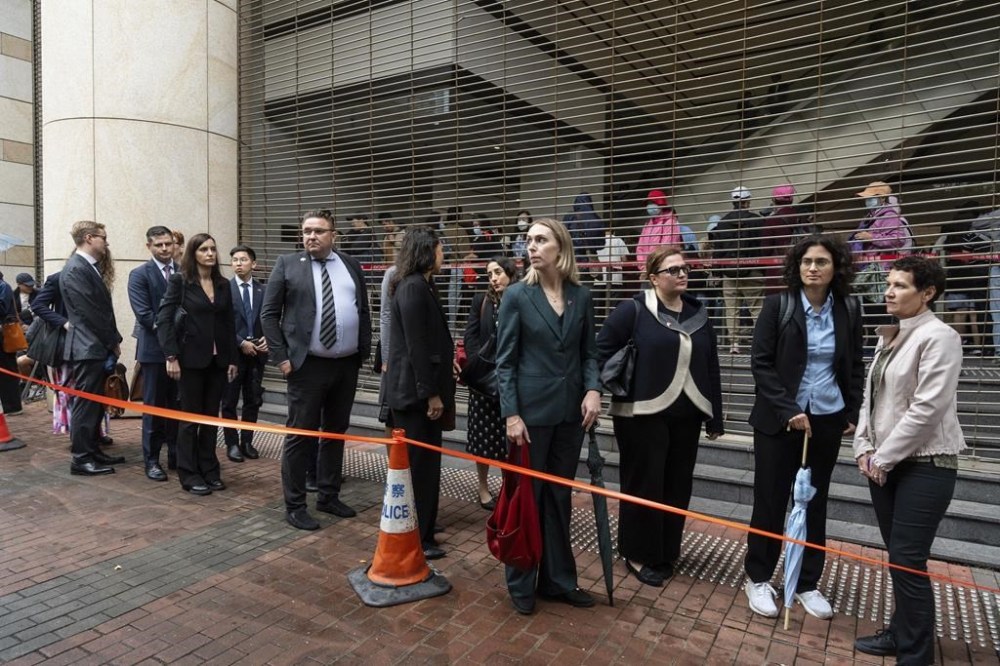
Hong Kong Secretary for Security Chris Tang said in a news briefing that the sentences showed those committing national security crimes must be severely punished.
The subversion case involved pro-democracy activists across the spectrum. They include Tai, former student leader Joshua Wong and former lawmakers. Wong was sentenced to four years and eight months in jail. He shouted “I love Hong Kong, bye bye!” before leaving the courtroom. Young activist Owen Chow was given the second-longest jail term, seven years and nine months.
Most of them have already been detained for more than three and a half years before the sentencing. The separations pained them and their families.
More than 200 people stood in line in rain and winds Tuesday morning for a seat in the court, including one of the acquitted defendants, Lee Yue-shun. Lee said he hoped members of the public would show they care about the court case.
“The public’s interpretation and understanding has a far-reaching impact on our society’s future development,” he said.
Wei Siu-lik, a friend of convicted activist Clarisse Yeung, said she arrived at 4 a.m. even though her leg was injured. “I wanted to let them know there are still many coming here for them,” she said.
Thirty-one of the activists entered guilty pleas and had better chances of getting reduced sentences. The law authorizes a range of sentences depending on the seriousness of the offense and the defendant’s role in it, from under three years for the least serious to 10 years to life for people convicted of “grave” offenses.