

Nicaragua’s Ortega proposes reform to make him and his wife ‘copresidents’
Advertisement
Read this article for free:
or
Already have an account? Log in here »
To continue reading, please subscribe:

Digital Subscription
One year of digital access for only $205*
- Enjoy unlimited reading on winnipegfreepress.com
- Read the E-Edition, our digital replica newspaper
- Access News Break, our award-winning app
- Play interactive puzzles
*First annual payment billed as $205.00 + GST for one year. This annual subscription will automatically renew at $233.00 + GST every 52 weeks (10% off the regular annual price of $259.35). Offer available to new and qualified returning subscribers only. Cancel any time.
To continue reading, please subscribe:
Add Free Press access to your Brandon Sun subscription for only an additional
$1 for the first 4 weeks*
- Enjoy unlimited reading on winnipegfreepress.com
- Read the E-Edition, our digital replica newspaper
- Access News Break, our award-winning app
- Play interactive puzzles
*Your next Brandon Sun subscription payment will increase by $1.00 and you will be charged $17.95 plus GST for four weeks. After four weeks, your payment will increase to $24.95 plus GST every four weeks.
Read unlimited articles for free today:
or
Already have an account? Log in here »
Hey there, time traveller!
This article was published 20/11/2024 (671 days ago), so information in it may no longer be current.
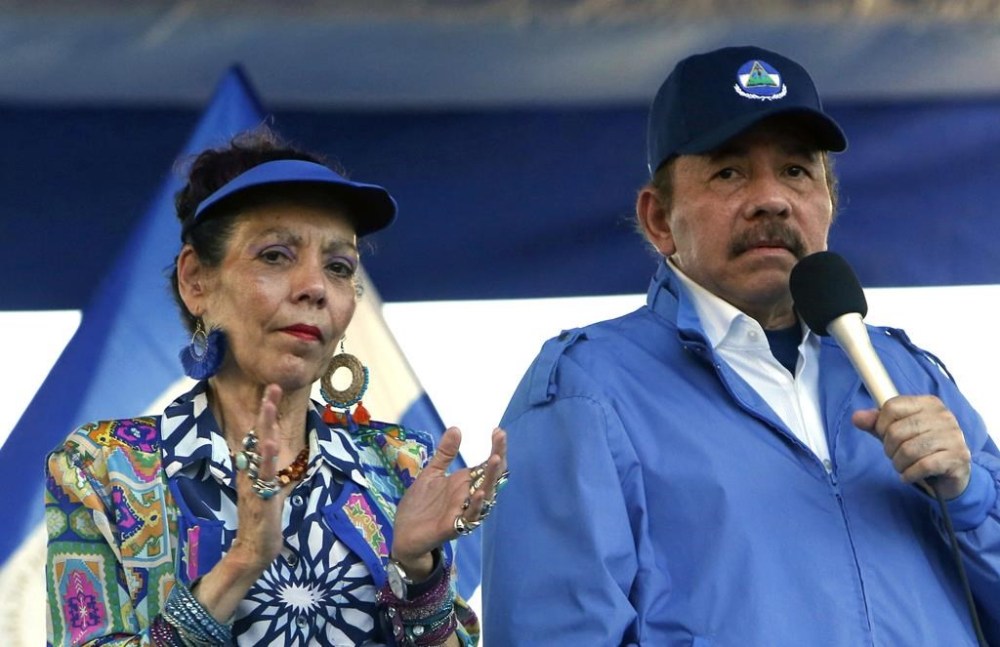
MEXICO CITY (AP) — Nicaragua’s President Daniel Ortega on Wednesday proposed a constitutional reform that would officially make him and his wife, current Vice President Rosario Murillo, “copresidents” of the Central American nation.
While the initiative has to pass through the country’s legislature, Ortega and Murillo’s Sandinista party control the congress and all government institutions, so it is likely to be approved.
The proposal also looks to expand the presidential term to six years from five. Ortega put forward another bill Wednesday that would make it illegal for anyone to enforce sanctions from the United States or other foreign bodies “within Nicaraguan territory.”
The Organization of American States general secretary’s office condemned the proposed constitutional reforms Wednesday.
“The ‘reform’ document is illegitimate in form and content, it merely constitutes an aberrant form of institutionalization of the matrimonial dictatorship in the Central American country and is a definitive attack on the democratic rule of law,” it said in a statement.
The proposals come amid an ongoing crackdown by the Ortega government since mass social protests in 2018 that the government violently repressed.
Nicaragua’s government has imprisoned adversaries, religious leaders, journalists and more, then exiled them, stripping hundreds of their Nicaraguan citizenship and possessions. Since 2018, it has shuttered more than 5,000 organizations, largely religious, and forced thousands to flee the country.
Dissident groups including the Nicaraguan University Alliance quickly railed against the measures, calling them an extension of that clampdown.
“They are institutionalizing nepotism and repression, destroying the rule of law. Democracy faces its greatest threat,” the organization wrote on the social media platform X on Wednesday.
Manuel Orozco, director of the migration, remittances, and development program at the Inter-American Dialogue, called Ortega’s proposed reforms “nothing but a rubber stamping formalization of a decision to guarantee presidential succession” for Murillo and their family. Ortega has referred to Murillo previously in recent years as his copresident.
While rejection of international sanctions would have no immediate impact, Orozco said it could put the country at “high financial risk” and risk further penalties from the U.S. Treasury Department.
Orozco said the constitutional reform to the presidency is part of a long-term plan for the administration to stay in power, and was pushed forward Wednesday as a way to avoid provoking the incoming administration of U.S. President-elect Donald Trump.
The analyst said Trump may not prioritize crackdowns on democratic freedoms in places like Nicaragua, but also isn’t likely to “tolerate provocations.”
“The procedure, apart from circumventing the popular will, the rule of law, creates the pathway to give Ortega extra time to stay in power,” Orozco said. Ortega was reelected to a fourth consecutive five-year term in November 2021.
____
Follow AP’s coverage of Latin America and the Caribbean at https://apnews.com/hub/latin-america