

France’s government looks on the brink of collapse. What’s next?
Advertisement
Read this article for free:
or
Already have an account? Log in here »
To continue reading, please subscribe:

Digital Subscription
One year of digital access for only $205*
- Enjoy unlimited reading on winnipegfreepress.com
- Read the E-Edition, our digital replica newspaper
- Access News Break, our award-winning app
- Play interactive puzzles
*First annual payment billed as $205.00 + GST for one year. This annual subscription will automatically renew at $233.00 + GST every 52 weeks (10% off the regular annual price of $259.35). Offer available to new and qualified returning subscribers only. Cancel any time.
To continue reading, please subscribe:
Add Free Press access to your Brandon Sun subscription for only an additional
$1 for the first 4 weeks*
- Enjoy unlimited reading on winnipegfreepress.com
- Read the E-Edition, our digital replica newspaper
- Access News Break, our award-winning app
- Play interactive puzzles
*Your next Brandon Sun subscription payment will increase by $1.00 and you will be charged $17.95 plus GST for four weeks. After four weeks, your payment will increase to $24.95 plus GST every four weeks.
Read unlimited articles for free today:
or
Already have an account? Log in here »
Hey there, time traveller!
This article was published 03/12/2024 (669 days ago), so information in it may no longer be current.
PARIS (AP) — France’s minority government looks in its final hours as opposition lawmakers from the left and the far right vowed to topple Prime Minister Michel Barnier’s Cabinet.
A no-confidence vote is scheduled Wednesday at parliament in the wake of a divisive budget debate, with a great chance of being successful.
If the motion passes, Barnier’s Cabinet would be the shortest-lived government in France’s modern history, marking an unprecedented period of political instability.
President Emmanuel Macron would be in charge of appointing a new prime minister.
Why is the situation so volatile?
Following the June-July parliamentary elections, the National Assembly, France’s powerful lower house of parliament, is divided into three major blocs: a left-wing coalition known as the New Popular Front, Macron’s centrist allies and the far-right National Rally party. None of them won an outright majority.
In September, Macron asked Barnier, a conservative, to form a government dominated by Republicans and centrists — implicitly relying on the far right’s goodwill to be able to stay in power.
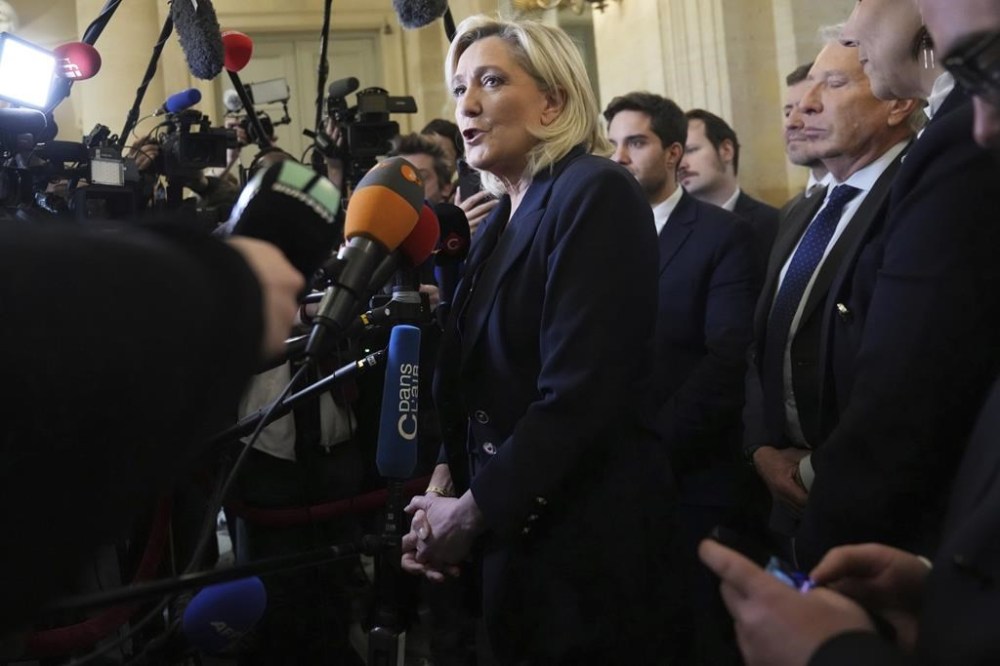
However, far-right leader Marine Le Pen now says her party will vote for bringing the government down, accusing Barnier of ignoring her demands.
Meanwhile, the leftwing coalition denounces an “austerity budget” and criticizes “the absence of dialogue and disregard for parliamentary work.”
A no-confidence motion requires at least half the votes at the National Assembly, that is 289 out of 577, to pass.
Altogether, the left and the far right count over 330 lawmakers — yet some of them may abstain from voting.
What if the government falls?
Wednesday could see the first no-confidence motion succeed in over six decades.
If the government falls, Macron could ask outgoing ministers to handle current affairs pending the appointment of a new prime minister.
The parliament’s fractured composition would remain the same. No new legislative elections can be held before July, because under the French Constitution, the National Assembly must remain in place for a minimum of one year.
No favorite figure to replace Barnier has emerged yet. Macron could pick a politician from his centrist alliance, French media report.
The New Popular Front asks for a left-wing Cabinet to be appointed instead.
Some opposition lawmakers are calling for Macron to resign, but the French president has previously ruled out that option.
How about the budget?
France is at no risk of a government shutdown that in the United States would disrupt many services and squeeze federal employees.
An outgoing government could present a special law to levy taxes from Jan. 1, based on this year’s rules. It would also be able to decide on renewing spending by decree in order to pay civil servants, pensions and other key government expenses.
However, this would suspend any potential tax hike — like one initially expected on big companies — and freeze any new spending.
In particular, an additional 3.3 billion euro ($3.5 billion) package for the French military was planned as the country supports Ukraine in its war against Russia.
Later on, a new government could present its own budget proposals at parliament.
Why are markets spooked?
In a last-ditch effort to save his government, Barnier warned of “ a big storm and very serious turbulence on the financial markets.”
France is under pressure from the European Union’s executive body to reduce its colossal debt. The country’s deficit is estimated to reach 6% of Gross Domestic Product this year and analysts say it could rise to 7% next year without drastic adjustments.
The political instability could push up French interest rates, digging the debt even further.
In addition, without a clear parliamentary majority, no major reform appears within the reach of a new government.