

Tonga’s prime minister quits moments ahead of no-confidence motion in parliament
Advertisement
Read this article for free:
or
Already have an account? Log in here »
To continue reading, please subscribe:
Monthly Digital Subscription
$0 for the first 4 weeks*
- Enjoy unlimited reading on winnipegfreepress.com
- Read the E-Edition, our digital replica newspaper
- Access News Break, our award-winning app
- Play interactive puzzles
*No charge for 4 weeks then price increases to the regular rate of $19.00 plus GST every four weeks. Offer available to new and qualified returning subscribers only. Cancel any time.
Monthly Digital Subscription
$4.75/week*
- Enjoy unlimited reading on winnipegfreepress.com
- Read the E-Edition, our digital replica newspaper
- Access News Break, our award-winning app
- Play interactive puzzles
*Billed as $19 plus GST every four weeks. Cancel any time.
To continue reading, please subscribe:
Add Free Press access to your Brandon Sun subscription for only an additional
$1 for the first 4 weeks*
*Your next subscription payment will increase by $1.00 and you will be charged $16.99 plus GST for four weeks. After four weeks, your payment will increase to $23.99 plus GST every four weeks.
Read unlimited articles for free today:
or
Already have an account? Log in here »
Hey there, time traveller!
This article was published 08/12/2024 (376 days ago), so information in it may no longer be current.
WELLINGTON, New Zealand (AP) — Tonga’s Prime Minister Siaosi Sovaleni abruptly resigned in parliament on Monday ahead of a planned no-confidence vote in his leadership, capping a period of fraught relations between his government and Tonga’s king.
Sovaleni, who took office in 2021, did not specify a reason for his departure but his resignation halted the no-confidence motion expected on Monday. It was not immediately clear who would succeed him.
His resignation comes less than a year before a national election in Tonga, a South Pacific island nation of 105,000 people, and it highlighted the occasional tensions between Tonga’s monarchy and elected lawmakers in a still-young democracy after reforms that transferred powers from the royal family and nobles to regular citizens in 2010.
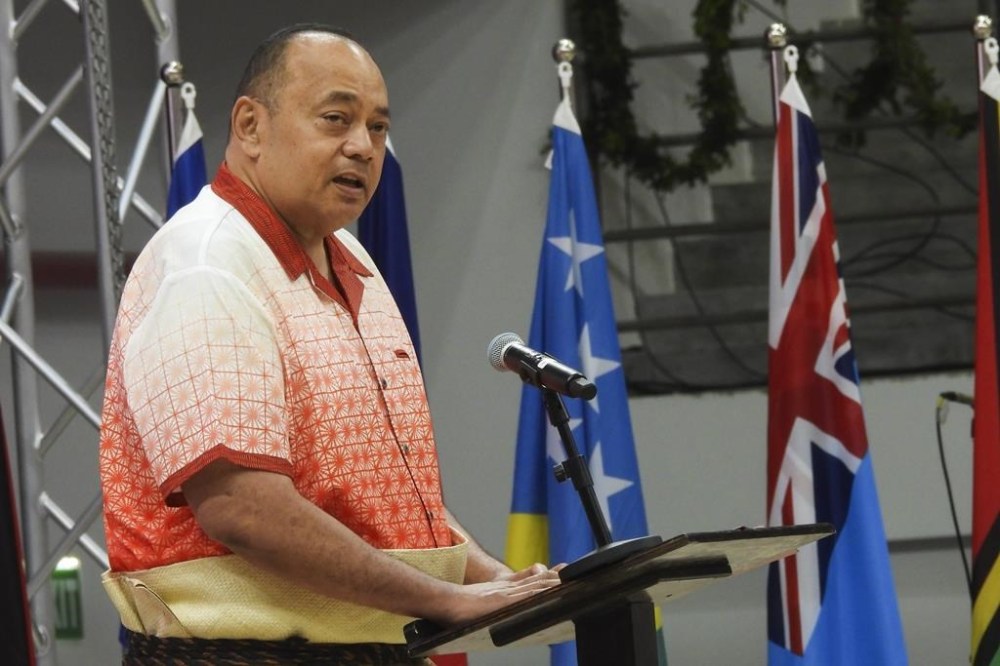
A statement on the Tongan Parliament Facebook page said Sovaleni, 54, quit “for the good of the country and moving Tonga forward.” Video from Tonga’s parliament on Monday showed the leader making brief and emotional remarks in Tongan before the no-confidence vote was scheduled to take place.
Sovaleni’s office did not immediately respond to a request for comment. His leadership had survived a previous no-confidence vote in September 2023.
In recent months, Sovaleni’s tenure was marked by difficult relations with Tonga’s head of state, King Tupou VI. Although the sovereign’s predecessor ceded power voluntarily in the 2010 democratic reforms, Tupou VI retains powers to dissolve parliament, appoint judges and veto laws.
The king at times made his dissatisfaction with Sovaleni apparent, including by withdrawing confidence in him as defense minister in February. Some lawmakers at first decried the king’s pressure on Sovaleni and his foreign minister as unconstitutional, but both eventually resigned their posts in April — although Sovaleni remained prime minister.
A month earlier, Sovaleni had been photographed at a traditional ceremony of apology to the king, but neither side publicly addressed the event. When Tonga hosted the Pacific Islands Forum Leaders’ Meeting in August, the king was traveling abroad and did not attend the conference — a significant event for the small Pacific nation — which analysts said was a snub to Sovaleni and his government.
Speaking to Radio New Zealand on Monday, Sovaleni did not signal a particular reason for his departure. Asked whether his decision was prompted by disagreements with the king, Sovaleni said that “differences in views” were normal.
“I’m not sure whether that’s the reason,” he said, according to RNZ, adding that he still did not know why he and Tonga’s foreign minister had lost the king’s confidence earlier this year.
“But we still provide respect to his majesty,” Sovaleni told RNZ. “Whatever we do, we always consider that relationship. So maybe you can ask someone else.”
His successor will be selected by Tonga’s 26 lawmakers in a vote. The parliament is made up of 17 lawmakers elected by the public and nine who are nobles, elected by a group of hereditary chiefs.
Sovaleni entered parliament in 2014 and had been a minister since 2019. He led Tonga as the tourism-dependent country struggled to rebound from the impact of the coronavirus pandemic, growing threats from climate change and a catastrophic 2022 volcanic eruption and tsunami, which battered beachfront resorts, homes and businesses around Tonga’s 171 islands.
A former senior public servant who also worked in the private sector before entering politics, Sovaleni is the son of a former Tongan deputy prime minister. He attended high school in New Zealand and studied at the University of Oxford and the University of the South Pacific, attaining master’s degrees in computer science and business.