

About 3 dozen high-rise buildings in South Florida are sinking
Advertisement
Read this article for free:
or
Already have an account? Log in here »
To continue reading, please subscribe:

Digital Subscription
One year of digital access for only $205*
- Enjoy unlimited reading on winnipegfreepress.com
- Read the E-Edition, our digital replica newspaper
- Access News Break, our award-winning app
- Play interactive puzzles
*First annual payment billed as $205.00 + GST for one year. This annual subscription will automatically renew at $233.00 + GST every 52 weeks (10% off the regular annual price of $259.35). Offer available to new and qualified returning subscribers only. Cancel any time.
To continue reading, please subscribe:
Add Free Press access to your Brandon Sun subscription for only an additional
$1 for the first 4 weeks*
- Enjoy unlimited reading on winnipegfreepress.com
- Read the E-Edition, our digital replica newspaper
- Access News Break, our award-winning app
- Play interactive puzzles
*Your next Brandon Sun subscription payment will increase by $1.00 and you will be charged $17.95 plus GST for four weeks. After four weeks, your payment will increase to $24.95 plus GST every four weeks.
Read unlimited articles for free today:
or
Already have an account? Log in here »
Hey there, time traveller!
This article was published 17/12/2024 (653 days ago), so information in it may no longer be current.
SUNNY ISLES BEACH, Fla. (AP) — Almost three dozen high-rise condos and luxury hotels along the beach in South Florida are sinking or settling in unexpected ways, in some cases because of nearby construction, according to a new study.
The 35 buildings surveyed along an almost 12-mile (19 kilometer) stretch from Miami Beach to Sunny Isles Beach have sunk or settled by 0.8 to 3.1 inches (2 to 8 cm). About half of the buildings are less than a decade old, according to scientists at the University of Miami Rosenstiel School of Marine, Atmospheric, and Earth Science. The study was published Friday.
“The discovery of the extent of subsidence hotspots along the South Florida coastline was unexpected,” Farzaneh Aziz Zanjani, the lead author, said in a statement. “The study underscores the need for ongoing monitoring and a deeper understanding of the long-term implications for these structures.”
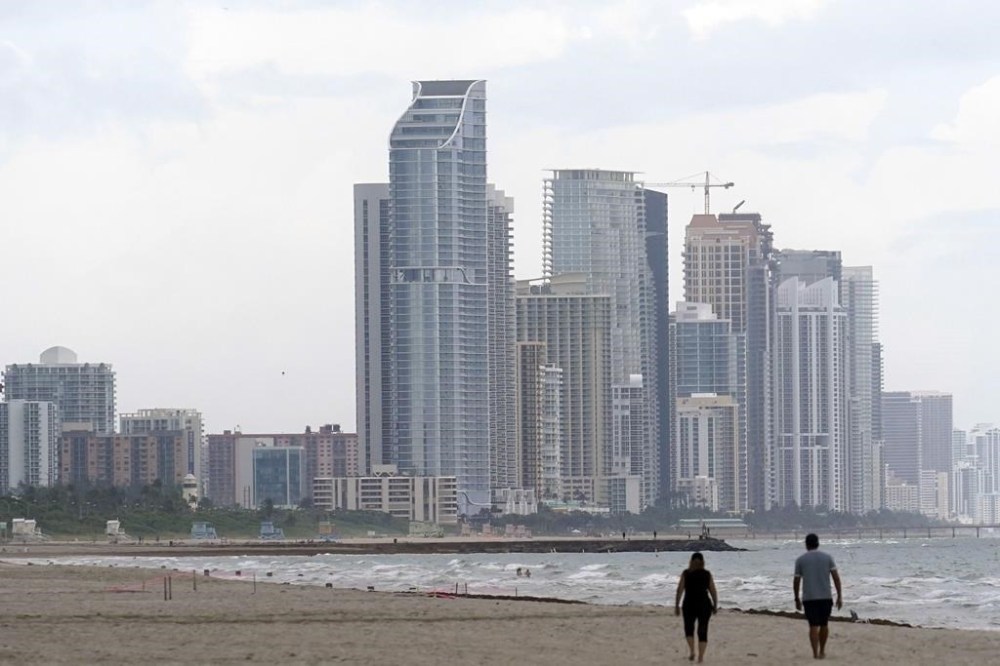
It’s not uncommon for buildings to sink a little during and soon after construction, but the scientists called their discovery surprising because some of the changes took place several years later.
Limestone under the South Florida beach is interspersed with layers of sand, which can shift under the weight of high-rises and as a result of vibrations from foundation construction. Tidal flows and construction projects as far away as 1,050 feet (320 meters) have contributed to settling, the researchers found. The study used satellite images to capture the changes, with settling most noticeable in buildings in Sunny Isles Beach. The scientists said preliminary data also suggests sinking or settling further north, along the beaches of Broward and Palm Beach counties.
The stretch of South Florida communities surveyed included Surfside, where the Champlain Towers South building collapsed in June 2021, killing 98 people. However, that collapse is thought to have been caused by reinforced concrete that deteriorated due to poor maintenance and flawed design.
Still, the Surfside catastrophe highlighted the need to monitor building stability “especially in coastal areas with corrosive environmental conditions,” the scientists said.
The scientists said they want to further study whether different sections of impacted buildings are sinking at different rates, which could lead to cracks in their walls or utility breaks and lead to long-term damage.
A separate study earlier this year showed buildings in major cities along the Atlantic Coast were sinking. The research from Virginia Tech and the U.S. Geological Survey showed that areas of New York City, Long Island, Baltimore and Virginia Beach were sinking more than the rate of seawater rise.