

German lawmakers back plan to protect supreme court against meddling by authoritarians, extremists
Advertisement
Read this article for free:
or
Already have an account? Log in here »
To continue reading, please subscribe:

Digital Subscription
One year of digital access for only $205*
- Enjoy unlimited reading on winnipegfreepress.com
- Read the E-Edition, our digital replica newspaper
- Access News Break, our award-winning app
- Play interactive puzzles
*First annual payment billed as $205.00 + GST for one year. This annual subscription will automatically renew at $233.00 + GST every 52 weeks (10% off the regular annual price of $259.35). Offer available to new and qualified returning subscribers only. Cancel any time.
To continue reading, please subscribe:
Add Free Press access to your Brandon Sun subscription for only an additional
$1 for the first 4 weeks*
- Enjoy unlimited reading on winnipegfreepress.com
- Read the E-Edition, our digital replica newspaper
- Access News Break, our award-winning app
- Play interactive puzzles
*Your next Brandon Sun subscription payment will increase by $1.00 and you will be charged $17.95 plus GST for four weeks. After four weeks, your payment will increase to $24.95 plus GST every four weeks.
Read unlimited articles for free today:
or
Already have an account? Log in here »
Hey there, time traveller!
This article was published 19/12/2024 (626 days ago), so information in it may no longer be current.
BERLIN (AP) — German lawmakers on Thursday approved legislation designed to protect the country’s highest court against possible future manipulation or obstruction by authoritarian or extremist politicians.
Officials have cited experiences in Poland, Hungary and elsewhere as illustrating the need to bolster the Federal Constitutional Court. The measure was drawn up by the three parties in the governing coalition that collapsed last month and the mainstream conservative opposition.
In what is expected to be one of its last sessions before it is dissolved ahead of an early election in February, parliament’s lower house, or Bundestag, backed the plan by 600 votes to 69.
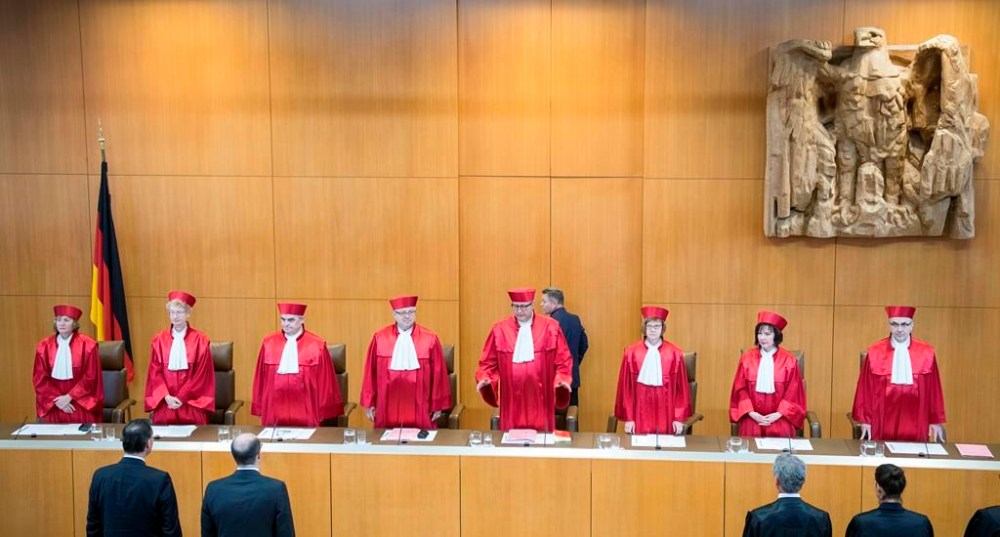
The legislation is set to anchor the court’s ground rules in the constitution. That means a two-thirds parliamentary majority would be required to change them in the future, rather than a simple majority.
“We see when we look abroad that, when autocrats come to power, they almost always first turn against the effectiveness and independence of justice,” Interior Minister Nancy Faeser told lawmakers.
She named no countries, but backers have pointed to Poland in particular as a cautionary tale. That country’s former nationalist conservative government moved to establish control over the Constitutional Tribunal.
Germany’s Federal Constitutional Court, based in the southwestern city of Karlsruhe, is frequently called on to act as the ultimate arbiter over policy.
It has two panels of eight judges each, who serve a single 12-year term. Those requirements are to be anchored in the constitution, as are the upper age limit of 68 for justices and other rules.
The far-right Alternative for Germany party, which has been polling at up to 20% in recent surveys, argues that mainstream parties are simply trying to cement their own influence over the court.
Half of its justices are elected by the Bundestag and the other half by parliament’s upper house, which represents Germany’s 16 state governments. Candidates are proposed by political parties and need a two-thirds majority to be elected, which is meant to ensure balance and effectively rules out highly polarizing figures.
The reform also includes a workaround in the case of “obstructive minorities” blocking the election of justices. That would enable the Bundestag to elect judges if the upper house fails to, or vice versa.