

Timeline: Key dates in the century-long battle over the Equal Rights Amendment
Advertisement
Read this article for free:
or
Already have an account? Log in here »
To continue reading, please subscribe:
Monthly Digital Subscription
$1 per week for 24 weeks*
- Enjoy unlimited reading on winnipegfreepress.com
- Read the E-Edition, our digital replica newspaper
- Access News Break, our award-winning app
- Play interactive puzzles
*Billed as $4.00 plus GST every four weeks. After 24 weeks, price increases to the regular rate of $19.95 plus GST every four weeks. Offer available to new and qualified returning subscribers only. Cancel any time.
Monthly Digital Subscription
$4.99/week*
- Enjoy unlimited reading on winnipegfreepress.com
- Read the E-Edition, our digital replica newspaper
- Access News Break, our award-winning app
- Play interactive puzzles
*Billed as $19.95 plus GST every four weeks. Cancel any time.
To continue reading, please subscribe:
Add Free Press access to your Brandon Sun subscription for only an additional
$1 for the first 4 weeks*
*Your next subscription payment will increase by $1.00 and you will be charged $16.99 plus GST for four weeks. After four weeks, your payment will increase to $23.99 plus GST every four weeks.
Read unlimited articles for free today:
or
Already have an account? Log in here »
Hey there, time traveller!
This article was published 17/01/2025 (434 days ago), so information in it may no longer be current.
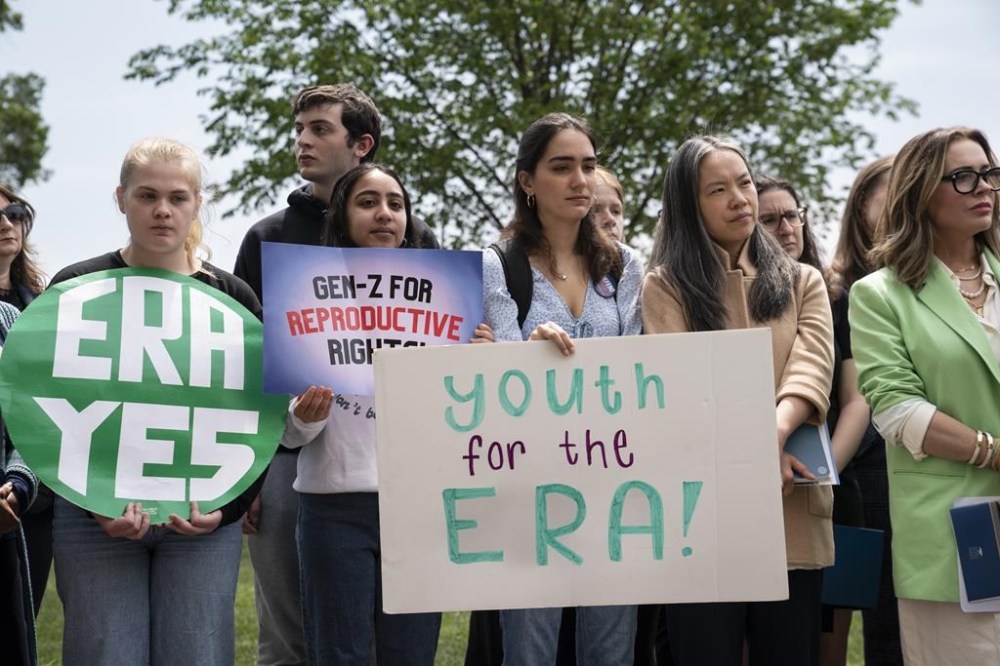
The struggle over the Equal Rights Amendment started more than a century ago when leading suffragist Alice Paul first proposed it shortly after the ratification of the 19th Amendment, which granted women the right to vote. The ERA, if formally recognized as the 28th Amendment, would make gender equality explicit under the Constitution.
President Joe Biden on Friday declared that the ERA should be considered a ratified addition to the Constitution. His announcement was symbolic, as the National Archives has declined to certify the amendment, noting it was passed with a ratification deadline that wasn’t met.
Here are some key dates in the history of the effort to enact the Equal Rights Amendment:
Dec. 10, 1923
The first draft of the ERA, written by Paul, is introduced in Congress by Sen. Charles Curtis, a Kansas Republican. Paul’s original amendment text stated: “Men and women shall have equal rights throughout the United States and every place subject to its jurisdiction. Congress shall have power to enforce this article by appropriate legislation.”
March 22, 1972
The Senate joins the House in passing an amended version of the ERA with a seven-year deadline for states to ratify it. It states: “Equality of rights under the law shall not be denied or abridged by the United States or by any State on account of sex.” Hawaii quickly becomes the first state to ratify.
Oct. 6, 1978
The Senate joins the House in approving an extension of the deadline for state ratification of the ERA to June 30, 1982.
June 30, 1982
The congressionally imposed deadline for ratification passes with three states short of the 38 needed for the ERA to become the law of the land.
Jan. 8, 2020
The Justice Department finds that it’s too late for additional states to ratify the ERA because of the two expired deadlines imposed by Congress.
Jan. 27, 2020
Virginia becomes the critical 38th state to ratify the Equal Rights Amendment.
Feb. 10, 2020
Supreme Court Justice Ruth Bader Ginsburg says those like her who support the ERA should start over in trying to get it passed rather than trying to revive the failed attempt from the 1970s.
Feb. 13, 2020
In a 232-183 vote, the House approves a measure removing a 1982 deadline for state ratification in a bid to revive the Equal Rights Amendment.
Feb. 28, 2023
A federal appeals court in Washington dismisses a case brought by two Democratic-led states seeking to have the U.S. archivist publish and certify the ERA as part of the Constitution.
April 27, 2023
Senate Republicans block a Democratic measure to remove the 1982 deadline for state ratification and move forward with the ERA.
Dec. 17, 2024
The archivist and deputy archivist of the United States issue a rare joint statement that ERA cannot be certified without further action by Congress or the courts.
Jan. 17, 2025
Biden declares that the ERA should be considered a ratified addition to the Constitution. It’s a symbolic statement that will not resolve the dispute.