

A 2,000-year-old statue is found abandoned in a garbage bag in Greece
Advertisement
Read this article for free:
or
Already have an account? Log in here »
To continue reading, please subscribe:
Digital Subscription
One year of digital access for only $75*
- Enjoy unlimited reading on winnipegfreepress.com
- Read the E-Edition, our digital replica newspaper
- Access News Break, our award-winning app
- Play interactive puzzles
*Billed as $5.77 plus GST every four weeks. After 52 weeks, price increases to the regular rate of $19.95 plus GST every four weeks. Offer available to new and qualified returning subscribers only. Cancel any time.
Monthly Digital Subscription
$4.99/week*
- Enjoy unlimited reading on winnipegfreepress.com
- Read the E-Edition, our digital replica newspaper
- Access News Break, our award-winning app
- Play interactive puzzles
*Billed as $19.95 plus GST every four weeks. Cancel any time.
To continue reading, please subscribe:
Add Free Press access to your Brandon Sun subscription for only an additional
$1 for the first 4 weeks*
- Enjoy unlimited reading on winnipegfreepress.com
- Read the E-Edition, our digital replica newspaper
- Access News Break, our award-winning app
- Play interactive puzzles
*Your next Brandon Sun subscription payment will increase by $1.00 and you will be charged $17.95 plus GST for four weeks. After four weeks, your payment will increase to $24.95 plus GST every four weeks.
Read unlimited articles for free today:
or
Already have an account? Log in here »
Hey there, time traveller!
This article was published 22/01/2025 (488 days ago), so information in it may no longer be current.
THESSALONIKI, Greece (AP) — A marble statue of a woman believed to be more than 2,000 years old was found abandoned in a garbage bag near the Greek city of Thessaloniki, police said Wednesday.
A resident discovered the 80-centimeter (31-inch) headless statue beside a trash bin in Neoi Epivates, outside Greece’s second-largest city. The man turned it over to local authorities, who contacted archaeologists to assess its significance.
Police said experts, following an initial evaluation, determined the piece dates to the Hellenistic era, a period roughly between 320 and 30 B.C. that was marked by a flourishing of art and culture following the conquests of Alexander the Great.
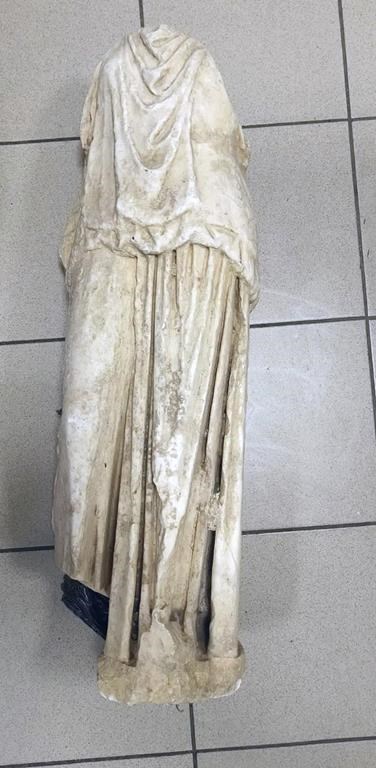
The statue was sent for further examination by archaeologists. It will ultimately be handed over to the local antiquities authority for preservation and study.
Police opened an investigation to determine who discarded the statue and briefly detained a man for questioning who was later released without charge.
Accidental archaeological discoveries are relatively common in Greece, a country renowned for its ancient heritage, and often made during building construction or public works. In December, workers installing natural gas pipelines near Athens uncovered a Roman-era statue of Hermes buried upright in a brick-lined pit near the Acropolis.
Thessaloniki weeks ago unveiled a trove of antiquities found during the decades-long construction of its metro system, which officially opened in November. Key finds, including a marble-paved Roman thoroughfare and tens of thousands of artifacts spanning the Greek, Byzantine, and Ottoman periods, are now showcased at subway stations.