

Georgia asks federal appeals court to tighten Voting Rights Act
Advertisement
Read this article for free:
or
Already have an account? Log in here »
To continue reading, please subscribe:

Digital Subscription
One year of digital access for only $205*
- Enjoy unlimited reading on winnipegfreepress.com
- Read the E-Edition, our digital replica newspaper
- Access News Break, our award-winning app
- Play interactive puzzles
*First annual payment billed as $205.00 + GST for one year. This annual subscription will automatically renew at $233.00 + GST every 52 weeks (10% off the regular annual price of $259.35). Offer available to new and qualified returning subscribers only. Cancel any time.
To continue reading, please subscribe:
Add Free Press access to your Brandon Sun subscription for only an additional
$1 for the first 4 weeks*
- Enjoy unlimited reading on winnipegfreepress.com
- Read the E-Edition, our digital replica newspaper
- Access News Break, our award-winning app
- Play interactive puzzles
*Your next Brandon Sun subscription payment will increase by $1.00 and you will be charged $17.95 plus GST for four weeks. After four weeks, your payment will increase to $24.95 plus GST every four weeks.
Read unlimited articles for free today:
or
Already have an account? Log in here »
Hey there, time traveller!
This article was published 23/01/2025 (600 days ago), so information in it may no longer be current.
ATLANTA (AP) — The state of Georgia is seeking another Supreme Court showdown over the Voting Rights Act, asking a federal appeals court on Thursday to interpret the 1965 law in a way that could make it much harder to prove minority votes have been illegally diluted.
A lawyer for the state on Thursday asked a three-judge panel of the 11th Circuit U.S. Court of Appeals in Atlanta to overturn a lower court that required lawmakers to draw more Black-majority electoral districts.
Georgia’s Republican Secretary of State Brad Raffensperger argued in court filings that the Voting Rights Act is being misused to bolster Democratic election chances and that white voters prefer Republicans for nonracial reasons.
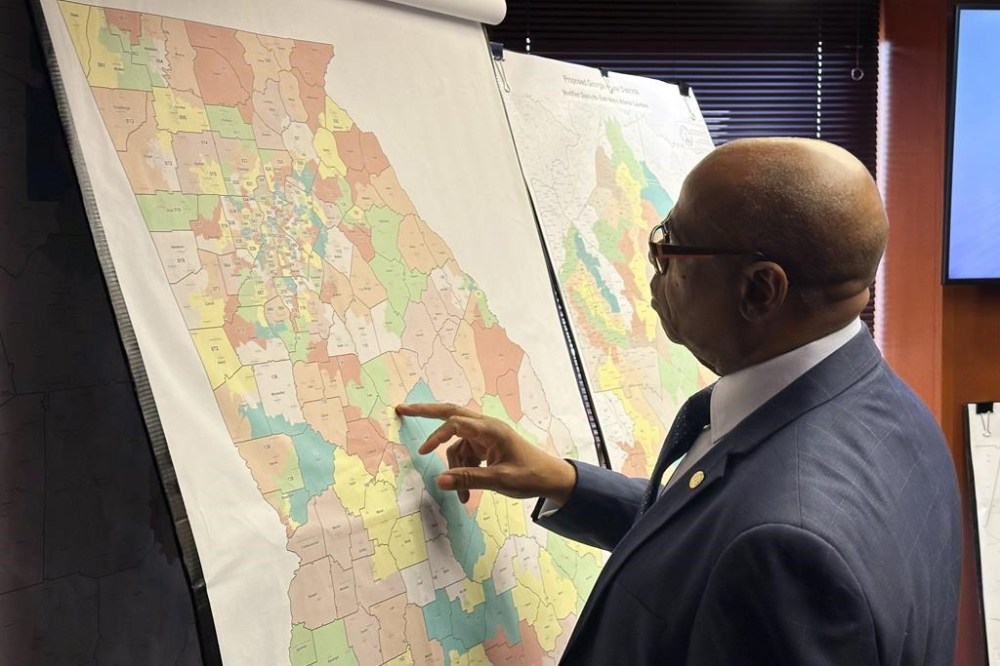
Representing the state in its appeal, Georgia Solicitor General Stephen Petrany said the evidence failed to prove white people vote the way they do because of race in the electoral districts Republicans drew.
“It is not covered when the majority simply outvotes the minority based on political polarization,” Petrany said.
But lawyers for the federal government and the groups who sued to redraw Georgia’s congressional and legislative maps say Georgia is trying persuade the judges to make up a new, harder-to-prove standard that could hobble Voting Rights Act lawsuits, less than two years after the U.S. Supreme Court turned back a separate challenge from Alabama to the landmark law.
Abha Khanna, a lawyer for some of the groups that sued to overturn the maps, said that in Georgia, Black voters overwhelmingly support Democrats and white voters overwhelmingly support Republicans.
“The secretary cannot muster any nonracial explanation for why Black and white voters in Georgia have separated so neatly into separate political parties,” Khana said.
Among those defending the lower court’s decision was Noah Bokat-Lindell, an attorney with the U.S. Department of Justice’s Civil Rights Division, who continued federal government involvement in the case Thursday despite the department’s new leadership under President Donald Trump ordering a freeze on certain civil rights litigation.
The Voting Rights Act was passed to outlaw racial discrimination in elections, including the drawing of districts in ways that effectively blocked minority groups from electing their preferred candidates. In the South, when the lines are redrawn every 10 years to reflect population changes, litigation has followed over whether legislative and congressional districts are fair to Black people.
In Georgia, those suits produced an order to redraw Georgia’s 14 congressional districts to create one more Black-majority district on the west side of metro Atlanta, as well as orders to draw additional Black-majority state Senate and state House districts.
Some Democrats had hoped the federal court order would result in more gains for their party But Republicans redrew maps that preserved their 9-5 advantage in congressional districts and 33-23 advantage in state Senate districts. Democrats picked up only two seats in the state House, cutting Republicans’ majority in that chamber to 100-80.
Raffensperger argues the case was wrongly decided because the judge didn’t determine that the reason for white voters’ behavior was racial. He pointed to the Republican nomination of Herschel Walker, who is Black, for the Senate in 2022.
“The evidence is virtually undisputed that when you change the race of the candidate, the majority votes virtually the same,” Petrany said. “When you change the party of the candidate, the majority voting behavior changes drastically.”
That brought agreement from Circuit Judge Barbara Lagoa, a Donald Trump appointee who asked “Isn’t this the best evidence that it’s partisan and not racial?”
But Sophia Lakin, a lawyer for the American Civil Liberties Union, said Walker’s nomination was an isolated case “that just cannot overcome the weight of the evidence.”
Petrany argued that much of that evidence is outdated and that Georgia’s segregationist history no longer applies. “It can’t be that the sins of the past forever taint what Georgia is doing today,” he said.
But at least one of the judges on the panel said what happened in the past remains important.
“That just ignores the history of what’s happened over 200 years in Georgia,” said Judge Robin Rosenbaum, a Barack Obama appointee.