

Wisconsin Republicans target governor’s uniquely broad partial veto powers
Advertisement
Read this article for free:
or
Already have an account? Log in here »
To continue reading, please subscribe:
Monthly Digital Subscription
$1 per week for 24 weeks*
- Enjoy unlimited reading on winnipegfreepress.com
- Read the E-Edition, our digital replica newspaper
- Access News Break, our award-winning app
- Play interactive puzzles
*Billed as $4.00 plus GST every four weeks. After 24 weeks, price increases to the regular rate of $19.95 plus GST every four weeks. Offer available to new and qualified returning subscribers only. Cancel any time.
Monthly Digital Subscription
$4.99/week*
- Enjoy unlimited reading on winnipegfreepress.com
- Read the E-Edition, our digital replica newspaper
- Access News Break, our award-winning app
- Play interactive puzzles
*Billed as $19.95 plus GST every four weeks. Cancel any time.
To continue reading, please subscribe:
Add Free Press access to your Brandon Sun subscription for only an additional
$1 for the first 4 weeks*
*Your next subscription payment will increase by $1.00 and you will be charged $16.99 plus GST for four weeks. After four weeks, your payment will increase to $23.99 plus GST every four weeks.
Read unlimited articles for free today:
or
Already have an account? Log in here »
Hey there, time traveller!
This article was published 27/01/2025 (442 days ago), so information in it may no longer be current.
MADISON, Wis. (AP) — Republicans want voters to curb the uniquely expansive partial veto powers that Wisconsin governors from both parties have enjoyed for nearly a century.
Wisconsin is the only state where governors can partially veto spending bills by striking words, numbers and punctuation to create new meaning or spending amounts. In most states, governors can only eliminate or reduce spending amounts.
And while the Wisconsin governor’s veto power has been reduced over the past four decades, it is still considered the strongest in the country. The issue has crossed party lines, with Republicans and Democrats pushing at different times for more limitations on the governor’s veto depending on which party was wielding the power.
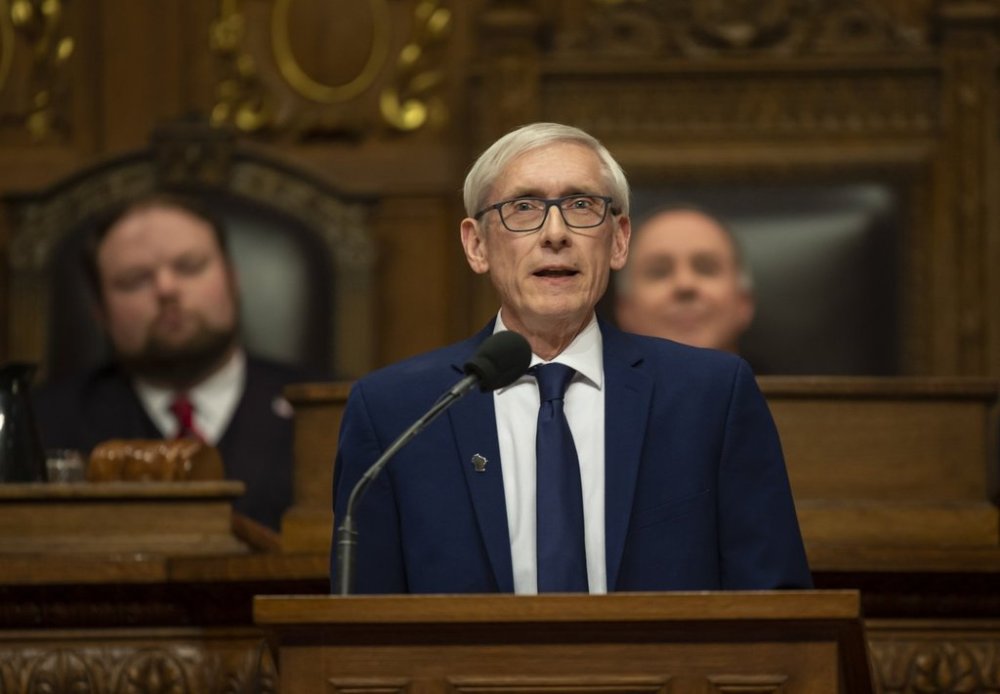
Republican state lawmakers on Monday took the latest swing at reducing the veto powers, proposing a constitutional amendment that would eliminate a governor’s powers to delete words and rework sentences in bills that spend taxpayer money.
Under the proposal, the governor could only veto entire sections from spending bills instead of individual words.
The partial veto as used by governors currently has turned them into a “super lawmaker,” according to Republican Sens. Julian Bradley and Cory Tomcyzk and Republican state Rep. Scott Allen. They circulated the proposal for cosponsors Monday.
The idea would have to pass two consecutive legislative sessions and be approved by voters before taking effect. The soonest that could happen is 2027. The Legislature is controlled by Republicans this session, but the 2026 election will determine who will have power starting in 2027.
The governor could not veto the proposal.
Democratic Gov. Tony Evers’ spokesperson Britt Cudaback said lawmakers instead should get behind the governor’s proposal to give voters the power to put issues on the ballot themselves through circulating referendums. Republicans oppose that idea.
“Republicans’ message to the people of Wisconsin is clear: power for me but not for thee,” Cudaback said.
The move comes as Republicans have increasingly gotten around Evers by proposing constitutional amendments, which the governor can’t stop. Five amendments were put on the ballot last year and a sixth which would add the state’s voter ID law to the constitution is up for voter approval on April 1.
Wisconsin’s partial veto power was created by a 1930 constitutional amendment, but it’s been weakened. Voters adopted constitutional amendments in 1990 and 2008 that removed the ability to strike individual letters to make new words — the “Vanna White” veto — and the power to eliminate words and numbers in two or more sentences to create a new sentence — the “Frankenstein” veto.
There is a pending case before the Wisconsin Supreme Court challenging a partial veto Evers made in 2023 that attempts to lock in a school funding increase for 400 years. Evers struck digits to create a new ending year for the increases, 2425.
The Supreme Court is weighing whether to declare that the state constitution forbids the governor from striking digits to create a new year or to remove language to create a longer duration than the one approved by the Legislature.