

Pakistani journalists protest after Senate passes bill allowing control over social media content
Advertisement
Read this article for free:
or
Already have an account? Log in here »
To continue reading, please subscribe:

Digital Subscription
One year of digital access for only $205*
- Enjoy unlimited reading on winnipegfreepress.com
- Read the E-Edition, our digital replica newspaper
- Access News Break, our award-winning app
- Play interactive puzzles
*First annual payment billed as $205.00 + GST for one year. This annual subscription will automatically renew at $233.00 + GST every 52 weeks (10% off the regular annual price of $259.35). Offer available to new and qualified returning subscribers only. Cancel any time.
To continue reading, please subscribe:
Add Free Press access to your Brandon Sun subscription for only an additional
$1 for the first 4 weeks*
- Enjoy unlimited reading on winnipegfreepress.com
- Read the E-Edition, our digital replica newspaper
- Access News Break, our award-winning app
- Play interactive puzzles
*Your next Brandon Sun subscription payment will increase by $1.00 and you will be charged $17.95 plus GST for four weeks. After four weeks, your payment will increase to $24.95 plus GST every four weeks.
Read unlimited articles for free today:
or
Already have an account? Log in here »
Hey there, time traveller!
This article was published 28/01/2025 (602 days ago), so information in it may no longer be current.
ISLAMABAD (AP) — Pakistan’s upper house of parliament on Tuesday passed a controversial bill that critics argue is designed to suppress freedom of speech.
The bill, which was passed by the lower house of parliament last Thursday, grants the government extensive powers to impose heavy fines and incarcerate social media users for spreading disinformation.
Journalists rallied on Tuesday in the country’s major cities, including Islamabad, Karachi, Faisalabad and Lahore, vowing to resist government efforts aimed at suppressing freedom of speech.
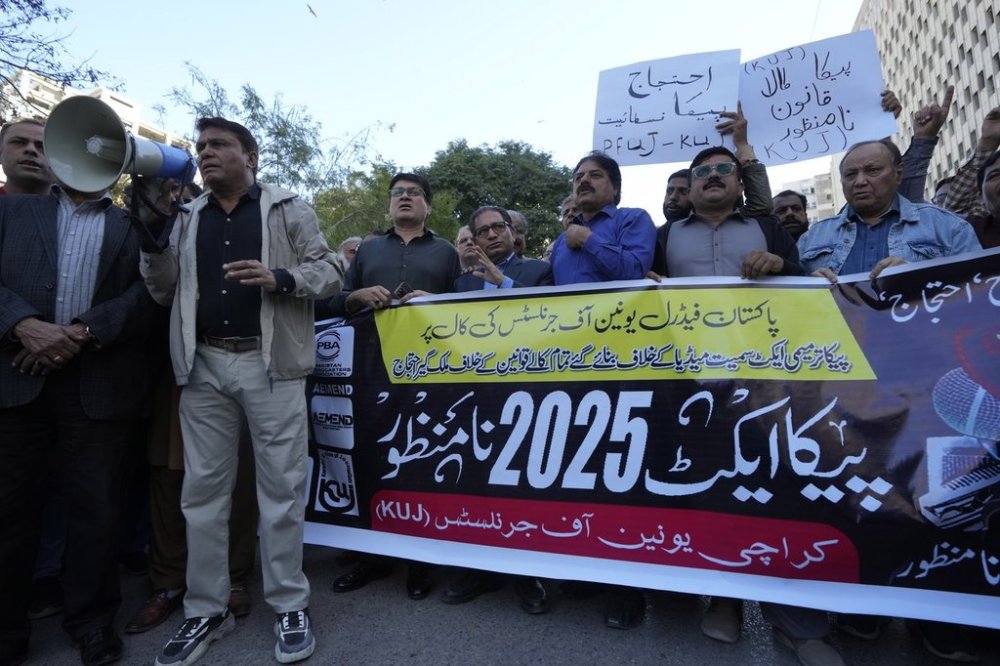
The approval on Tuesday by the Senate removes the last obstacle in the bill’s path. It will now be sent to the President Asif Ali Zardari, who is likely to sign it quickly.
Under the Prevention of Electronic Crimes Act, authorities would create an agency with the power to order the immediate blocking of content deemed “unlawful and offensive” from social media, such as content critical of judges, the armed forces, parliament or provincial assemblies.
Those failing to comply could face temporary or permanent bans. The law also makes spreading disinformation a criminal offense, punishable by three years in prison and a fine of 2 million rupees ($7,150).
The latest development comes days after National Assembly passed it despite protests by the opposition. On Tuesday, Shibli Faraz, an opposition leader in the Senate, opposed the bill, saying it was being passed in a haste and without consulting all the stake-holders.
Zulfiqar Bukhari, a spokesman for former Prime Minister Imran Khan, said their Pakistan Tehreek-e-Insaf party, or PTI, would challenge the legislation in the court. “The bill has been passed from the both houses of the parliament to silence the freedom of expression on the pretext of combating fake news, and no democracy-lover can support it,” he said in a statement.
Pakistan’s media has faced growing censorship in recent years, but the government of Prime Minister Shehbaz Sharif says the law is necessary to limit the spread of disinformation.