

Tunisia jails opposition politicians and journalist as crackdown on political dissent resumes
Advertisement
Read this article for free:
or
Already have an account? Log in here »
To continue reading, please subscribe:
Monthly Digital Subscription
$1 per week for 24 weeks*
- Enjoy unlimited reading on winnipegfreepress.com
- Read the E-Edition, our digital replica newspaper
- Access News Break, our award-winning app
- Play interactive puzzles
*Billed as $4.00 plus GST every four weeks. After 24 weeks, price increases to the regular rate of $19.95 plus GST every four weeks. Offer available to new and qualified returning subscribers only. Cancel any time.
Monthly Digital Subscription
$4.99/week*
- Enjoy unlimited reading on winnipegfreepress.com
- Read the E-Edition, our digital replica newspaper
- Access News Break, our award-winning app
- Play interactive puzzles
*Billed as $19.95 plus GST every four weeks. Cancel any time.
To continue reading, please subscribe:
Add Free Press access to your Brandon Sun subscription for only an additional
$1 for the first 4 weeks*
*Your next subscription payment will increase by $1.00 and you will be charged $16.99 plus GST for four weeks. After four weeks, your payment will increase to $23.99 plus GST every four weeks.
Read unlimited articles for free today:
or
Already have an account? Log in here »
Hey there, time traveller!
This article was published 06/02/2025 (413 days ago), so information in it may no longer be current.
A judge in Tunisia handed down lengthy sentences to prominent politicians and at least one leading journalist in a move criticized by a media union and leading opposition parties as the latest move targeting critics of President Kais Saied.
Among those sentenced Wednesday include 83-year-old Rached Ghannouchi, the country’s most prominent opposition leader, who has been behind bars for nearly two years.
Ghannouchi, the co-founder of the Islamist movement Ennahda and Tunisia’s former Assembly Speaker, was sentenced to an additional 22 years in prison for undermining state security. He boycotted the proceedings against him.
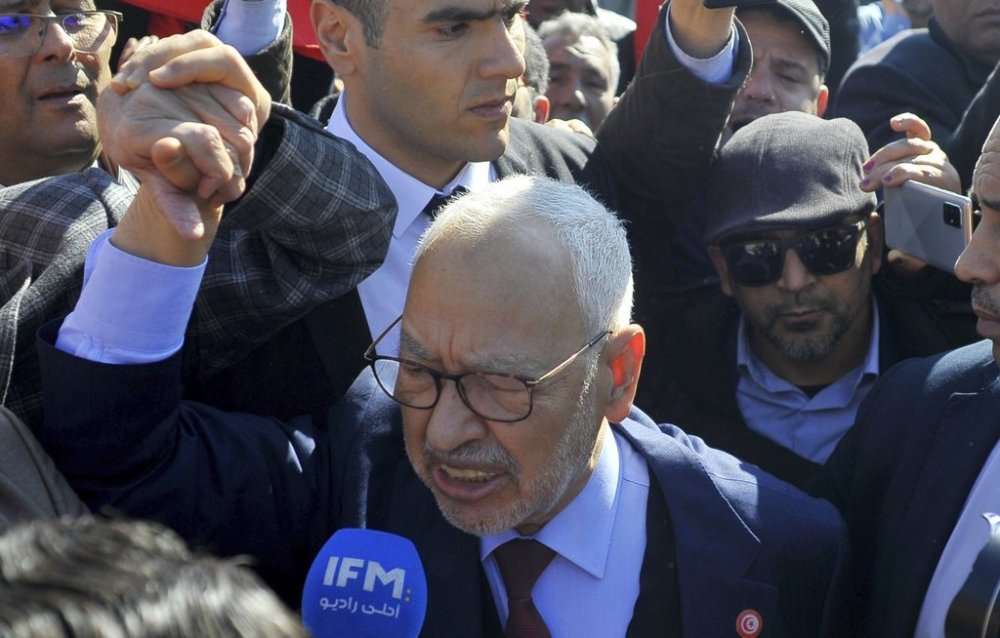
Ennahda condemned the trial as politically motivated and said the prosecutions were “aimed at revenge, violating basic human rights and freedoms, undermining the rule of law and blatantly politicizing the judiciary.”
The National Salvation Front, a coalition of opposition parties that includes Ennahda, said in a statement that the sentences issued against bloggers, politicians and former government officials totaled more than 760 years and marked “one of the darkest periods” for the country’s judicial branch, which has seen judges dismissed and power wrested from it by Saied’s executive branch.
“This particular chamber is becoming a specialized tool for issuing harsh sentences against politicians,” said one of its leaders, Ahmed Nejib Chebbi.
The charges stem from a 2019 case against a media company that provided services for Ennahda during that year’s presidential elections.
The charges stem from a 2019 case against a media company that prosecutors say provided services for various candidates during that year’s presidential elections. Those involved are accused of defamation, spreading falsehoods, money laundering, undermining state security and illegally accepting funds from abroad.
Ennahda has denied working with the company yet was targeted by the court as part of the investigation.
Human rights groups have criticized such cases as a way to target Saied’s opponents. Saied won a second term last October in a landslide election while his leading opponents, including Ghannouchi, languished in prison.
“These rulings bring Tunisia back to a period the people sought to leave behind through their revolution,” an Ennahda statement on Thursday said, referring to the 2011 ouster of Zine El Abidine Ben Ali, the first Arab dictator toppled as part of the Arab Spring uprising that swept the region that year.
In the years that followed, the North African nation was seen as a success story for its transition to democracy, rewriting its constitution and winning a Nobel Peace Prize for political compromise. But signs of authoritarianism have re-emerged since Saied took power in 2019.
Throughout his tenure, Saied has suspended parliament, rewritten the constitution to consolidate his power and arrested politicians, activists and journalists who criticized him.
The court on Wednesday also sentenced in absentia a group of Ennahda politicians who’ve fled the country and now live in exile, including former Prime Minister Hichem Mechichi, who was sentenced to 35 years on state security charges similar to Ghannouchi’s.
Journalist Chadha Haj Mubarak was sentenced to five years in prison as part of the same case, the National Syndicate of Tunisian Journalists said. The union called for her immediate release and in a statement denounced the court’s lack of respect for press freedoms. In a statement Mubarak’s attorney, Souhail Medimegh, said his client was being charged purely for her journalism.
__
Metz reported from Rabat, Morocco.
__
A previous version of this story erroneously stated that Ennahda hired the media company that was later investigated for the content it published. The political party maintained throughout court proceedings that it never contracted them for any services.