

At least 200,000 protesters rally in Munich against far-right AfD ahead of German election
Advertisement
Read this article for free:
or
Already have an account? Log in here »
To continue reading, please subscribe:

Digital Subscription
One year of digital access for only $205*
- Enjoy unlimited reading on winnipegfreepress.com
- Read the E-Edition, our digital replica newspaper
- Access News Break, our award-winning app
- Play interactive puzzles
*First annual payment billed as $205.00 + GST for one year. This annual subscription will automatically renew at $233.00 + GST every 52 weeks (10% off the regular annual price of $259.35). Offer available to new and qualified returning subscribers only. Cancel any time.
To continue reading, please subscribe:
Add Free Press access to your Brandon Sun subscription for only an additional
$1 for the first 4 weeks*
- Enjoy unlimited reading on winnipegfreepress.com
- Read the E-Edition, our digital replica newspaper
- Access News Break, our award-winning app
- Play interactive puzzles
*Your next Brandon Sun subscription payment will increase by $1.00 and you will be charged $17.95 plus GST for four weeks. After four weeks, your payment will increase to $24.95 plus GST every four weeks.
Read unlimited articles for free today:
or
Already have an account? Log in here »
Hey there, time traveller!
This article was published 08/02/2025 (600 days ago), so information in it may no longer be current.
MUNICH, Germany (AP) — More than 200,000 protesters rallied in Munich, Germany, on Saturday against far-right extremism ahead of the country’s general election.
The far-right, anti-immigrant Alternative for Germany, or AfD, is in second place in recent polls and has prompted widespread protests across the country before voters cast their ballots on Feb. 23.
The protest at Munich’s Theresienwiese — where Oktoberfest takes place each year — brought a significantly larger crowd than expected, according to the German dpa news agency. The event’s organizer estimated the crowd could be up to 320,000 people, many of whom carried signs against the AfD with slogans like, “Racism and hatred is not an alternative.”
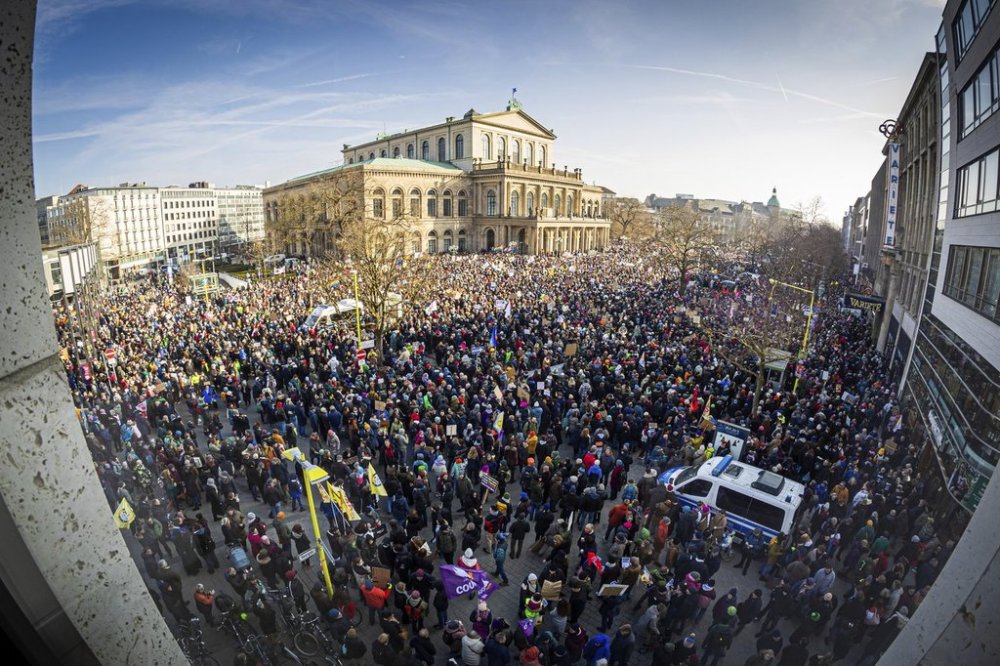
The protest was supported by activist groups as well as the Munich Film Festival, churches and Munich soccer clubs FC Bayern and TSV 1860, among others. Police told dpa that the demonstration was peaceful.
Similar protests attracted large crowds on Saturday in Hanover, Rostock, and elsewhere in Germany, mirroring other demonstrations that have occurred across the country in recent weeks.
Last month, at Berlin’s Brandenburg Gate, a huge crowd blew whistles, sang anti-fascist songs and carried banners denouncing AfD. Activists said they hoped the rally also would draw attention to other far-right parties in Europe and the new administration of U.S. President Donald Trump.
Demonstrators have recently also opposed Friedrich Merz, the center-right leader and front-runner in the upcoming election, and his Christian Democrats for last month sending to parliament proposals for tough new migration rules that received AfD’s backing.
The protesters say Merz and his party broke Germany’s unwritten post-Nazi promise by all democratic parties to never pass any rule or resolution in parliament with the support of far-right, nationalist parties like the AfD. Merz insists his position is unchanged and that he didn’t and won’t work with the party.
The 12-year-old AfD entered the national parliament in 2017, benefiting from then-Chancellor Angela Merkel ’s decision two years earlier to allow large numbers of migrants into the country.