

Australia holds its nose for its 3rd rancid bloom of a rare corpse plant in 3 months
Advertisement
Read this article for free:
or
Already have an account? Log in here »
To continue reading, please subscribe:
Monthly Digital Subscription
$1 per week for 24 weeks*
- Enjoy unlimited reading on winnipegfreepress.com
- Read the E-Edition, our digital replica newspaper
- Access News Break, our award-winning app
- Play interactive puzzles
*Billed as $4.00 plus GST every four weeks. After 24 weeks, price increases to the regular rate of $19.95 plus GST every four weeks. Offer available to new and qualified returning subscribers only. Cancel any time.
Monthly Digital Subscription
$4.99/week*
- Enjoy unlimited reading on winnipegfreepress.com
- Read the E-Edition, our digital replica newspaper
- Access News Break, our award-winning app
- Play interactive puzzles
*Billed as $19.95 plus GST every four weeks. Cancel any time.
To continue reading, please subscribe:
Add Free Press access to your Brandon Sun subscription for only an additional
$1 for the first 4 weeks*
*Your next subscription payment will increase by $1.00 and you will be charged $16.99 plus GST for four weeks. After four weeks, your payment will increase to $23.99 plus GST every four weeks.
Read unlimited articles for free today:
or
Already have an account? Log in here »
Hey there, time traveller!
This article was published 09/02/2025 (413 days ago), so information in it may no longer be current.
MELBOURNE, Australia (AP) — A rare bloom with a pungent odor like decaying flesh has opened in the Australian capital in the nation’s third such extraordinary flowering in as many months.
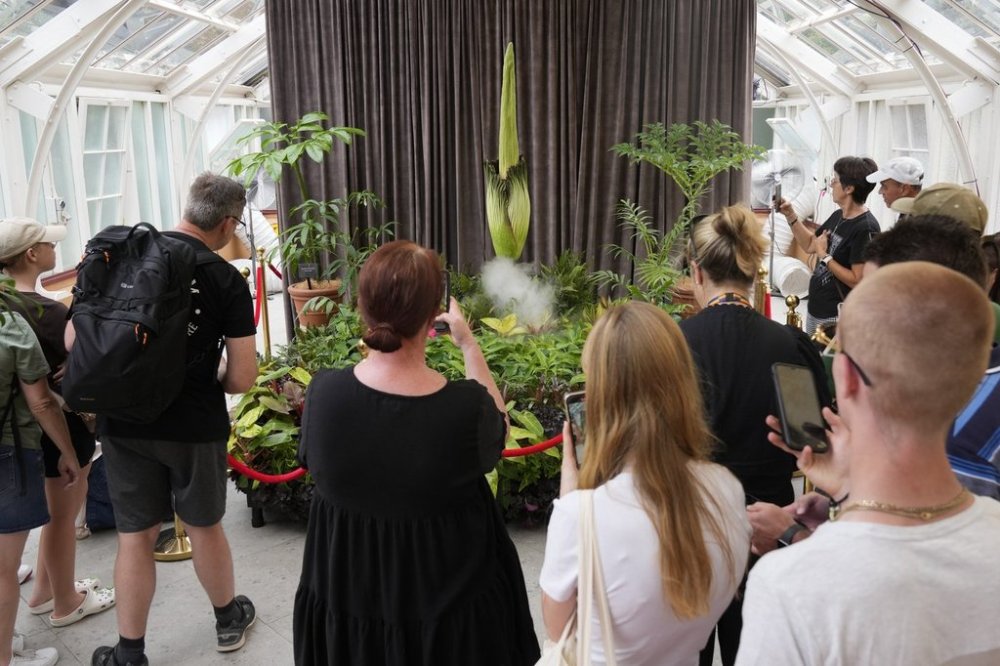
The corpse flower, also known by its scientific name amorphophallus titanium, bloomed for the first time in its 15 years at Canberra’s Australian National Botanic Gardens on Saturday and was closing on Monday, staff said.
Another flowered briefly in the Sydney Royal Botanic Gardens in late January, attracting 20,000 admirers. Similar numbers turned out to experience another rancid bloom at the Geelong Botanic Gardens southwest of Melbourne in November.
What is a corpse flower?
The corpse flower or corpse plant, known as bunga bangkai in its native Indonesia, is endemic to the rainforests of western Sumatra.
It only blooms for a few days every 7 to 10 years in its natural habitat. Its rancid scent attracts pollinators such as flies.
There are thought to be only 300 of the plants in the wild and fewer than 1,000 including those in cultivation.
Why have three bloomed in Australia in as many months?
Canberra’s acting nursery manager Carol Dale said there was no clear explanation for Australia’s spate of putrid blooms.
A flower is produced when the plant has stored enough energy in its underground tuber known as a corm.
“One of the theories is that a lot of these plants are of a similar age, so they have just stored up enough carbohydrates in the corm to finally produce a flower,” Dale said.
“All of the plants around Australia are held in different conditions, so it’s unusual that they’re all flowering at the same time.” she added.
She said Canberra, Sydney and Geelong had different climates. Gardeners used different fertilizing regimes on each plant and different management plans.
Was the Canberra bloom expected?
Dale said that after 15 years without a bloom, she had decided that Canberra, which occasionally receives snowfall, was not the place for a corpse plant to thrive.
“It’s been in our collection for slightly longer than these plants would normally take to flower for the first time, so we just didn’t think we had the right conditions here in Canberra,” Dale said.
“So yes, it did catch us by surprise; a very pleasant one,” she added.
The flower began opening around lunchtime on Saturday and its rancid odor quickly deteriorated.
“By Saturday evening, it was incredibly pungent. We could smell it from across the road. It was definitely gag worthy,” Dale said.
The crowds attracted to the 135-centimeter (53-inch) tall flower were limited to the hundreds by a ticketing system due to space constraints within the greenhouse.
Admirers likened the stench to a range of dead animals, rotten eggs, sweaty socks, sewage and garbage.
Dale said the worst had passed by Monday.
“We collected pollen about an hour ago and when you’re right up close to the plant, it’s still got that rotting flesh smell,” she said.