

What is the ‘firewall’ against the far-right Alternative for Germany party?
Advertisement
Read this article for free:
or
Already have an account? Log in here »
To continue reading, please subscribe:
Monthly Digital Subscription
$1 per week for 24 weeks*
- Enjoy unlimited reading on winnipegfreepress.com
- Read the E-Edition, our digital replica newspaper
- Access News Break, our award-winning app
- Play interactive puzzles
*Billed as $4.00 plus GST every four weeks. After 24 weeks, price increases to the regular rate of $19.95 plus GST every four weeks. Offer available to new and qualified returning subscribers only. Cancel any time.
Monthly Digital Subscription
$4.99/week*
- Enjoy unlimited reading on winnipegfreepress.com
- Read the E-Edition, our digital replica newspaper
- Access News Break, our award-winning app
- Play interactive puzzles
*Billed as $19.95 plus GST every four weeks. Cancel any time.
To continue reading, please subscribe:
Add Free Press access to your Brandon Sun subscription for only an additional
$1 for the first 4 weeks*
*Your next subscription payment will increase by $1.00 and you will be charged $16.99 plus GST for four weeks. After four weeks, your payment will increase to $23.99 plus GST every four weeks.
Read unlimited articles for free today:
or
Already have an account? Log in here »
Hey there, time traveller!
This article was published 12/02/2025 (407 days ago), so information in it may no longer be current.
BERLIN (AP) — Alternative for Germany, or AfD, has established itself as a significant political force in the 12 years since it was founded, but it hasn’t yet been part of any state or national government. That’s a result of what is often called a “firewall” against the anti-immigrant, far-right party.
Other parties say they won’t work with Alternative for Germany, which is under observation by the domestic intelligence agency for suspected right-wing extremism, something that AfD objects to strongly. Its branches in three eastern states are designated “proven right-wing extremist” groups. That’s particularly sensitive in view of Germany’s Nazi past.
That has sometimes forced other parties into unusual alliances to keep AfD out of power — for instance, a three-party coalition straddling ideological divisions that governs the eastern state of Thuringia after AfD emerged as the strongest party for the first time in a regional election there in September.
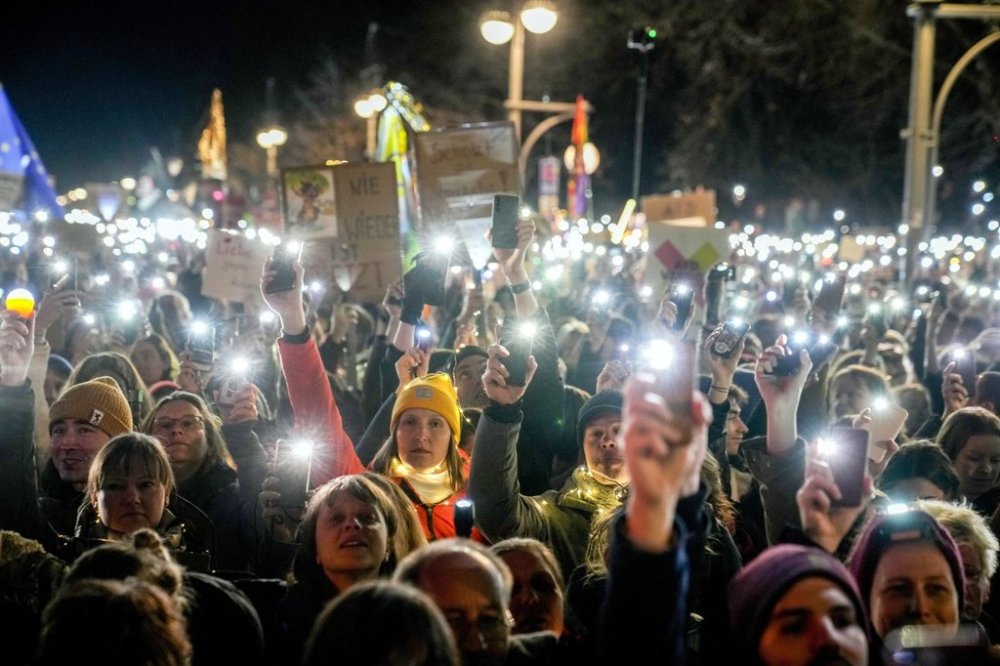
Did Merz breach the firewall? Opinions are divided
Germany’s conservative opposition leader, Friedrich Merz, drew accusations of breaking a taboo and damaging the firewall after he brought a nonbinding motion calling for many more migrants to be turned back at the country’s borders to parliament last month. It was narrowly approved thanks to votes from the far-right party. That was a first for post-World War II Germany.
Two days later, lawmakers narrowly rejected an opposition-sponsored bill calling for tougher rules on migration that risked becoming the first draft legislation to pass thanks to AfD. The events in parliament prompted sizeable protests.
Merz insisted that his position was unchanged. He said that he didn’t and won’t work with AfD, won’t go into government with it or form a minority government that needs its support, and didn’t and won’t negotiate with it on motions or legislation.