

Bakery owner in New England says he was offended over town’s decision against pastry painting
Advertisement
Read this article for free:
or
Already have an account? Log in here »
To continue reading, please subscribe:
Monthly Digital Subscription
$1 per week for 24 weeks*
- Enjoy unlimited reading on winnipegfreepress.com
- Read the E-Edition, our digital replica newspaper
- Access News Break, our award-winning app
- Play interactive puzzles
*Billed as $4.00 plus GST every four weeks. After 24 weeks, price increases to the regular rate of $19.95 plus GST every four weeks. Offer available to new and qualified returning subscribers only. Cancel any time.
Monthly Digital Subscription
$4.99/week*
- Enjoy unlimited reading on winnipegfreepress.com
- Read the E-Edition, our digital replica newspaper
- Access News Break, our award-winning app
- Play interactive puzzles
*Billed as $19.95 plus GST every four weeks. Cancel any time.
To continue reading, please subscribe:
Add Free Press access to your Brandon Sun subscription for only an additional
$1 for the first 4 weeks*
*Your next subscription payment will increase by $1.00 and you will be charged $16.99 plus GST for four weeks. After four weeks, your payment will increase to $23.99 plus GST every four weeks.
Read unlimited articles for free today:
or
Already have an account? Log in here »
Hey there, time traveller!
This article was published 14/02/2025 (408 days ago), so information in it may no longer be current.
CONCORD, N.H. (AP) — A bakery owner in New Hampshire testified Friday that his excitement about displaying a painting by high school students of giant pastries quickly turned to annoyance after a zoning code officer told him it was a sign and had to be changed or removed.
Sean Young said the the work atop his bakery is art, and was never intended to be a sign.
“I was artistically offended for the students,” said Young, who’s suing the town of Conway because he says it violated the First Amendment’s guarantee of free speech.
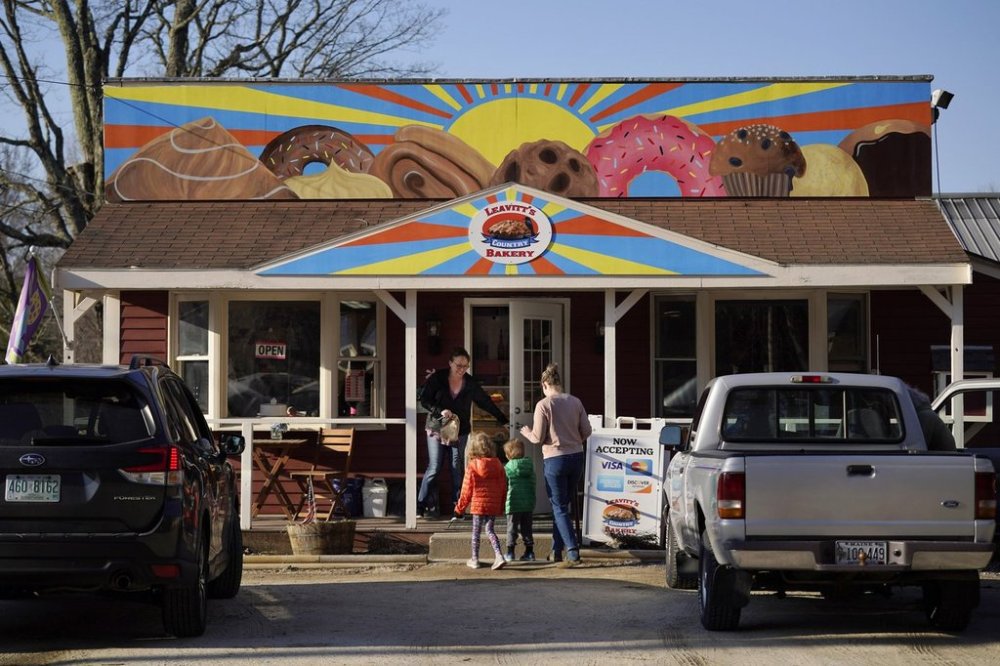
“It’s offensive to move it,” he said in court Friday. “I just didn’t want to do it.”
The bright painting atop Leavitt’s Country Bakery shows sunbeams shining down on a mountain range made of sprinkle-covered chocolate and strawberry doughnuts, a blueberry muffin, a cinnamon roll and other pastries.
A federal judge is considering whether the town is infringing on Young’s rights. U.S. District Judge Joseph Laplante did not reach a verdict following the daylong trial. He’s giving lawyers time to file additional briefs.
For now, the painting has been allowed to remain since it was first displayed in June 2022.
The zoning board determined the painting is not so much art as advertising.
If it didn’t show what’s sold inside — baked goods — it wouldn’t be considered a sign and could stay, board members said. But because of its size, they say it can’t remain as-is. At about 90 square feet (8.6 square meters), it’s four times bigger than the local sign code allows.
Jeremy Gibbs, the zoning officer who issued the citation, testified that he was following the town’s definition of a sign, which some lawyers and even the judge remarked seemed to cover “everything.”
A sign in Conway is “any device, fixture, placard, structure or attachment thereto that uses color, form, graphic, illumination, symbol, or writing to advertise, announce the purpose of, or identify the purpose of any person or entity, or to communicate information of any kind to the public, whether commercial or noncommercial,” according to the sign code.
Gibbs testified that if there were no regulation, then signs could be placed anywhere and there could be safety concerns about lighting or distracted drivers. He also noted that Conway, near the White Mountains, draws tourists to its natural resources.
If signage was unregulated, he said, “we could lose a lot of that beauty.”
Laplante couldn’t resist adding a bit of levity to the proceeding.
“It’s shocking that no one brought doughnuts to this trial,” he said at one point.
During another moment, he asked Young to describe each pastry in the painting, starting with a scone on the left. He quibbled over Young’s description that a raspberry cookie was actually the top of a cupcake.