

US Vice President JD Vance meets German far-right leader as he criticizes ‘firewalls’ in Europe
Advertisement
Read this article for free:
or
Already have an account? Log in here »
To continue reading, please subscribe:

Digital Subscription
One year of digital access for only $205*
- Enjoy unlimited reading on winnipegfreepress.com
- Read the E-Edition, our digital replica newspaper
- Access News Break, our award-winning app
- Play interactive puzzles
*First annual payment billed as $205.00 + GST for one year. This annual subscription will automatically renew at $233.00 + GST every 52 weeks (10% off the regular annual price of $259.35). Offer available to new and qualified returning subscribers only. Cancel any time.
To continue reading, please subscribe:
Add Free Press access to your Brandon Sun subscription for only an additional
$1 for the first 4 weeks*
- Enjoy unlimited reading on winnipegfreepress.com
- Read the E-Edition, our digital replica newspaper
- Access News Break, our award-winning app
- Play interactive puzzles
*Your next Brandon Sun subscription payment will increase by $1.00 and you will be charged $17.95 plus GST for four weeks. After four weeks, your payment will increase to $24.95 plus GST every four weeks.
Read unlimited articles for free today:
or
Already have an account? Log in here »
Hey there, time traveller!
This article was published 14/02/2025 (593 days ago), so information in it may no longer be current.
MUNICH (AP) — U.S. Vice President JD Vance met the leader of a German far-right party during a visit to Munich on Friday, nine days before a German election and after lecturing European leaders about the state of democracy. He said there is no place for “firewalls.”
Vance met with Alice Weidel, the co-leader and candidate for chancellor of the far-right and anti-immigrant Alternative for Germany party, his office said.
Mainstream German parties say they won’t work with the party, a stance often referred to as a “firewall.” Polls put Alternative for Germany, or AfD, in second place going into the Feb. 23 election with about 20% support.
News of the meeting came after top German officials pushed back hard against Vance’s complaints about the state of democracy in Europe, with the defense minister calling it “unacceptable” to draw a parallel with authoritarian governments. He and Chancellor Olaf Scholz defended German mainstream parties’ firewall.
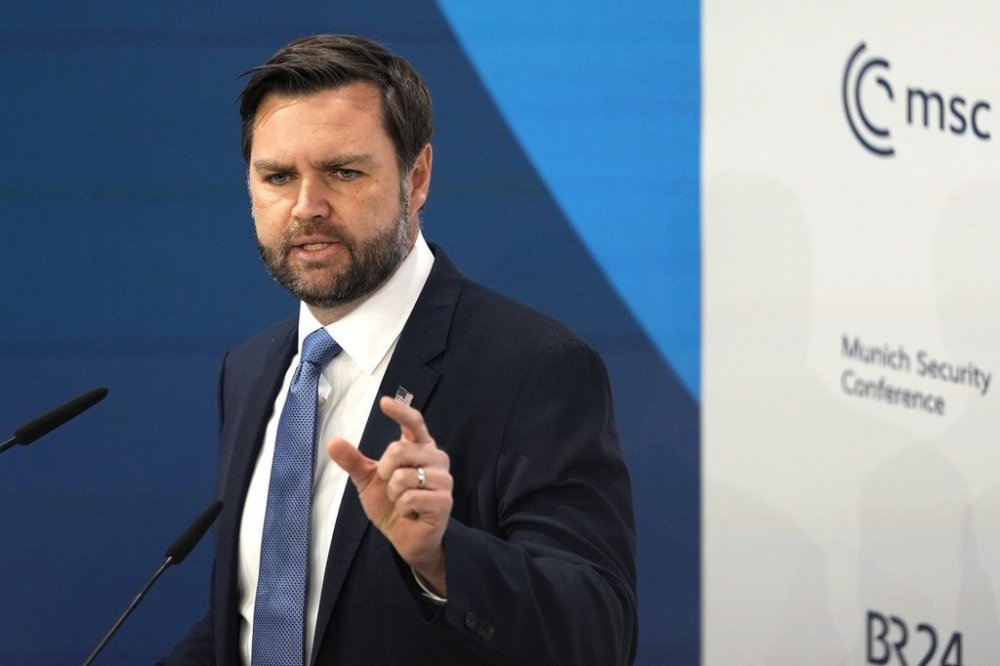
Vance said Friday at the Munich Security Conference that he fears free speech is “in retreat” across the continent.
“To many of us on the other side of the Atlantic, it looks more and more like old entrenched interests hiding behind ugly Soviet-era words like misinformation and disinformation, who simply don’t like the idea that somebody with an alternative viewpoint might express a different opinion or, God forbid, vote a different way, or even worse, win an election,” Vance said.
German Defense Minister Boris Pistorius, speaking a couple of hours later, said he couldn’t let the speech go without comment.
“If I understood him correctly, he is comparing conditions in parts of Europe with those in authoritarian regimes,” Pistorius said. “That is unacceptable, and it is not the Europe and not the democracy in which I live and am currently campaigning.”
Vance also told European leaders that “if you’re running in fear of your own voters, there is nothing America can do for you.” He said no democracy could survive telling millions of voters that their concerns “are invalid or unworthy of even being considered.”
“Democracy rests on the sacred principle that the voice of the people matters,” he said. “There’s no room for firewalls.”
Pistorius countered that “every opinion has a voice in this democracy. It makes it possible for partly extremist parties like AfD to campaign completely normally, just like every other party.”
He noted that Weidel was on prime-time German television on Thursday night along with the other contenders.
But he added that “democracy doesn’t mean that the loud minority is automatically right,” and that “democracy must be able to defend itself against the extremists who want to destroy it.”
Scholz posted on social network X to “emphatically reject” Vance’s comments.
“Out of the experiences of Nazism, the democratic parties in Germany have a joint consensus — that is the firewall against extreme right-wing parties,” he wrote.
Bavarian governor Markus Söder — a prominent figure in Germany’s center-right opposition bloc, which leads pre-election polls — told reporters that “we take every opinion seriously, but we decide ourselves with whom we form a coalition,” German news agency dpa reported.
In a post on X earlier Friday, Weidel wrote “Excellent speech! ‘There’s no room for firewalls!’”
Vance’s meeting with Weidel came after she was received on Wednesday by Hungary’s right-wing nationalist Prime Minister Viktor Orbán. The vice president’s office said Vance also met Friday with German President Frank-Walter Steinmeier and opposition leader Friedrich Merz, while he met Scholz earlier this week when both were in Paris for a summit on artificial intelligence
Norwegian Prime Minister Jonas Gahr Støre took issue with how Vance urged European officials to stem irregular migration in Friday’s speech. Vance said the European electorate didn’t vote to open “floodgates to millions of unvetted immigrants.”
“He speaks as though we are not focused on immigration in Europe,” Gahr Støre said. “I mean, this is the big theme in every country, that we want to have control of our borders.”
He argued that Ukrainian refugees accounted for a significant increase in unvetted immigrants in recent years — and they were accepted “because there is a bloody war going on, which he did not mention, which I think is not really addressing reality.”
“I don’t agree with him that what’s happening in Ukraine, what’s happening in Russia, what’s happening in China is less important than the presumed loss of freedom of speech in Europe,” Gahr Støre said.
___
Moulson reported from Berlin.