

Turkish opposition party delegation meets with Kurdish leader in Iraq as part of PKK peace efforts
Advertisement
Read this article for free:
or
Already have an account? Log in here »
To continue reading, please subscribe:
Monthly Digital Subscription
$1 per week for 24 weeks*
- Enjoy unlimited reading on winnipegfreepress.com
- Read the E-Edition, our digital replica newspaper
- Access News Break, our award-winning app
- Play interactive puzzles
*Billed as $4.00 plus GST every four weeks. After 24 weeks, price increases to the regular rate of $19.95 plus GST every four weeks. Offer available to new and qualified returning subscribers only. Cancel any time.
Monthly Digital Subscription
$4.99/week*
- Enjoy unlimited reading on winnipegfreepress.com
- Read the E-Edition, our digital replica newspaper
- Access News Break, our award-winning app
- Play interactive puzzles
*Billed as $19.95 plus GST every four weeks. Cancel any time.
To continue reading, please subscribe:
Add Free Press access to your Brandon Sun subscription for only an additional
$1 for the first 4 weeks*
*Your next subscription payment will increase by $1.00 and you will be charged $16.99 plus GST for four weeks. After four weeks, your payment will increase to $23.99 plus GST every four weeks.
Read unlimited articles for free today:
or
Already have an account? Log in here »
Hey there, time traveller!
This article was published 16/02/2025 (405 days ago), so information in it may no longer be current.
BAGHDAD (AP) — A Turkish opposition party delegation arrived in Iraq’s semiautonomous Kurdish region Sunday against the backdrop of peace efforts between Ankara and a banned Kurdish separatist movement in Turkey.
The delegation led by Sirri Sureyya Onder and Pervin Buldan, two senior officials with the pro-Kurdish People’s Equality and Democracy Party, or DEM, in Turkey, met with Masoud Barzani, the head of the Kurdistan Democratic Party — the dominant Kurdish party in Iraq — in Irbil Sunday.
Barzani’s office said in a statement that they discussed “the peace process in Turkey” and that the Turkish delegation conveyed a message from Abdullah Ocalan, the imprisoned leader of Turkey’s banned Kurdistan Workers’ Party, or PKK.
Barzani “stressed the need for all parties to intensify their efforts and endeavors to enable the peace process to achieve the desired results” and reiterated “his full readiness to provide assistance and support to the peace process in Turkey and make it a success,” the statement said.
The DEM party has long pressed for greater democracy in Turkey and rights for the country’s Kurdish population, and also to improve conditions for the imprisoned Ocalan.
Ocalan, 75, founded the PKK, in 1978, which began an armed insurrection for an autonomous Kurdish state in Turkey’s southeast in 1984, costing tens of thousands of lives. The group is considered a terrorist organization by Turkey and its Western allies. The central Iraqi government in Baghdad announced a ban on the group, which maintains bases in northern Iraq, last year.
Captured in 1999 and convicted of treason, Ocalan has been serving a life sentence on Imrali island in the Marmara Sea.
The government of Turkish President Recep Tayyip Erdogan has traditionally had an antagonistic relationship with the left-wing DEM party, frequently ousting its elected officials on charges of ties to the PKK and replacing them with state appointed officials.
However, this icy relationship began thawing last October, when Erdogan’s coalition partner, far-right nationalist politician Devlet Bahceli suggested that Ocalan could be granted parole, if his group renounces violence and disbands.
The peace effort comes at a time when Erdogan may need support from the DEM party in parliament to enact a new constitution that could allow him to stay in power for unlimited terms.
The Turkish Constitution doesn’t allow Erdogan, who has been in power since 2003 as prime minister and later as president, to run for office again unless an early election is called — something that would also require the support of the pro-Kurdish party.
Even as the latest peace efforts are underway, Erdogan’s government has widened a crackdown on the opposition, arresting journalists and politicians. Several elected Kurdish mayors have been ousted from office and replaced with state appointed officials, the latest this Saturday, when the mayor of Van municipality in eastern Turkey was removed from his post and replaced with the state-appointed governor.
Meanwhile, conflict is ongoing between Turkish-backed armed groups and Kurdish forces in northeastern Syria.
Turkey views the Syrian Democratic Forces, a U.S.-backed military Kurdish alliance in Syria, as an extension of the PKK. The SDF is in negotiations with the new government in Damascus following the ouster of then Syrian President Bashar Assad in a rebel offensive.
While most former insurgent groups have agreed to dissolve and integrate into the new Syrian army, the SDF has refused so far.
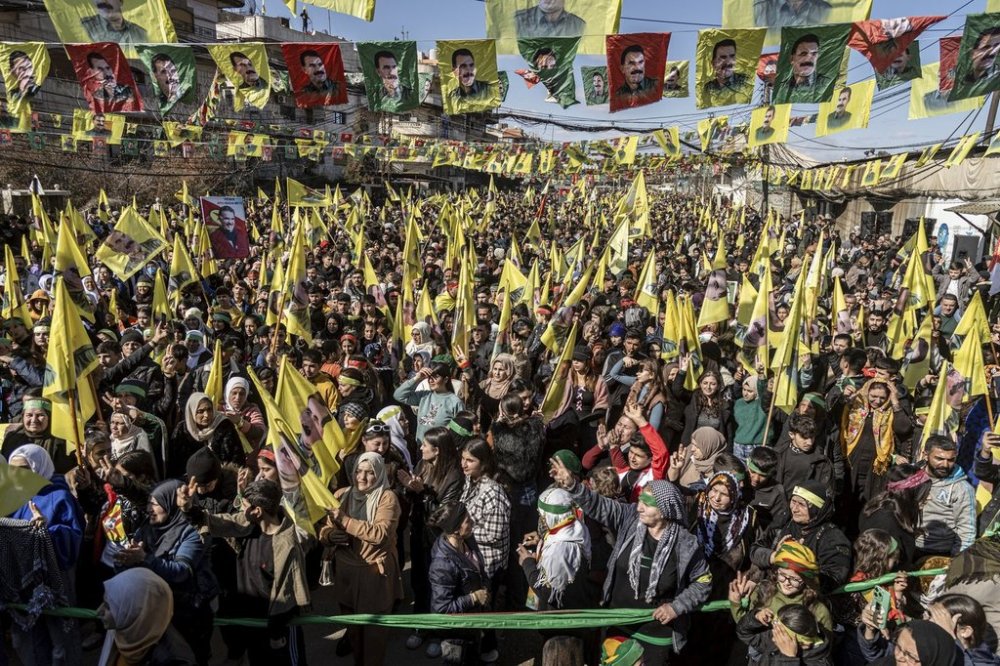
Turkish Foreign Minister Hakan Fidan said Saturday that the government would reconsider its military presence in northeastern Syria if that country’s new leaders eliminate the presence of the PKK in the area. Also Saturday, Kurds in northeastern Syria staged a mass protest to demand Ocalan’s release.
___
Çınar Kiper reported from Istanbul.