

Ecuador will seek foreign military aid to combat drug cartels as violence surges
Advertisement
Read this article for free:
or
Already have an account? Log in here »
To continue reading, please subscribe:
Monthly Digital Subscription
$1 per week for 24 weeks*
- Enjoy unlimited reading on winnipegfreepress.com
- Read the E-Edition, our digital replica newspaper
- Access News Break, our award-winning app
- Play interactive puzzles
*Billed as $4.00 plus GST every four weeks. After 24 weeks, price increases to the regular rate of $19.95 plus GST every four weeks. Offer available to new and qualified returning subscribers only. Cancel any time.
Monthly Digital Subscription
$4.99/week*
- Enjoy unlimited reading on winnipegfreepress.com
- Read the E-Edition, our digital replica newspaper
- Access News Break, our award-winning app
- Play interactive puzzles
*Billed as $19.95 plus GST every four weeks. Cancel any time.
To continue reading, please subscribe:
Add Free Press access to your Brandon Sun subscription for only an additional
$1 for the first 4 weeks*
*Your next subscription payment will increase by $1.00 and you will be charged $16.99 plus GST for four weeks. After four weeks, your payment will increase to $23.99 plus GST every four weeks.
Read unlimited articles for free today:
or
Already have an account? Log in here »
Hey there, time traveller!
This article was published 19/02/2025 (402 days ago), so information in it may no longer be current.
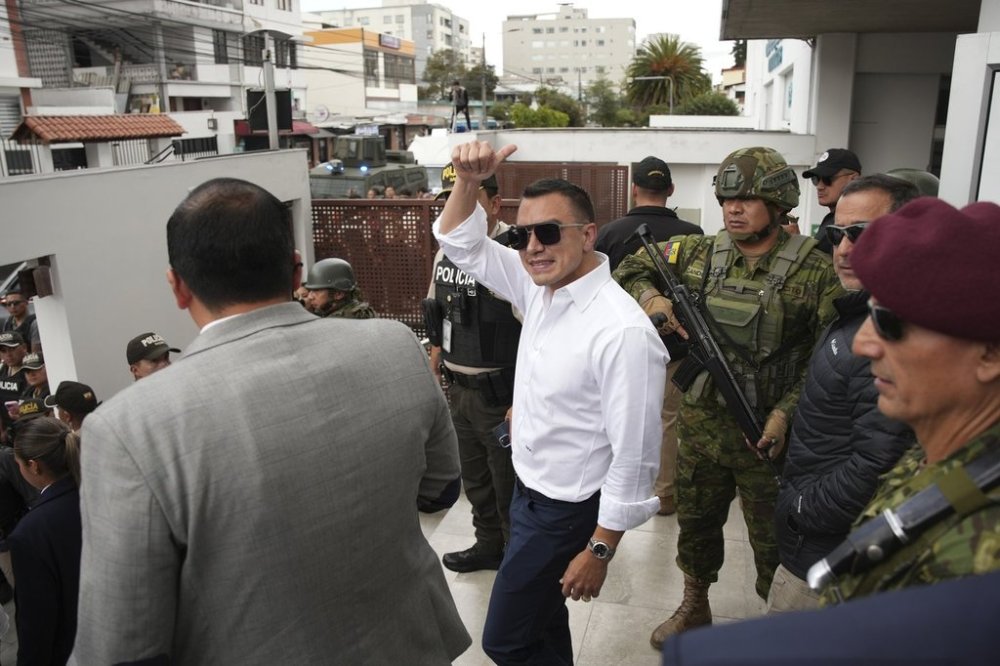
QUITO, Ecuador (AP) — Ecuadorian President Daniel Noboa on Wednesday took another step in his effort to enlist foreign military assistance to combat the drug cartels and organized crime groups that have been behind the escalation in violent crime over the past four years.
Noboa, according to a statement from the communications secretariat, ordered the foreign ministry to seek cooperation agreements with “allied nations” that would allow “the incorporation of special forces” on a temporary basis as support for the Ecuadorian police and armed forces. He also urged the opposition-controlled National Assembly to back his initiative.
The statement did not say which countries Ecuador would seek military assistance from.
The spike in violence across the South American country is tied to the trafficking of cocaine produced in neighboring Colombia and Peru. Mexican, Colombian and Balkan cartels have set down roots in Ecuador and operate with assistance from local criminal gangs.
Under Noboa’s watch, the homicide rate dropped from 46.18 per 100,000 people in 2023 to 38.76 per 100,000 people last year. But the rate remained far higher than the 6.85 per 100,000 people in 2019, and the country is already on track to exceed that number this year. January was Ecuador’s deadliest month on record, with 731 homicides.
The conservative Noboa earlier this month won one of two spots in an April runoff election.
Wednesday’s announcement comes months after he asked Ecuador’s Constitutional Court to clear a partial constitutional reform that would allow the installation of foreign military bases in the country. The court ruled in favor of his initiative, which now must be debated twice by the National Assembly and, if approved, ratified in a referendum.
The U.S. military for a decade operated a base in Ecuador that was mainly focused on anti-narcotic operations. But that stopped in 2009, when then-President Rafael Correa ended an agreement with the U.S. citing sovereignty issues.
Security expert Mario Pazmiño told The Associated Press he believes that the government’s proposal does not seek foreign troops for combat, but instead, for help with intelligence gathering and support of ports and maritime interdictions.
____
Follow AP’s coverage of Latin America and the Caribbean at https://apnews.com/hub/latin-america